


Conduit selection in Coronary Artery Bypass Grafting (CABG) remains a critical factor in determining long-term graft patency, patient survival, and the need for repeat revascularization. The choice involves balancing the superior durability of arterial grafts against technical demands and patient-specific risk factors.
Here is a clinical breakdown of the pros and cons for the primary conduits used in surgical revascularization:
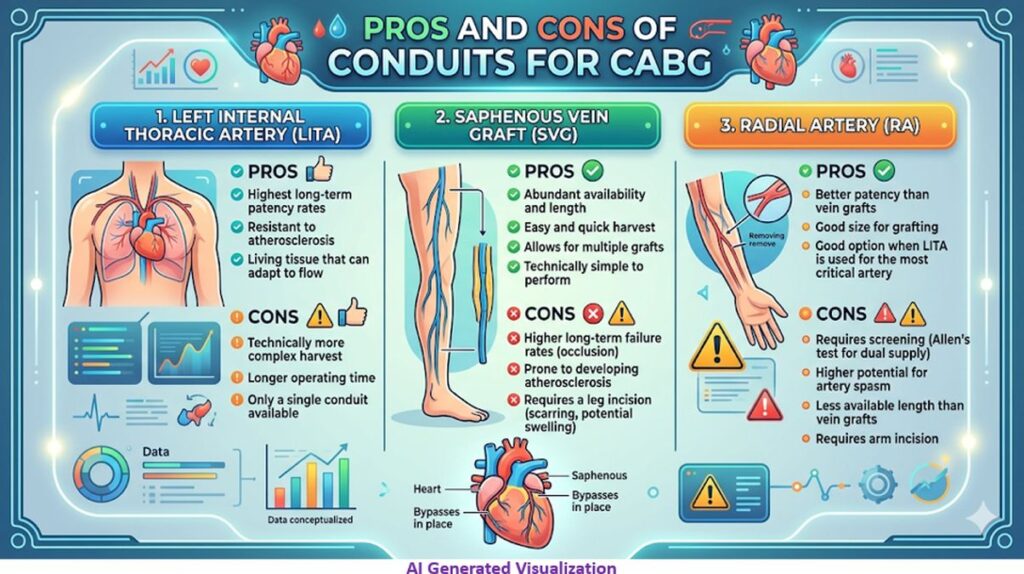
1. Left Internal Mammary Artery (LIMA)
The LIMA remains the undisputed gold standard conduit, universally recommended for bypassing the Left Anterior Descending (LAD) artery.
- Pros:
- Unmatched Patency: Long-term patency rates exceed 90-95% at 10 to 15 years.
- Endothelial Function: The LIMA endothelium secretes high levels of nitric oxide and prostacyclin, rendering it actively resistant to atherosclerosis, intimal hyperplasia, and thrombosis.
- Autoregulation: It actively adapts its luminal diameter to the myocardial demand of the target territory.
- In-Situ Graft: Retains its native proximal connection to the subclavian artery, avoiding ascending aorta manipulation (reducing stroke risk).
- Cons:
- Limited Reach: Primarily restricted to the LAD and diagonal branches; rarely reaches lateral or inferior targets unless used as a free graft (which diminishes some hemodynamic benefits).
- Flow Competition: Highly sensitive to competitive flow; if the native LAD has a non-critical stenosis (e.g., <70%), LIMA flow can be compromised, leading to the “string sign.”
2. Right Internal Mammary Artery (RIMA)
Utilized primarily to achieve Bilateral Internal Mammary Artery (BIMA) grafting, often directed to the circumflex or right coronary systems.
- Pros:
- Survival Benefit: BIMA grafting is associated with improved long-term survival and greater freedom from reintervention compared to single IMA approaches.
- Biological Equivalence: Shares the same endothelial advantages and resistance to atherosclerosis as the LIMA.
- Cons:
- Sternal Wound Complications: The most significant drawback is a markedly increased risk of Deep Sternal Wound Infection (DSWI), particularly in patients with diabetes, obesity, COPD, or advanced age. Skeletonized harvesting mitigates, but does not eliminate, this risk.
- Technical Complexity: Routing requires careful planning (e.g., retrocaval or anterior to the aorta) to avoid kinking or injury during potential future sternotomies.
3. Radial Artery (RA)
The radial artery has become the preferred second arterial conduit for many surgeons, offering a balance of handling and durability.
- Pros:
- Superior to Veins: Demonstrates significantly better long-term patency than SVGs (often >80% at 10 years).
- Versatility & Handling: Thick muscular wall makes it easy to handle and suture. Its length allows it to reach almost any target vessel.
- Simultaneous Harvest: Can be harvested concurrently with the chest opening, reducing operative time.
- Cons:
- Vasospasm: Highly muscular wall makes it prone to severe perioperative and postoperative vasospasm. Patients typically require systemic vasodilators (calcium channel blockers or long-acting nitrates) for months post-op.
- Strict Target Criteria: Extremely sensitive to competitive flow. It should strictly be grafted to vessels with high-grade stenosis (typically >70% for left-sided lesions and >90% for right-sided lesions).
- Collateral Dependency: Requires preoperative validation of adequate ulnar collateral flow via a modified Allen’s test or Doppler ultrasound to prevent hand ischemia.
4. Saphenous Vein Graft (SVG)
Despite the push for total arterial revascularization, the SVG remains the most frequently used conduit worldwide due to its ease of use.
- Pros:
- Abundant Availability: Length allows for sequential grafting and reaching any distal target.
- Flow Dynamics: Larger caliber and lack of muscular autoregulation mean it is less sensitive to competitive flow from moderately stenosed native vessels.
- Technical Ease: Harvest is straightforward (especially with endoscopic vein harvesting) and anastomoses are technically forgiving.
- Cons:
- High Failure Rates: Prone to early thrombosis and late structural failure. Up to 10-20% occlude within the first year, and 50% are occluded or severely diseased by 10 years.
- Atherosclerosis Susceptibility: Highly vulnerable to intimal hyperplasia followed by aggressive, friable atherosclerosis, which makes future PCI of failing SVGs high-risk for distal embolization.
- Aortic Manipulation: Requires a proximal anastomosis to the ascending aorta, increasing the risk of atheroembolism and perioperative stroke.
5. Right Gastroepiploic Artery (GEA)
An alternative in-situ arterial conduit, typically reserved for specific anatomical scenarios.
- Pros:
- Target Specificity: Well-suited as an in-situ graft for the distal Right Coronary Artery (RCA) or Posterior Descending Artery (PDA) due to its anatomical origin.
- Arterial Durability: Offers better long-term patency than SVG when grafted to a heavily stenosed target.
- Cons:
- Surgical Morbidity: Requires an abdominal incision (laparotomy/opening the peritoneum), increasing surgical trauma and risk of abdominal complications.
- Variable Caliber: Size and flow capacity can be unpredictable.
- Spasm Risk: Highly muscular and prone to spasm, similar to the radial artery.