


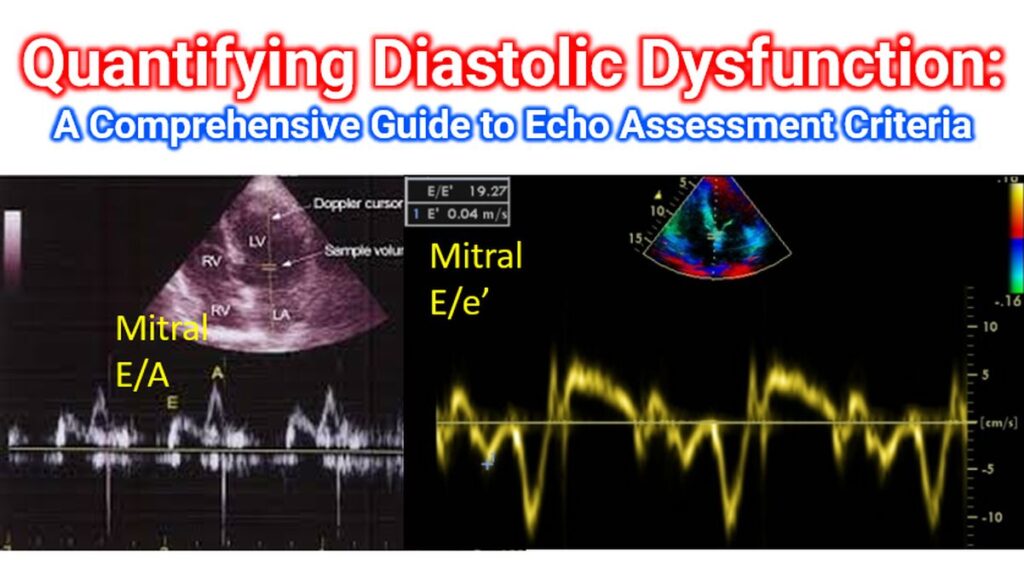

Quantifying diastolic dysfunction by echocardiography is essential for identifying heart failure with preserved ejection fraction (HFpEF). The current clinical standard is based on the 2016 ASE/EACVI Guidelines, though emerging research in 2025–2026 emphasizes the integration of Left Atrial (LA) Strain for higher sensitivity.
1. The Initial Screening (Normal LVEF)
In patients with a normal ejection fraction (LVEF ≥ 50%) and no known heart disease, the presence of diastolic dysfunction is determined by four primary variables.
Primary Criteria & Thresholds
| Parameter | Abnormal Value |
|---|---|
| Average E/e’ ratio | > 14 |
| Septal e’ velocity | < 7 cm/s (or Lateral e’ < 10 cm/s) |
| TR Peak Velocity | > 2.8 m/s |
| LA Volume Index (LAVi) | > 34 mL/m² |
Interpretation:
- Normal: < 2 positive criteria.
- Indeterminate: Exactly 2 positive criteria.
- Diastolic Dysfunction: > 2 positive criteria.
2. Grading Diastolic Dysfunction
Once diastolic dysfunction is confirmed—or if the patient has a reduced LVEF/structural heart disease (like LV Hypertrophy)—the focus shifts to grading the severity and estimating Left Ventricular Filling Pressures.
Grade I: Impaired Relaxation
- Physiology: The LV takes longer to relax, but filling pressures remain normal.
- Mitral Inflow: E/A ≤ 0.8 and E ≤ 50 cm/s.
- Clinical: Patients are typically asymptomatic at rest but may have dyspnea on exertion.
Grade II: Pseudonormal Pattern
- Physiology: Moderate diastolic dysfunction where increased left atrial pressure “pushes” blood into the LV, making the inflow pattern look superficially normal.
- Mitral Inflow: E/A is 0.8 to 2.0.
- Verification: To confirm Grade II, you must meet at least 2 of the 3 follow-up criteria:
- Average E/e’ >14.
- LAVi > 34 mL/m².
- TR velocity >2.8 m/s.
Grade III: Restrictive Filling
- Physiology: Severe diastolic dysfunction with high left atrial pressures and a stiff, non-compliant left ventricle.
- Mitral Inflow: E/A > 2.0.
- Clinical: Highly suggestive of advanced heart failure and poor prognosis.
3. Advanced Parameters (2025-2026 Trends)
While the 2016 criteria are specific, they can be insensitive. Contemporary practice now often includes:
- Left Atrial Reservoir Strain: A value < 18-20% is highly predictive of elevated filling pressures even when standard Doppler measurements are borderline.
- H2FPEF Score: A clinical score (Heavy, Hypertensive, Atrial Fibrillation, Pulmonary Hypertension, Elderly, Filling Pressure) used alongside Echo to rule in HFpEF. The H2FPEF score can be used to predict prognosis in patients having heart failure with preserved ejection fraction. Higher scores are associated with higher all‐cause mortality and rehospitalization rates.
- Diastolic Stress Test: If resting Echo is indeterminate but the patient has exertional dyspnea, an exercise Echo is performed to see if E/e’ increases or TR velocity rises significantly.
4. Common Pitfalls & Limitations
- Atrial Fibrillation: E/A ratio cannot be used. Assessment relies on TR velocity, E/e’, and the acceleration rate of the E wave.
- Mitral Annular Calcification (MAC): Can falsely lower e’ velocities, leading to an overestimation of E/e’.
- Mitral Valve Disease: Moderate-to-severe Mitral Regurgitation or Stenosis renders standard E/e’ and E/A criteria unreliable.