


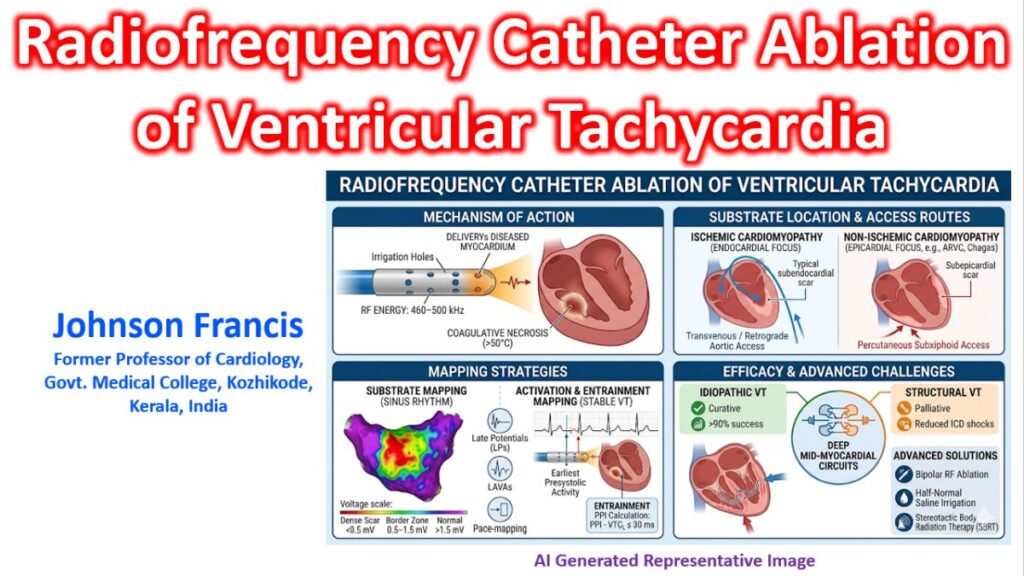

Radiofrequency (RF) catheter ablation has evolved from a rescue therapy to a primary strategy in the management of recurrent ventricular tachycardia (VT), particularly for patients with structural heart disease and recurrent ICD shocks. The procedure relies on delivering alternating high-frequency current (typically around 500 kHz) to the myocardium. This causes resistive heating of the tissue, and once the temperature exceeds ~50°C, it induces irreversible coagulative necrosis, effectively destroying the arrhythmogenic substrate.
Mapping Strategies
The approach heavily depends on whether the VT is hemodynamically tolerated and the underlying etiology (idiopathic vs. structural).
1. Substrate Mapping
Because most VTs in structural heart disease are hemodynamically unstable, mapping during sinus rhythm or paced rhythm is often the default.
- Voltage Mapping: Using a 3D electroanatomical mapping (EAM) system, bipolar voltage amplitudes define the tissue. Normal myocardium is typically >1.5 mV. The scar border zone (the usual site of the reentrant circuit) is between 0.5 and 1.5 mV, while dense scar is <0.5 mV.
- Target Identification: The goal is to identify and ablate abnormal electrograms during sinus rhythm. This includes Late Potentials (LPs), which occur after the surface QRS, and Local Abnormal Ventricular Activities (LAVAs).
- Pace-mapping: Pacing from the catheter tip to match the 12-lead ECG morphology of the clinical VT helps identify the exit site of the reentrant circuit.
2. Activation and Entrainment Mapping
Reserved for stable VTs, this strategy pinpoints the specific components of the reentrant circuit.
- Activation Mapping: Finding the earliest presystolic electrical activity relative to the QRS onset.
- Entrainment Mapping: Pacing during VT at a cycle length slightly shorter than the VT cycle length. A post-pacing interval (PPI) that closely matches the VT cycle length (typically PPI – VTCL ≤ 30 ms) confirms the catheter is within the critical isthmus of the circuit.
Endocardial vs. Epicardial Approaches
The location of the arrhythmogenic substrate dictates the access route:
- Ischemic Cardiomyopathy: The scar and VT circuits are typically subendocardial, progressing outward. A standard transvenous (transseptal) or retrograde aortic approach is usually sufficient.
- Non-Ischemic Cardiomyopathy: Conditions like Arrhythmogenic Right Ventricular Cardiomyopathy (ARVC), Chagas disease, and non-ischemic dilated cardiomyopathy (NIDCM) frequently feature epicardial or mid-myocardial substrates. These often require a percutaneous subxiphoid approach to map and ablate the epicardial surface directly.
Efficacy and Challenges
In structurally normal hearts (idiopathic VT, commonly originating from the RVOT or LV fascicles), RF ablation is often curative with success rates exceeding 90%.
In structural heart disease, the goal is typically palliation to reduce ICD shocks and amiodarone toxicity. Success is hindered by deep mid-myocardial circuits (which standard irrigated RF catheters struggle to penetrate) and extensive disease progression. For refractory cases, advanced techniques like bipolar ablation, half-normal saline irrigation, or stereotactic body radiation therapy (SBRT) are increasingly utilized.