


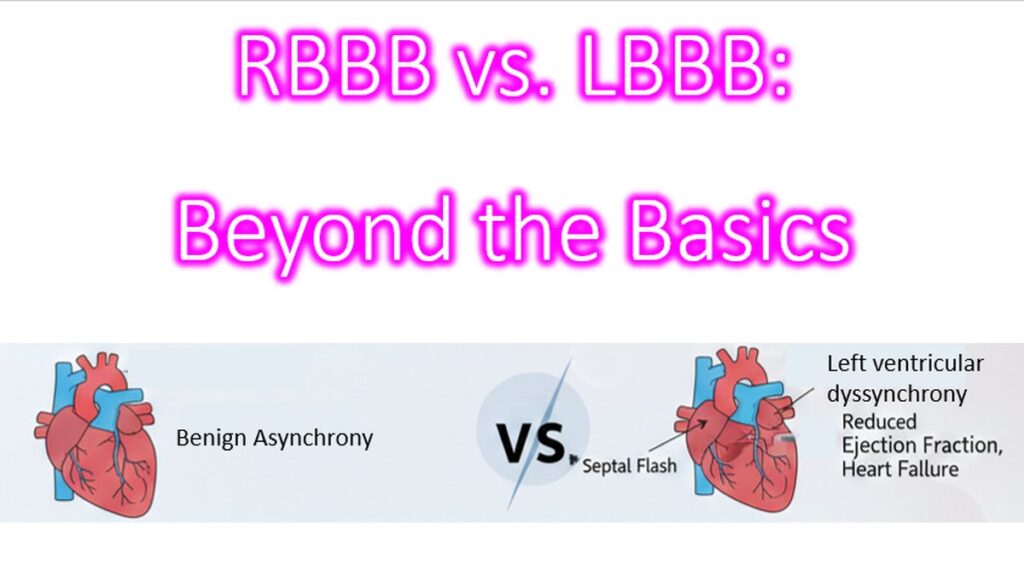

While the basic “WiLLiaM MaRRoW” mnemonic helps identify the patterns, the clinical implications of Right Bundle Branch Block (RBBB) and Left Bundle Branch Block (LBBB) differ significantly.
WiLLiaM refers to Left Bundle Branch Block:
W – V1: A deep, wide S-wave (or QS complex) resembling a ‘W’.
LL – Left Bundle Branch Block.
M – V6: A broad, notched R-wave resembling an ‘M’.
MaRRoW refers to Right Bundle Branch Block:
M – V1: An rSR’ pattern (bunny ears) resembling an ‘M’.
RR – Right Bundle Branch Block.
W – V6: A wide, notched S-wave resembling a ‘W. May be this part is too much of a simplification as you seldom see a W pattern in V6 in RBBB.
Hemodynamic and Functional Impact
The most profound difference lies in how these blocks affect the heart’s pumping efficiency.
- LBBB (Dyssynchrony): LBBB causes the interventricular septum to depolarize from right to left, leading to “septal flash.” The right ventricle contracts first, pushing the septum toward the left, which then bounces back. This ventricular dyssynchrony significantly reduces ejection fraction over time and can lead to heart failure (dilated cardiomyopathy).
- RBBB (Benign Asynchrony): Because the left ventricle (the primary pump) still depolarizes normally and early, RBBB usually has minimal impact on overall cardiac output. The right ventricle eventually catches up via cell-to-cell conduction, which is slower but less hemodynamically taxing.
The “Masking” Effect (Ischemia Diagnosis)
This is perhaps the most critical distinction for acute care.
| Feature | Right Bundle Branch Block (RBBB) | Left Bundle Branch Block (LBBB) |
| ST-Segment Interpretation | Generally reliable. You can usually see ST-elevation in the setting of an acute MI. | Unreliable. The massive repolarization abnormality masks standard STEMI criteria. |
| Q-Waves | Initial septal depolarization is intact; Q-waves remain diagnostic of old MI. | Septal Q-waves are lost. New LBBB is often treated as a “STEMI equivalent” in the right clinical context. |
| Diagnostic Aids | Standard ECG interpretation. | Requires Sgarbossa Criteria or Smith-modified Sgarbossa to identify ischemia. |
Axis and “The Company They Keep”
Looking at the electrical axis provides clues about the severity of the conduction system disease.
- RBBB + Left Axis Deviation: This suggests Bifascicular Block (RBBB + Left Anterior Fascicular Block). Since the Right Bundle and Left Anterior Fascicle are both supplied by the Left Anterior Descending (LAD) artery, this pattern often signals significant LAD disease.
- LBBB: LBBB is rarely an isolated finding in a healthy heart. It is almost always a marker of underlying structural disease—hypertension, ischemic heart disease, or valvular issues (like aortic stenosis).
Waveform Nuances
- The Discordance Rule: In LBBB, the ST segment and T-wave should always point in the opposite direction of the terminal QRS complex. If you see a positive QRS with a positive T-wave in LBBB, that “concordance” is a major red flag for acute ischemia.
- R’ in V1 and slurred S in V6: In RBBB, R’ in V1 and the delayed “slurred” S-wave in Lead I and V6 represents the slow, arduous journey of depolarization across the right ventricular myocardium.
Clinical Decision Making
- Potential Pacemaker Need: Isolated RBBB rarely requires a pacemaker. However, a new LBBB in a patient with syncope is a high-risk scenario which might eventually need a pacemaker, especially in the setting of Transcatheter Aortic Valve Implantation (TAVI).
- Heart Failure Therapy: LBBB with heart failure can be an indication for Cardiac Resynchronization Therapy (CRT). By pacing both ventricles simultaneously, we can “fix” the electrical delay and physically shrink a dilated heart. RBBB patients with heart failure typically do not respond as well to CRT.