


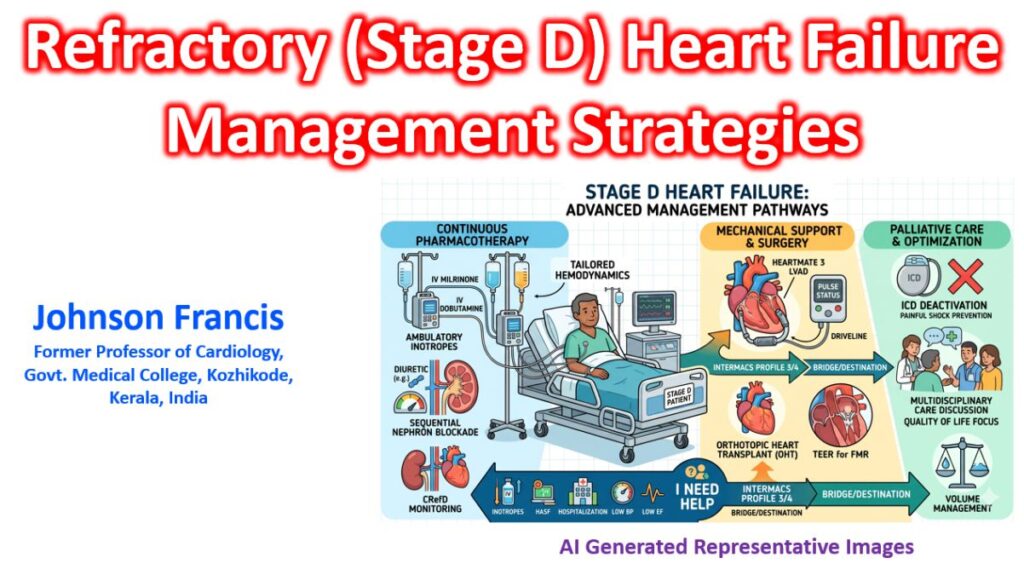

The management of Refractory (Stage D) Heart Failure represents the most challenging frontier in cardiology. By definition, these patients remain symptomatic despite optimal medical therapy (OMT) at maximum tolerated doses and require specialized interventions.
1. Advanced Pharmacotherapy & Hemodynamics
When GDMT (ACEi/ARNI, Beta-blockers, MRA, SGLT2i) is no longer sufficient, the focus shifts to palliative or bridge-to-transplant stability:
- Inotropes: Use of “tailored therapy” with milrinone or dobutamine. While milrinone is often preferred in the setting of pulmonary hypertension (due to its vasodilatory properties), it requires careful monitoring of renal function.
- Diuretic Resistance: Often managed with the “sequential nephron blockade” strategy—adding metolazone or chlorothiazide to high-dose loop diuretics.
- LVEDP & PCWP Management: In refractory cases, maintaining a pulmonary capillary wedge pressure (PCWP) < 15 mmHg and a cardiac index > 2.2 L/min/m2 becomes the primary hemodynamic goal.
2. Surgical & Interventional Options
For patients who are candidates for more than medical management:
- LVAD (Left Ventricular Assist Device): As seen in trials like MOMENTUM 3, the HeartMate 3 has significantly improved outcomes, reducing the incidence of pump thrombosis and stroke compared to older axial-flow pumps.
- Orthotopic Heart Transplant (OHT): Still the “gold standard” for those who meet the rigorous selection criteria.
- MitraClip (TEER): Based on the COAPT trial, transcatheter edge-to-edge repair is a viable option for refractory patients with grade 3-4+ secondary mitral regurgitation.
3. Palliative Care & Quality of Life
In Stage D, the conversation often transitions from “prolonging life” to “optimizing the remainder of life.”
- Deactivation of ICDs: A critical but often overlooked discussion to prevent painful, unnecessary shocks in the final stages.
- Ultrafiltration: Considered for patients with volume overload refractory to high-dose diuretics, though the CARESS-HF trial suggested it might not be superior to stepped pharmacotherapy regarding renal function preservation.
4. Key Clinical Considerations
| Feature | Clinical Significance |
| Cardiorenal Syndrome | Type 1 or Type 2 cardiorenal syndrome often limits the use of ARNI/ACEi in Stage D. |
| Cardiac Cachexia | A profound prognostic indicator of end-stage metabolic failure. |
| Right Ventricular Failure | Often the “Achilles’ heel” for LVAD candidacy; high CVP/PCWP ratios and low PAPi (Pulmonary Artery Pulsatility Index) are red flags. |