


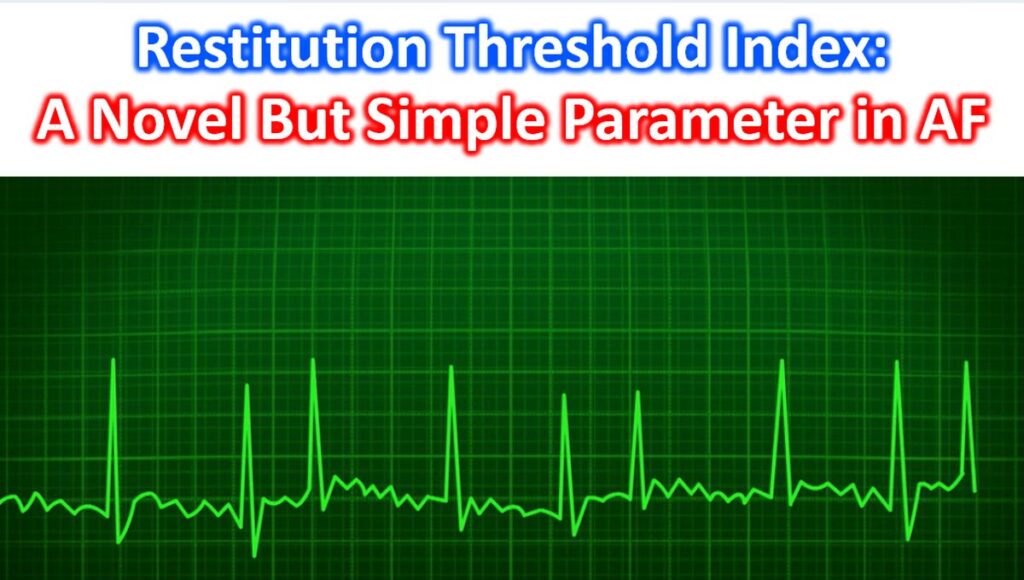

It is well known that controlling ventricular rate in atrial fibrillation with fast heart rate can improve heart failure. But reduction of ventricular rate beyond a threshold of about 110/min in AF did not improve or preserve cardiac function [1]. Still, restoration of sinus rhythm can improve cardiac function in those with AF and heart failure [2]. Restitution Threshold Index is a novel parameter which has been tested in patients having AF and heart failure. Usually we assess heart control in AF based on the mean heart rate. But it may underestimate the actual tachycardia burden due to significant variation in RR intervals. Restitution Threshold Index is the percentage of RR intervals less than 660 ms [3]. It can be measured from a 10 minute supervised Holter recording.
The threshold of 660ms for restitution threshold was found from studies which showed that though increasing RR intervals improved cardiac function, it plateaued off at a level. This may be corresponding to mechanical restitution after a cardiac contraction. Mechanical restitution is the recovery of mechanical force of contraction of cardiac muscle following a contraction. Force of contraction gradually increases as the interval between contractions increases, reaching a peak at a certain interval. It can potentially decrease with longer intervals. This phenomenon is linked to the availability of calcium for cardiac muscle contraction.
Shorter RR intervals can result in incomplete mechanical restitution prior to the next contraction, resulting in lower cardiac function. It has been shown that restitution threshold index is an independent predictor of reduced left ventricular ejection fraction in persistent AF while mean heart rate is not [3]. Persistent AF is defined as AF which has persisted more than 7 days. Restitution threshold index can be used to predict improvement in left ventricular ejection fraction after catheter ablation of AF.
References
- Smit MD, Crijns HJ, Tijssen JG, Hillege HL, Alings M, Tuininga YS, Groenveld HF, Van den Berg MP, Van Veldhuisen DJ, Van Gelder IC; RACE II Investigators. Effect of lenient versus strict rate control on cardiac remodeling in patients with atrial fibrillation data of the RACE II (RAte Control Efficacy in permanent atrial fibrillation II) study. J Am Coll Cardiol. 2011 Aug 23;58(9):942-9. doi: 10.1016/j.jacc.2011.04.030. PMID: 21851883.
- Hunter RJ, Berriman TJ, Diab I, Kamdar R, Richmond L, Baker V, Goromonzi F, Sawhney V, Duncan E, Page SP, Ullah W, Unsworth B, Mayet J, Dhinoja M, Earley MJ, Sporton S, Schilling RJ. A randomized controlled trial of catheter ablation versus medical treatment of atrial fibrillation in heart failure (the CAMTAF trial). Circ Arrhythm Electrophysiol. 2014 Feb;7(1):31-8. doi: 10.1161/CIRCEP.113.000806. Epub 2014 Jan 1. PMID: 24382410.
- Ahluwalia N, Honarbakhsh S, Joshi A, Abbass H, Chow AW, Dhinoja M, Petersen SE, Lloyd G, Hunter RJ, Schilling RJ. The Restitution Threshold Index Characterizes the Association Between Atrial Fibrillation Ventricular Rate and Ejection Fraction. JACC Clin Electrophysiol. 2025 Feb;11(2):282-294. doi: 10.1016/j.jacep.2024.10.020. Epub 2024 Dec 11. PMID: 39665707.