


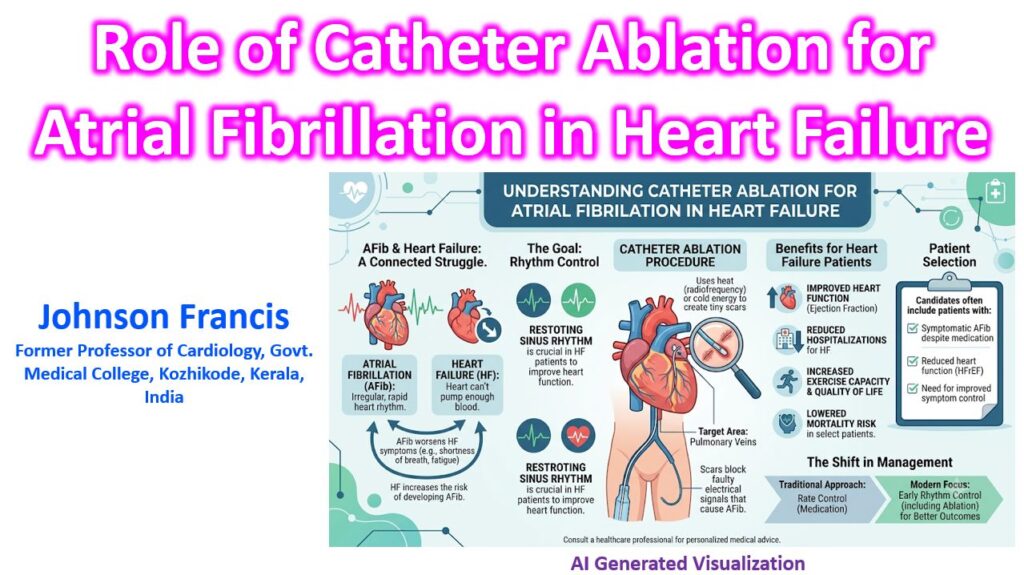

The management of atrial fibrillation (AF) in the setting of heart failure (HF) has undergone a major paradigm shift. The historical approach of rate control as a purely palliative measure has been largely superseded by aggressive, early rhythm control. Catheter ablation is no longer viewed just as a tool for symptom management in refractory patients; it is now recognized as a potent, disease-modifying therapy that improves left ventricular ejection fraction (LVEF), reduces hospitalizations, and lowers all-cause mortality. Here is a breakdown of the current clinical consensus and the landmark trial data driving these changes.
The 2023 ACC/AHA/ACCP/HRS Guideline Shift
The 2023 guidelines firmly prioritize sinus rhythm maintenance in heart failure. Catheter ablation is heavily endorsed over antiarrhythmic drugs (AADs) due to its superior efficacy and better side-effect profile.
- Class 1 and 2a Recommendations: Catheter ablation is recommended for patients with AF and HF to improve symptoms, enhance LVEF, and reduce the rates of hospitalization and mortality, with Class 1 and Class 2a recommendations in various subsets.
- The Primary Lesion Set: Pulmonary vein isolation (PVI) remains the cornerstone primary lesion set for these procedures, unless a discrete arrhythmogenic focus is identified.
Landmark Evidence
The recommendation upgrades are anchored by robust data demonstrating survival benefits across the spectrum of heart failure.
1. CASTLE-AF (HFrEF)
This trial was the initial turning point for patients with Heart Failure with reduced Ejection Fraction (HFrEF). It demonstrated that catheter ablation was vastly superior to guideline-directed medical therapy (GDMT) in reducing both all-cause mortality and hospitalizations for worsening heart failure.
2. CASTLE-HTx (End-Stage HF)
Published in 2023, CASTLE-HTx answered whether ablation is viable for the sickest patients—those with end-stage HFrEF (LVEF ≤35%) being evaluated for a left ventricular assist device (LVAD) or urgent heart transplantation (HTx).
- Outcome: The trial was terminated early due to overwhelming efficacy in the ablation arm.
- Primary Endpoint: The composite of all-cause mortality, LVAD implantation, or urgent HTx occurred in just 8% of the ablation group versus 30% in the medical therapy group (HR 0.29).
- LVEF Improvement: At 12 months, the ablation arm saw a +7.8% increase in LVEF compared to +1.4% with GDMT.
3. CABANA (HFpEF Integration)
While previous trials focused heavily on HFrEF, the CABANA trial‘s heart failure subgroup (where 79% of the HF patients had an LVEF ≥50%) extended the evidence to the Heart Failure with preserved Ejection Fraction (HFpEF) population.
- Outcome: Patients randomized to ablation had a significantly lower rate of the primary composite endpoint (death, disabling stroke, serious bleeding, or cardiac arrest) compared to drug therapy (9.0% vs 12.3%).
- Mortality: All-cause mortality was notably reduced (6.1% vs 9.3%).
Key insight: The absolute benefit of catheter ablation is actually more pronounced in higher-risk patients (like those in CASTLE-HTx), though the window for intervention requires careful patient selection before irreversible left atrial myopathy sets in.
Pathophysiological Rationale
The outsized benefit of achieving sinus rhythm in HF patients compared to the general population likely stems from reversing the vicious cycle of AF and HF. Restoring sinus rhythm eliminates tachycardia-induced cardiomyopathy, restores the active atrial contribution to ventricular filling (the “atrial kick,” which is critical in HFpEF), and reduces the neurohormonal activation that drives progressive ventricular remodeling.