


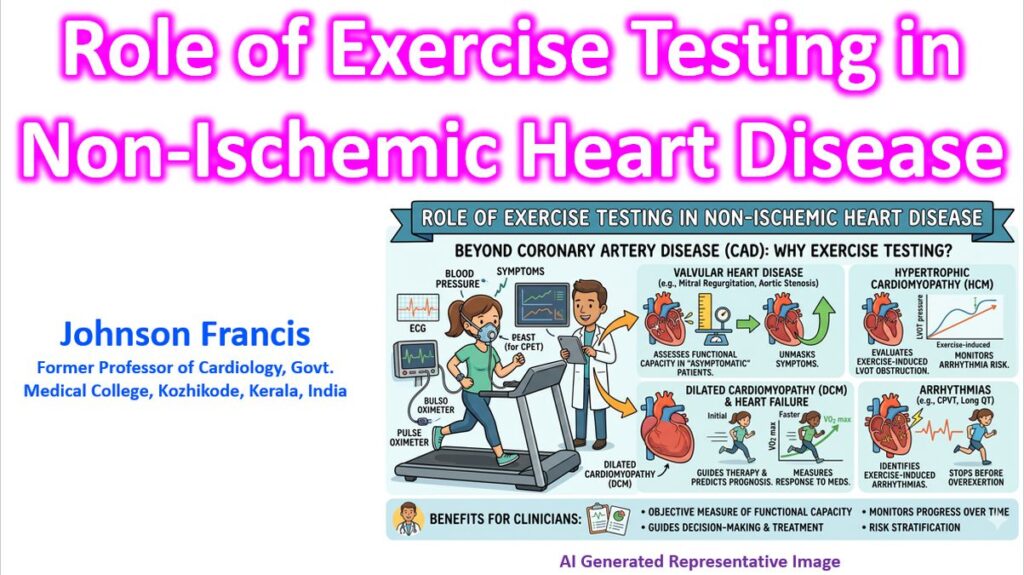

In the management of non-ischemic heart disease, exercise testing has evolved from a tool for “ischemia detection” to a sophisticated method for functional phenotyping, hemodynamic unmasking, and prognostic stratification. For a clinician, the utility shifts towards evaluating the heart’s integrated response to metabolic demand.
1. Hypertrophic Cardiomyopathy (HCM)
In HCM, exercise testing—particularly Cardiopulmonary Exercise Testing (CPET)—is essential for identifying patients at risk of heart failure (HF) progression rather than just sudden cardiac death (SCD).
- Prognostic Thresholds: A peak oxygen consumption (pVO2) of <14 mL/kg/min or <80% of predicted is a robust predictor of adverse outcomes, including HF hospitalization and the need for transplant.
- Hemodynamic Unmasking: Exercise stress echocardiography (ESE) is used to detect latent Left Ventricular Outflow Tract (LVOT) obstruction. A gradient ≥ 50 mmHg during or immediately after exercise is clinically significant in symptomatic patients with resting gradients <30 mmHg.
- SCD Risk Stratification: The presence of Abnormal Blood Pressure Response (ABPR)—defined as a failure to increase systolic BP by ≥ 20 mmHg or a drop in BP during exercise—remains a traditional risk marker, though its specificity is limited in older cohorts.
- Safety: Recent large-scale data (n=7637) confirms that CPET is safe in HCM; sustained ventricular arrhythmias (VA) occur in <2% of cases, even in high-risk patients.
2. Valvular Heart Disease
The 2025 ESC/EACTS Guidelines have refined the role of stress testing in “asymptomatic” severe valvular disease to prevent irreversible ventricular damage.
| Condition | Role of Exercise Testing | Key Triggers for Intervention |
| Aortic Stenosis (AS) | Unmask “pseudo-asymptomatic” status. | Symptoms during test or drop in BP below baseline. |
| Mitral Regurgitation (MR) | Unmask dynamic MR and exercise-induced pulmonary hypertension. Evaluate functional reserve in borderline LV function. | Exercise-induced PASP > 60 mmHg or unmasking of symptoms. LVESDi ≥ 20 mm/m2 or failure of EF to increase. |
3. HFpEF and Infiltrative Diseases
Exercise testing is often the only way to diagnose HFpEF when resting hemodynamics are normal.
- The “Gold Standard”: Invasive CPET (combining gas exchange with right heart catheterization) remains the definitive method to demonstrate exercise-induced elevation in Pulmonary Capillary Wedge Pressure (PCWP) (>25 mmHg).
- Non-Invasive Markers: A high VE/VCO2 slope (ventilatory efficiency) is often a more sensitive predictor of mortality in HFpEF than pVO2 itself. VCO2: carbon dioxide production; VE minute ventilation.
- Cardiac Amyloidosis (ATTR-CA): Patients typically exhibit a significantly lower pVO2 and a “decoupling” of the TAPSE/PASP ratio during effort, reflecting limited right ventricular contractile reserve compared to other hypertrophic phenotypes. PASP Pulmonary Artery Systolic Pressure.
4. Inherited Arrhythmias (ARVC & CPVT)
In these conditions, exercise testing is primarily diagnostic and for risk assessment of effort-induced VAs.
- ARVC: Exercise testing is recommended every 1–2 years to monitor for effort-induced VAs, which typically present with a Left Bundle Branch Block (LBBB) morphology. High-intensity exercise is strictly restricted as it accelerates desmosomal disruption and disease progression.
- Catecholaminergic Polymorphic VT (CPVT): Exercise testing is the diagnostic cornerstone, revealing progressive ventricular ectopy (starting with isolated PVCs and moving to bidirectional or polymorphic VT) as the heart rate increases toward a specific threshold.
5. Summary of Key Parameters for Clinical Practice
- Peak VO2 (the highest rate of oxygen consumption): The most objective measure of functional capacity.
- VE/VCO2 Slope: Values 36 and above indicate ventilatory class III and above. Heart transplantation or Left Ventricular Assist Device implantation should be considered for subjects in VC-III and VC-IV who do not improve to a lower class after optimization of pharmacological interventions, implementation of an aerobic training program, and consideration of cardiac resynchronization therapy.
- Oxygen Pulse (VO2/HR): A surrogate for stroke volume; a plateau or decline during exercise suggests contractile failure or severe valvular/obstructive issues.