


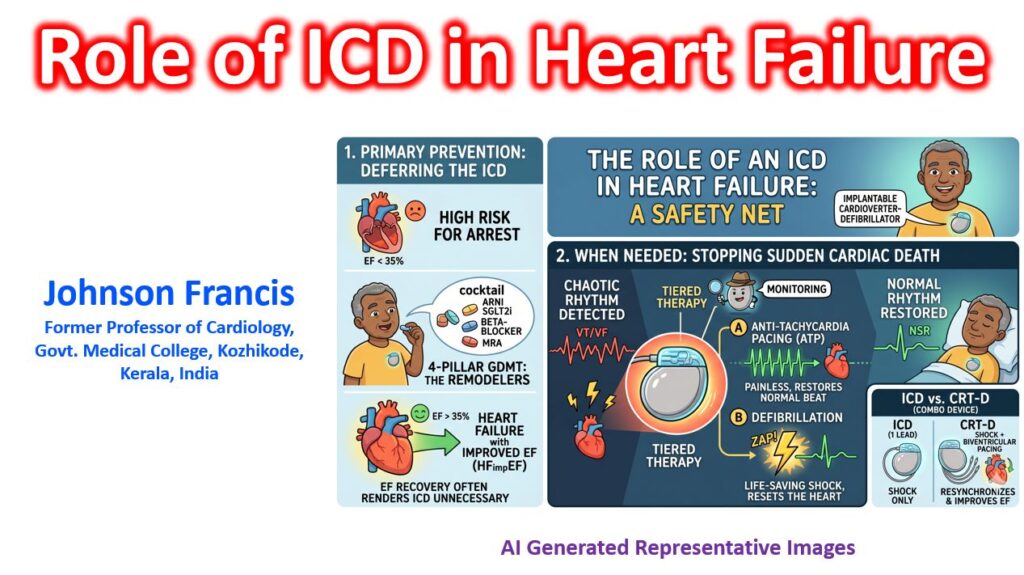

The role of an Implantable Cardioverter Defibrillator (ICD) in heart failure is primarily centered on the prevention of Sudden Cardiac Death (SCD) due to ventricular arrhythmias. While heart failure medications improve cardiac function and symptoms, they cannot always stop the chaotic electrical signals that lead to cardiac arrest. The use of an ICD is generally categorized into two – primary and secondary prevention strategies.
1. Primary Prevention
This applies to patients who have never had a life-threatening arrhythmia but are at high risk because of their underlying cardiac condition.
- Ejection Fraction (EF) < 35%: This is the most common threshold. If the left ventricular ejection fraction remains low despite at least 3 months of Optimal Medical Therapy (OMT), an ICD is often indicated.
- Ischemic vs. Non-Ischemic: Patients with a history of myocardial infarction (Ischemic Cardiomyopathy) typically see a more pronounced survival benefit, as established by trials like MADIT-II and SCD-HeFT.
- Wait Period: For those who have suffered a recent myocardial infarction, guidelines usually require waiting 40 days post-MI before ICD implantation to see if the EF recovers.
2. Secondary Prevention
This is for patients who have already survived a “sentinel event,” such as:
- Sustained Ventricular Tachycardia (VT).
- Ventricular Fibrillation (VF) cardiac arrest.
- Syncope where a ventricular arrhythmia is highly suspected.
Key Functions of the ICD
The ICD monitors and analyzes the cardiac rhythm continuously and provides a tiered therapy approach:
- Anti-Tachycardia Pacing (ATP): If the device detects a ventricular tachycardia, it can pace the heart even faster for a few seconds to “break” the circuit and return it to normal. This is painless and often goes unnoticed by the patient.
- Defibrillation: If ATP fails or the rhythm is ventricular fibrillation, the device delivers a high-energy shock.
Important Considerations
- ICD vs. CRT-D: Many heart failure patients also have a conduction delay (like a Left Bundle Branch Block). In these cases, a Cardiac Resynchronization Therapy Defibrillator (CRT-D) is used. It combines the “shock” features of an ICD with “biventricular pacing” to synchronize the left ventricular contraction, which can actually improve the EF.
- The “DANISH” Trial Context: Recent data (specifically the DANISH trial) has sparked debate regarding the extent of the ICD’s benefit in non-ischemic cardiomyopathy, especially in elderly patients, suggesting that as medical therapy (like ARNIs and SGLT2 inhibitors) improves, the relative benefit of the ICD may shift.
The clinical use of Implantable Cardioverter Defibrillators (ICDs) is guided by several landmark trials that differentiate between Ischemic (ICM) and Non-Ischemic (NICM) etiologies.
Here are the pivotal trials, their key findings, and references.
1. Ischemic Cardiomyopathy (ICM)
These trials established the ICD as the gold standard for primary prevention after a myocardial infarction (MI).
| Trial | Population | Key Finding | Reference |
| MADIT-II | Prior MI + EF ≤ 30% | 31% reduction in all-cause mortality vs. conventional therapy. | NEJM 2002 |
| SCD-HeFT | NYHA Class II/III + EF ≤ 35% | 23% reduction in mortality. ICD was superior to amiodarone and placebo. | JACC 2022 Attenuation of the ICD benefit was observed after 6 years. |
| DINAMIT | Early post-MI (6–40 days) | No benefit. ICD reduced sudden death but increased non-arrhythmic death early on. | NEJM 2004 |
2. Non-Ischemic Cardiomyopathy (NICM)
The data here is more nuanced, particularly with the advent of modern Guideline-Directed Medical Therapy (GDMT).
| Trial | Population | Key Finding | Reference/Link |
| DANISH | NICM + EF ≤ 35% | No significant reduction in all-cause mortality overall, though sudden death was reduced. | NEJM 2016 |
| DANISH Extended Follow Up | Benefit in patients ≤ 70 years | Reduced long-term sudden CV death in those ≤ 70 years | JACC 2025 |
| DEFINITE | NICM + EF < 36% + PVCs/NSVT | Trend toward reduced mortality but did not reach statistical significance. Reduced the risk of sudden death from arrhythmia. | NEJM 2004 |
Modern heart failure management, particularly the integration of the “Four Pillars” of Guideline-Directed Medical Therapy (GDMT)—ARNI, SGLT2 inhibitors, Beta-blockers, and MRAs—has fundamentally changed the landscape of ICD eligibility. The primary “role” of the ICD is now being deferred or even eliminated in many patients due to a phenomenon called Reverse Remodeling.
Reverse Remodeling and “EF Recovery”
The most significant impact of ARNI and SGLT2i is their ability to improve the Left Ventricular Ejection Fraction (LVEF) beyond the 35% threshold, rendering an ICD unnecessary.
- PROVE-HF (ARNI): This trial demonstrated that sacubitril/valsartan leads to significant rapid reverse remodeling. Among patients with HFrEF who met primary prevention ICD eligibility criteria at baseline, 62% improved their EF to >35% by 12 months after initiation of sacubitril/valsartan therapy.
- SGLT2i Impact: Recent evidence shows that adding an SGLT2i to an ARNI has a synergistic effect on ventricular volumes and mass reduction, further increasing the rate of “HFimpEF” (Heart Failure with Improved EF). SGLT2i therapy is associated with a reduced risk of sudden cardiac death in patients with heart failure receiving contemporary medical therapy.
Change in ICD Implantation Rates
Recent observational data indicates a downward trend in primary prevention ICD implantations. In real-world cohorts, ICD implantation rates have dropped by ~4-5% because patients simply get better on drugs.