


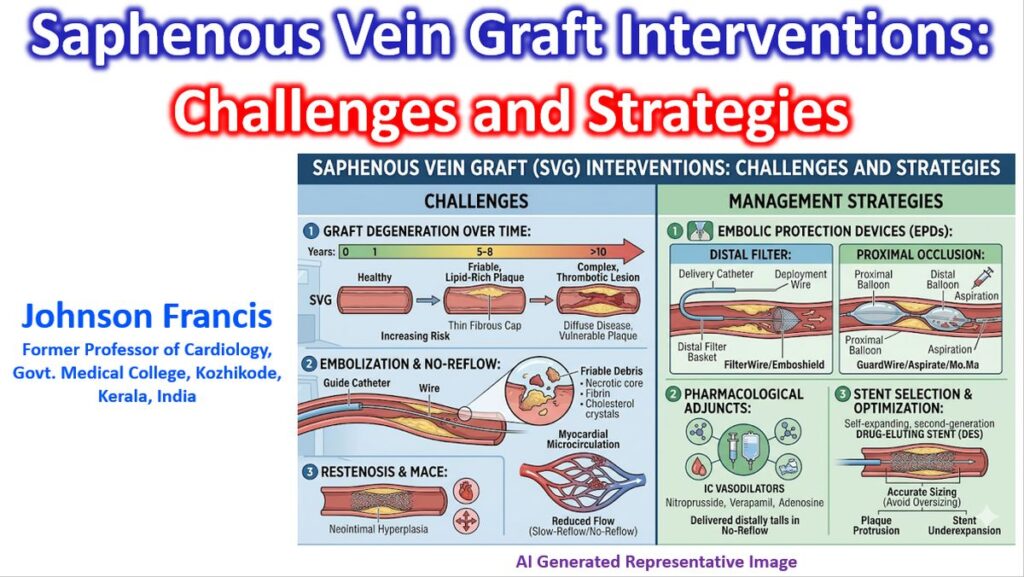

Interventions for Saphenous Vein Grafts (SVG) remain a high-risk subset of percutaneous coronary intervention (PCI) due to the unique pathophysiology of graft degeneration. Unlike native vessel atherosclerosis, SVG plaque is often friable, lacks a fibrous cap, and is prone to distal embolization.
Clinical Challenges
- Embolic Phenomenon: The primary risk during SVG PCI is the “no-reflow” or “slow-flow” phenomenon, caused by the distal embolization of necrotic core material and fibrin.
- Restenosis Rates: Historically, SVGs have shown higher rates of Major Adverse Cardiac Events (MACE) and target lesion revascularization compared to native vessels.
- Graft Age: The risk of intervention increases significantly as the graft ages, particularly beyond the 5-to-8-year mark when degenerative changes become more pronounced.
Procedural Strategies
To mitigate risks and improve outcomes, several technical approaches are standard:
- Embolic Protection Devices (EPDs):
- Distal Filters: The most common approach, allowing for continued blood flow while capturing debris.
- Proximal Occlusion: Used less frequently but effective in specific anatomical subsets where a distal filter cannot be landed.
- Pharmacological Adjuncts:
- Intracoronary vasodilators such as Nitroprusside, Verapamil, or Adenosine are often used to treat or prevent the no-reflow phenomenon.
- The role of GP IIb/IIIa inhibitors is controversial in SVG PCI; while they reduce thrombus burden, they do not necessarily prevent embolization of friable plaque.
- Stent Selection:
- Drug-Eluting Stents (DES): Current evidence favors second-generation DES over Bare-Metal Stents (BMS) to reduce target-vessel failure, though the benefit is less pronounced than in native coronary arteries.
- Stent Sizing: Avoiding “aggressive” post-dilation is often preferred to minimize plaque protrusion and embolization.
Alternative Approaches
Given the high friability of older grafts, clinicians often weigh SVG PCI against other strategies:
- Native Vessel PCI: If the native circulation is amenable to revascularization (e.g., chronic total occlusion or high-grade stenosis), PCI of the native vessel is often preferred over the SVG due to better long-term patency.
- Medical Management: Optimization of intensive statin therapy and antiplatelet regimens.
- Redo CABG: Generally reserved for patients with multiple failing grafts and no viable PCI options, given the significantly higher surgical mortality of secondary procedures.
Comparison of Outcomes
| Feature | Native Vessel PCI | SVG PCI |
| Plaque Type | Calcific/Fibrous | Friable/Thrombotic |
| Embolic Risk | Low | High |
| No-Reflow Risk | Minimal | Significant |
| Long-term Patency | High | Moderate to Low |
Foundational Trials: Embolic Protection Devices (EPD)
The use of EPDs is a Class I recommendation in guidelines based on early randomized evidence showing a significant reduction in periprocedural major adverse cardiac events (MACE).
- SAFER Trial: This landmark study evaluated the GuardWire (distal occlusion) and demonstrated a 42% reduction in 30-day MACE compared to conventional wires (16.5% vs. 9.6%, p=0.001). It established that distal embolization is a primary driver of periprocedural MI in SVGs.
- FIRE Trial (2003): This trial confirmed that distal filter devices (specifically the FilterWire EX) are non-inferior to distal balloon occlusion (GuardWire), offering more technical flexibility by maintaining distal perfusion during the procedure.
Stent Selection: DES vs. BMS in SVG
While drug-eluting stents (DES) are superior in native vessels, their benefit in SVGs has been more nuanced due to the friable nature of vein graft plaques.
- DIVA Trial (2018): A multicenter, double-blind RCT comparing second-generation DES to BMS in 597 patients. At 1 year, there was no significant difference in the composite of cardiac death, target vessel MI, or target-lesion revascularization (TLR).
- ISAR-CABG Trial (2011/2018): This trial randomized 610 patients to DES or BMS. Long-term outcomes (up to 10 years) showed that DES were safe but did not provide a definitive long-term survival benefit or significant reduction in MACE compared to BMS in the SVG setting.
Recent Clinical Trials
Recent evidence has shifted toward refining the “lifetime management” of patients post-CABG, emphasizing native vessel PCI and optimized medical therapy.
- TACSI Trial (2025): Evaluated dual antiplatelet therapy (DAPT) vs. aspirin alone post-CABG for ACS. It found no ischaemic benefit but significantly increased major bleeding with DAPT, leading to recommendations for aspirin monotherapy in stable post-CABG patients.
- TOP-CABG (2025): Demonstrated that a time-limited intensification of therapy followed by aspirin alone resulted in non-inferior SVG occlusion rates with significantly lower bleeding risks.
- VELETI Trials: These explored stenting intermediate (30–60%) SVG lesions with DES versus medical therapy. VELETI I showed a decrease in luminal narrowing with DES. VELETI II concluded that sealing intermediate nonobstructive SVG lesions with DES was safe but was not associated with a significant reduction of cardiac events at 3-year follow-up.
Technical Predictors of Outcome
A pooled analysis of 3958 patients from the Harvard Clinical Research Institute EPD data set identified key angiographic predictors of 30-day MACE:
- SVG Degeneration Score: It is an ordinal metric of the extent of lumen irregularities and ectasia (>20% of the reference normal segment) within the SVG that makes up 25% (SVG degeneration score, 0), 26% to 50% (SVG degeneration score, 1), 51% to 75% (SVG degeneration score, 2), or >75% (SVG degeneration score, 3) of the total SVG length.
- Estimated Plaque Volume: Large plaque burdens remain the strongest predictor of “no-reflow” despite embolic protection.
References
- Agostoni, P., & Vermeersch, P. (2011). Percutaneous coronary interventions in saphenous vein grafts: the more things change, the more they stay the same. EuroIntervention, 7(8), 893–895.
- Bulluck, H., Bagur, R., & Mamas, M. A. (2018). Percutaneous coronary intervention of saphenous vein grafts: where do we stand? EuroIntervention, 14(2), 142–143.
- Coolong, A. (2008). Saphenous Vein Graft Stenting and Major Adverse Cardiac Events. Circulation. https://www.ahajournals.org/doi/10.1161/circulationaha.106.651232
- Hall, A. B., & Brilakis, E. S. (2019). Saphenous vein graft failure: seeing the bigger picture. Journal of Thoracic Disease, 11(S1441–S1444).
- Lee, M., & Kong, J. (2017). Current State of the Art in Approaches to Saphenous Vein Graft Interventions. Interventional Cardiology Review, 12(85).
- Neumann, F.-J., et al. (2018). 2018 ESC/EACTS Guidelines on myocardial revascularization. European Heart Journal, 40(87–165).