


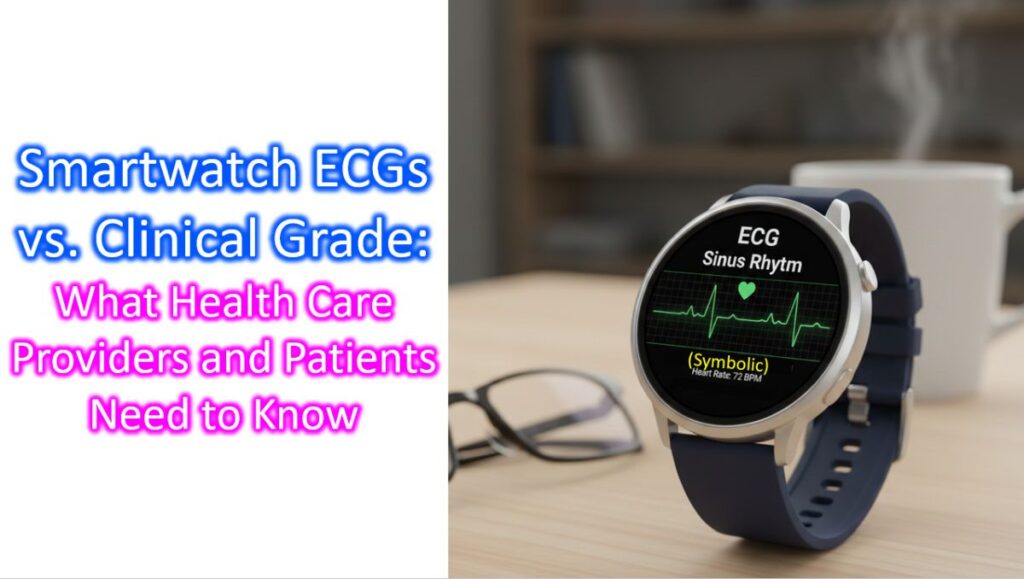

For health care providers and patients alike, the rise of ECG-enabled wearables has transformed heart monitoring from a clinic-only event into a pocket-sized habit. However, while these devices are FDA-cleared for certain uses, they are not “clinical grade” in the way many users assume. Here is the breakdown of what separates your wrist from the hospital ward.
Single-Lead vs. 12-Lead: The “Snapshot” vs. the “3D Movie”
The most fundamental difference is the perspective of the heart’s electrical activity.
- Smartwatch (Single-Lead): When you touch the crown or button, the watch creates a circuit that mimics Lead I of a clinical ECG. It looks at the heart from a single angle (typically across the chest from arm to arm). It is excellent for rhythm (is the beat steady or chaotic?) but poor for structure or blood flow.
- Clinical Grade (12-Lead): In a clinic, ten electrodes are placed on the limbs and chest. This allows the machine to view the heart from 12 different electrical angles. This “3D” view is necessary to see exactly where a problem is occurring (e.g., the front vs. the bottom of the heart).
What It Can (and Cannot) Detect
Misunderstanding the limitations of a smartwatch can lead to dangerous “false reassurance.”
| Condition | Smartwatch ECG | Clinical 12-Lead ECG |
| Atrial Fibrillation (AFib) | Yes (FDA-cleared for this) | Yes (The gold standard) |
| Heart Attack | No | Yes (Detects ST-segment changes) |
| Heart Blockages | No | Yes (Shows signs of ischemia) |
| Valvular Issues | No | No (Requires Echocardiogram) |
| PVCs/PACs | Sometimes (If caught during 30s) | Yes |
Note: A smartwatch cannot detect a heart attack. If you have chest pain, a “Normal” or “Sinus Rhythm” reading on your watch is irrelevant—you must seek emergency care.
Accuracy and Reliability
While modern smartwatches are remarkably accurate at identifying AFib—often boasting 96-99% sensitivity in controlled studies—real-world factors frequently interfere:
- The “Inconclusive” Trap: Up to 30% of watch readings can be labeled “inconclusive” due to a heart rate that is too high (>120 bpm) or too low (<50 bpm), or simply because the user was moving too much.
- Artifacts: Shivering, talking, or even being near a plugged-in electronic device can create “noise” in the tracing that looks like an arrhythmia to an untrained eye.
Key Takeaways
For Health Care Providers
- Contextualize Alerts: Remind your patients that an “Irregular Rhythm Notification” is a prompt for a check up, not a diagnosis.
- Clarify Sensors: Distinguish between the green light (PPG) used for 24/7 heart rate and the electrical sensor (ECG) used for 30-second on-demand strips.
For Patients
- Use the PDF: Most watches allow you to export a PDF of your ECG. This is infinitely more useful to a cardiologist than a screenshot of the “Sinus Rhythm” result.
- The Symptoms Rule: If you feel heart palpitations, dizziness, or shortness of breath, that is the time to take a 30-second recording. A snapshot taken when you feel fine is less likely to catch intermittent issues.
As of early 2026, the medical community has shifted from “skeptical observation” to “structured integration.” Here are the current clinical “rules of engagement” for physicians and patients.
The “Confirmation” Requirement
Guidelines now explicitly state that a smartwatch algorithm’s diagnosis (e.g., “AFib Detected”) is a screening result, not a clinical diagnosis.
- Manual Review: Doctors are advised to never treat the watch’s automated text output as fact. They must manually interpret the PDF rhythm strip provided by the patient.
- Gold Standard Confirmation: If the watch PDF suggests an arrhythmia, the standard protocol is still to confirm it with a clinical-grade 12-lead ECG or a 24-hour Holter monitor before starting long-term treatments like anticoagulants (blood thinners).
Managing the “Inconclusive” Result
One of the biggest updates involves handling the ~20–30% of readings labeled “Inconclusive.”
- Algorithm Limitations: Doctors are trained that “Inconclusive” often occurs because the heart rate is outside the algorithm’s range (typically <50 or >120/150 bpm) or because the rhythm is something other than AFib (like frequent premature beats).
- Clinical Action: Guidelines suggest that if a patient has persistent “Inconclusive” readings while symptomatic, the clinician should bypass the watch entirely and move to a medical-grade patch monitor.
Diagnostic Accuracy: Algorithm vs. Human
Recent 2025 meta-analyses have quantified the “gap” that clinicians must account for:
- Algorithmic Reading: Sensitivity ~86%, Specificity ~94%.
- Manual Physician Reading (of the Watch PDF): Sensitivity ~96%, Specificity ~95%.
- The Takeaway: The hardware is often better than the software. A trained cardiologist can often see a clear diagnosis on a strip that the watch’s AI failed to categorize.
Specific Clinical Recommendations
| Category | Recommendation |
| Stroke Prevention | Wearables are strongly recommended for “opportunistic screening” in patients over 65 or those with high-risk factors (hypertension/diabetes). |
| Post-Ablation | Doctors are increasingly using patient ECGs to monitor for AFib recurrence after a procedure, often reducing the need for frequent in-person visits. |
| Data Integration | New standards are being pushed to allow patients to “push” their ECG PDFs directly into Electronic Health Records rather than showing a phone screen during a visit. |
Please note:
- Patients should never change medication dosages based on a watch reading.
- A smartwatch can show a normal rhythm while the user is having an active myocardial infarction (heart attack).
- No panic over “artifacts”: Sharp spikes or messy lines are usually “electrical noise” from muscle movement, not a “dying heart.”
EQUAL Study: Enhanced Detection and Prompt Diagnosis of Atrial Fibrillation Using Apple Watch: A Randomized Controlled Trial. This randomized controlled trial concluded that 6-month smartwatch-based AF screening enhances the detection rate of new onset AF compared with standard care in patients at elevated stroke risk – 21 January 2026.