


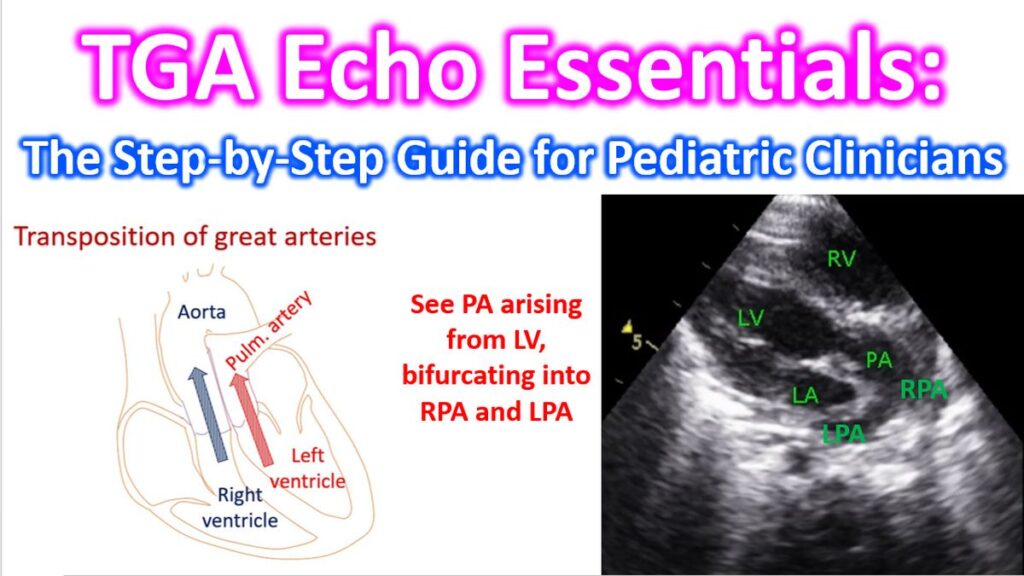

In pediatric cardiology, an echocardiogram is the definitive tool for diagnosing Dextro-Transposition of the Great Arteries (d-TGA). For a clinician, the “essentials” involve more than just seeing the switched vessels; you must meticulously detail the coronary anatomy and mixing sites to guide the surgeon.
1. The Diagnostic “Quick Look”
Before a deep dive, two classic signs confirm d-TGA:
- Subcostal/Apical: The great vessels run parallel rather than crossing at a 90° angle.
- The “Double Circle” (Parasternal Short Axis): In a normal heart, you see a “circle and sausage” (aortic valve in cross-section with the PV or rather the right ventricular outflow tract, wrapping around it). In d-TGA, you see two side-by-side circles because both vessels are viewed in cross-section simultaneously.
2. Step-by-Step Echo Protocol
A complete TGA study follows a “Segmental Approach.”
Step 1: Confirm Ventriculoarterial Discordance
- Subcostal Long Axis Sweep: Identify the morphological Left Ventricle and follow its outflow. In d-TGA, the LV gives rise to the Pulmonary Artery, which is identified by its early bifurcation into the left and right branches.
Step 2: Evaluate Mixing Sites
The baby’s survival depends on shunting.
- Atrial Septum (Subcostal View): Assess the Patent Foramen Ovale (PFO) or ASD. Measure the size and use Color/Spectral Doppler to determine if it is restrictive. A restrictive ASD with severe cyanosis is an indication for an urgent Balloon Atrial Septostomy.
- Ductus Arteriosus (Suprasternal Notch): Check for a PDA. In d-TGA, blood typically flows from the Aorta to the PA (left-to-right) via the ductus to provide oxygenated blood to the lungs.
Step 3: Coronary Artery Mapping (Crucial for Surgery)
This is the most technically demanding part of the exam, typically done in the Parasternal Short Axis (PSAX).
- The surgeon needs to know the origin and course of the coronaries to “re-plant” them during the Arterial Switch Operation.
- Identify the two “facing sinuses” (the sinuses of the aorta that face the PA). Standard anatomy is the Left Main arising from Sinus 1 and the Right Coronary from Sinus 2.
Step 4: Assess for Associated Lesions
- VSD: Look for any ventricular septal defects (found in ~50% of cases).
- LVOT Obstruction: Check for sub-pulmonary stenosis. A high-pressure LV (due to stenosis) can actually be beneficial for “training” the LV before surgery. Even a bit delayed surgery can be useful when there is sub-pulmonary stenosis. Otherwise early surgery within 2-3 weeks of life is needed to prevent regression of LV musculature as it faces the low pressure pulmonary circulation after birth.
3. Summary of Essential Views
| View | Primary Goal |
| Subcostal | Confirm parallel vessels; measure ASD/PFO size. |
| Parasternal Long (PLAX) | Visualize PA arising from LV; assess mitral-pulmonary continuity. |
| Parasternal Short (PSAX) | The “Gold Standard” for coronary origins and vessel relationship. |
| Suprasternal Notch | Assess the Aortic Arch and PDA status. |