



In the world of clinical ECG interpretation, things are rarely as neat as they look in textbooks. Small deviations in morphology or external interference can lead to misdiagnosis, potentially resulting in unnecessary interventions or missed emergencies.
Here is a breakdown of the three most common ECG confusions and how to tell them apart.
1. Pacing Spikes vs. Narrow QRS Complexes
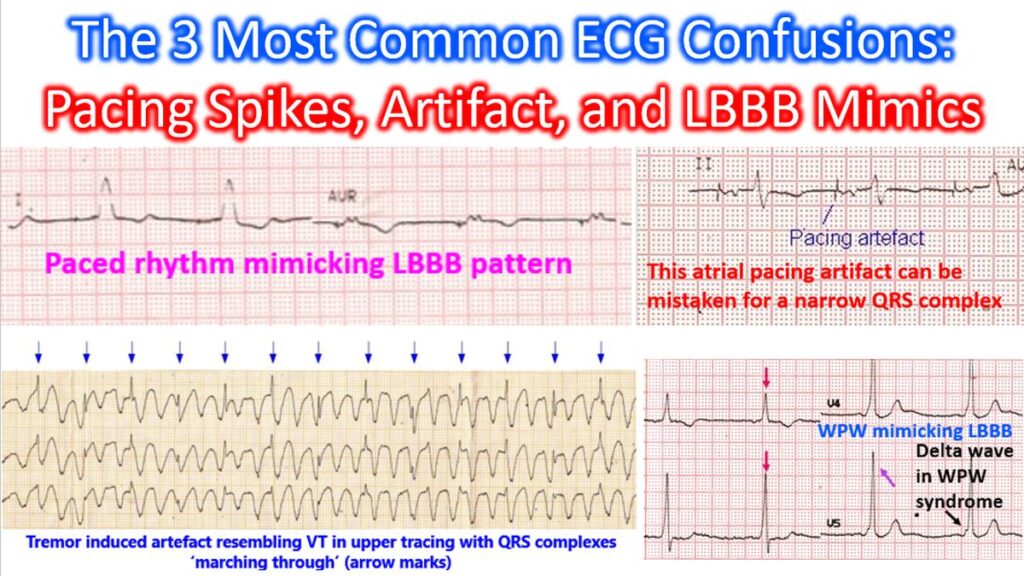
Large unipolar pacemaker spikes can be confused with normal QRS components. Conversely, sharp artifacts can sometimes look like pacing spikes to the untrained eye.
- The Confusion: A ventricular paced rhythm often creates a wide QRS complex that can be mistaken for a spontaneous Bundle Branch Block. If the pacing spikes are “micro-spikes,” you might assume the patient is in a natural wide-complex rhythm.
- The Differentiator: Pacing Spikes: Look for a perfectly vertical, nearly instantaneous line preceding the QRS (ventricular) or P-wave (atrial). They occur at a metronomic, fixed interval.
- Intrinsic QRS: Will have a sloped “R” wave or “Q” wave start, even if it is fast.
- Clinical Tip: If you see a wide QRS with a Left Bundle Branch Block (LBBB) morphology and a vertical line before it, always assume a pacemaker is present until proven otherwise.
2. Artifact vs. Ventricular Tachycardia (VT)
This is perhaps the most dangerous confusion in a hospital setting. “Toothbrush tachycardia” or patient movement can create waveforms that mimic life-threatening arrhythmias.
- The Confusion: Repetitive movement (shivering, brushing teeth, or a loose lead) can create large, wide, rhythmic deflections that look remarkably like Ventricular Tachycardia or Ventricular Fibrillation.
- The Differentiator: The “Marching” R-wave: Look closely at the rhythm during the “arrhythmia.” In many cases of artifact, you can see the normal, underlying QRS complexes “marching through” the noise.
- Lead Check: If the “VT” is only present in Lead II but Lead III looks like a normal Sinus Rhythm, it is almost certainly artifact. True VT will usually be visible across multiple leads.
- Clinical Tip: Always “check the patient, not the monitor.” If the patient is sitting up and talking while the monitor shows V-Fib, check the electrode pads.
3. Left Bundle Branch Block (LBBB) vs. Mimics
LBBB is a classic ECG finding, but several conditions can “mimic” its appearance, leading to incorrect assumptions about heart failure or ischemia.
- The Confusion: Conditions like Ventricular Pacing, Wolff-Parkinson-White (WPW) Syndrome, and Hyperkalemia can all produce wide QRS complexes with a dominant S-wave in lead V1, much like a classic LBBB.
- The Differentiator:
- WPW: Look for the “Delta Wave”—a slurred upstroke at the beginning of the QRS—and a short PR interval (<120 ms).
- Hyperkalemia: Look for the “Sine Wave” appearance. The QRS will be wide, but you will also see peaked T-waves and a flattening or disappearance of P-waves.
- True LBBB: Requires a QRS duration ≥ 120 ms, a broad/notched R-wave in I, aVL, V5, or V6, and the absence of Q-waves in those same leads.