


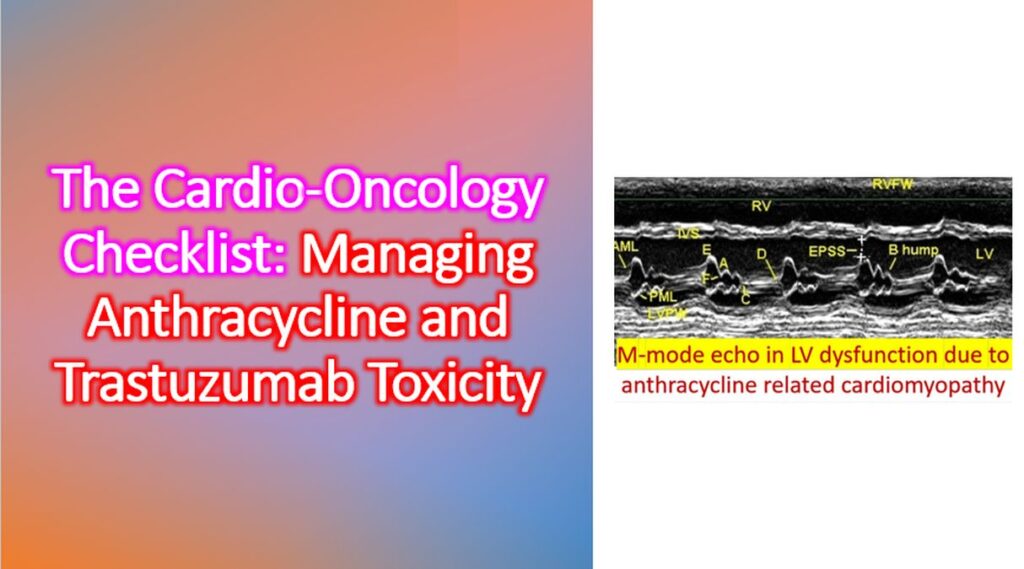

Managing the cardiotoxic effects of Anthracyclines (e.g., Doxorubicin) and Trastuzumab is a cornerstone of modern cardio-oncology. While both can lead to heart failure, their mechanisms and “reversibility” profiles differ significantly. Here is a clinical checklist for managing these toxicities.
1. Baseline Assessment (Pre-Treatment)
Before the first dose, establish a “cardiac starting point” to identify high-risk patients.
- Imaging: Obtain a baseline Echo with Global Longitudinal Strain (GLS). GLS is more sensitive than LVEF for detecting early subclinical injury.
- Biomarkers: Measure baseline Troponin (I or T) and BNP/NT-proBNP.
- Risk Scoring: Calculate risk using the HFA-ICOS assessment tool, accounting for age, prior CVD, hypertension, and previous chest radiation. That is a tool by Cardio‐Oncology Study Group of the Heart Failure Association of the European Society of Cardiology in collaboration with International Cardio‐Oncology Society.
- Optimization: Ensure BP is strictly controlled (target <130/80 mmHg) and start statins if the patient is high-risk.
2. Monitoring During Therapy
The frequency of monitoring depends on the specific drug and the patient’s baseline risk.
Anthracyclines (Type I Toxicity – “Irreversible”)
Mechanism: Myocyte death and replacement fibrosis (often dose-dependent).
- Monitoring: Usually at baseline, at a cumulative dose of 250 mg/m2.
- Red Flags: A drop in LVEF >10 percentage points to a value below 50%, or a relative decrease in GLS >15% from baseline.
Trastuzumab (Type II Toxicity – “Reversible”)
Mechanism: Myocyte “stunning” or dysfunction without structural death.
- Monitoring: Typically every 3 months during the one-year course of therapy.
- Key Distinction: Unlike anthracyclines, trastuzumab toxicity is usually not dose-dependent and often improves after holding the medication.
3. Intervention Thresholds
If toxicity is detected, the “Stop, Start, or Continue” decision is critical.
| Clinical Finding | Action Plan |
| Asymptomatic LVEF 40-49% | Start ACEI/ARB and Beta-blocker (Carvedilol preferred). Discuss “Treat-to-through” with Oncology. |
| Symptomatic Heart Failure | Hold chemotherapy immediately. Initiate standard GDMT (Guideline-Directed Medical Therapy). |
| Δ GLS decline >15% (Normal LVEF) | Consider starting cardioprotective therapy (ACEI/Statins) even if LVEF remains normal. |
| Elevated Troponin | Frequent monitoring; consider initiating ACEI to prevent LVEF decline. |
4. Post-Treatment Surveillance
Cardiotoxicity can manifest years after the conclusion of chemotherapy.
- High-Risk Patients: Echo at 6 months and 12 months post-treatment.
- Long-term: Periodic screening every 1–5 years depending on the cumulative anthracycline dose and clinical status.
- Lifestyle: Emphasize “heart-healthy” habits, as these survivors have a higher lifetime risk of CAD and metabolic syndrome.