


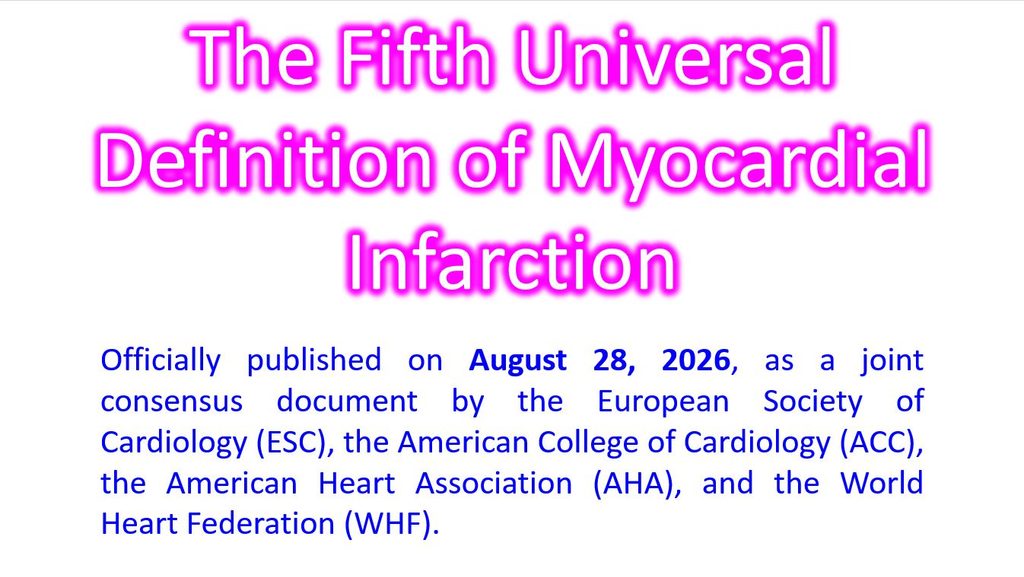

The Fifth Universal Definition of Myocardial Infarction (UDMI) was officially published on August 28, 2026, as a joint consensus document by the European Society of Cardiology (ESC), the American College of Cardiology (ACC), the American Heart Association (AHA), and the World Heart Federation (WHF). Replacing the 2018 Fourth UDMI, this major update aims to simplify the diagnosis of MI in clinical practice, better reflect underlying pathophysiology, and standardize global research terminology.
The New Clinical Classification System
The most significant change in the 2026 update is the abandonment of the traditional numerical typing system (formerly Types 1 through 5). To improve clarity for both clinicians and patients, all MIs are now grouped into three descriptive clinical categories:
| Classification | Pathophysiology & Mechanism | Common Examples |
| Primary MI | Arises spontaneously due to an acute intrinsic event within a coronary artery. | Atherosclerotic plaque rupture, spontaneous coronary artery dissection (SCAD), coronary spasm, or thrombosis. |
| Secondary MI | Triggered by an imbalance in myocardial oxygen supply and demand, rather than an acute coronary plaque event. | Severe hypertension, profound hypotension, or sustained tachyarrhythmia. |
| Procedure-Related MI | Occurs within 30 days of a mechanical cardiac intervention or surgery. | Complications following percutaneous coronary intervention (PCI) or coronary artery bypass grafting (CABG). |
Key Updates & Diagnostic Refinements
Beyond the core classifications, the Fifth UDMI introduces several critical refinements to clinical evaluation:
- Sex-Specific Troponin Thresholds:To combat systematic bias and the historical underdiagnosis of MI in women, the guidelines mandate the use of sex-specific thresholds for high-sensitivity cardiac troponin (hs-cTn) assays.
- MINOCA as a “Working Diagnosis”: The definition of MINOCA has been refined to “myocardial injury with nonobstructive coronary arteries.” The document strongly emphasizes that MINOCA is a working diagnosis—not a final one—and encourages the use of advanced imaging to definitively identify the underlying etiology.
- Accelerated Diagnostic Pathways:The document formally incorporates guidance for rapid triage algorithms using hs-cTn to quickly rule-in or rule-out MI in acute settings.
- Silent and Unrecognized MI:New, highly objective criteria have been established for diagnosing silent or unrecognized infarctions.
- ICD Coding Alignment:For the first time, the clinical definitions have been directly mapped to align seamlessly with the International Classification of Diseases (ICD), improving epidemiological tracking across borders.
References
Journal of the American College of Cardiology (JACC)
Mills, N., Newby, L., Zaman, S., et al. (2026). Fifth Universal Definition of Myocardial Infarction (2026). Journal of the American College of Cardiology. Published online, August 27, 2026.
European Heart Journal (EHJ)
Fifth Universal Definition of Myocardial Infarction (2026). European Heart Journal. Published online, August 28, 2026.