


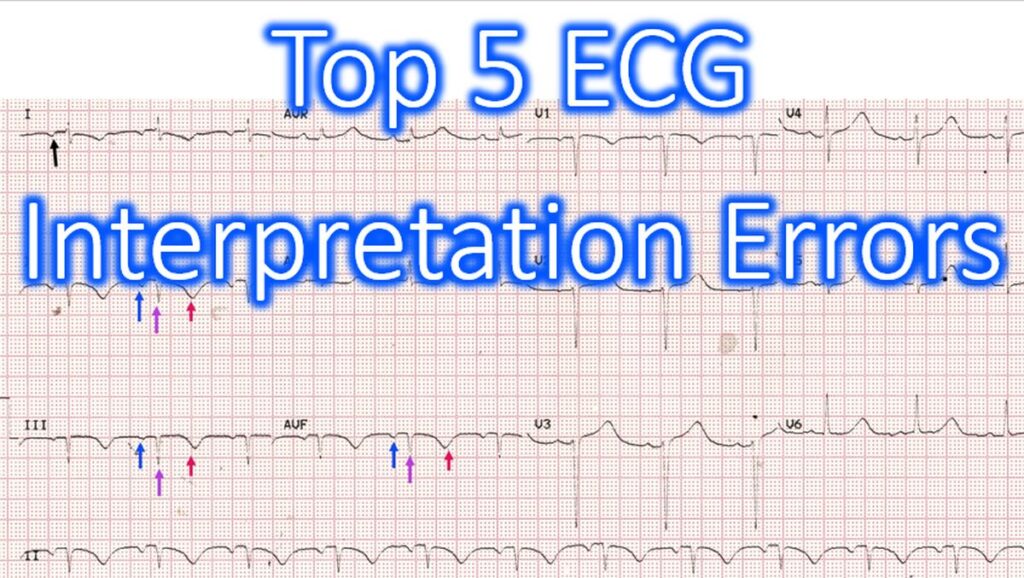

Even for the most seasoned clinicians, ECG interpretation is a blend of pattern recognition and rigorous systematic analysis. Errors usually occur when we rely too heavily on the former and skip the latter.
Here are five of the most common and clinically significant pitfalls in ECG interpretation:
1. Lead Misplacement (The “Technical Mimic”)
The most frequent error isn’t clinical—it’s technical. Reversing the limb leads is a classic trap.
- Swapping the Right Arm (RA) and Left Arm (LA) leads.
- This produces a T-wave inversion in Lead I and an upright P-wave in aVR, which can be mistaken for dextrocardia or a lateral MI.
- Always check Lead I and aVR first. If Lead I is entirely “upside down” (P, QRS, and T waves are all negative) and aVR is positive, suspect lead reversal before pathology.
2. Misidentifying the “J-Point” in STEMI
Distinguishing between a true ST-segment elevation and mimics like Early Repolarization is a high-stakes challenge.
- Measuring the ST elevation too late in the segment or failing to identify the J-point (the junction where the QRS complex ends and the ST segment begins).
- Over-diagnosing STEMI in patients with Benign Early Repolarization (common in young, healthy individuals) or under-diagnosing a “subtle” STEMI because the elevation isn’t massive.
- Use the TP segment (the baseline between the T wave and the next P wave) as your reference point for “zero,” not the PR segment.
3. Overlooking Reciprocal Changes
Focusing only on the leads showing ST elevation can lead to missing the bigger picture.
- Seeing ST elevation in Lead III and assuming it’s a localized issue without looking for ST depression in Lead aVL.
- Reciprocal ST depression is often the earliest sign of an evolving MI. If you see elevation in the inferior leads (II, III, aVF) but don’t see depression in aVL, you should be highly suspicious of Pericarditis rather than a STEMI.
- True STEMIs almost always have a reciprocal “reflection” in the opposite leads.
4. The “S1Q3T3” Myth in Pulmonary Embolism
Medical school often emphasizes the S1Q3T3 pattern for PE, but in practice, it is neither sensitive nor specific.
- Relying on the absence of S1Q3T3 to “rule out” a Pulmonary Embolism.
- Missing a PE because the ECG “looks normal” or only shows Sinus Tachycardia (which is actually the most common finding in PE).
- Look for signs of Right Ventricular Strain, such as T-wave inversions in the right precordial leads (V1–V4) and Lead III, which are far more indicative of a significant PE than the classic S1Q3T3.
5. Confusing SVT with Aberrancy for VT
This is a classic “danger zone” in the Emergency Department.
- Assuming a wide-complex tachycardia is Supraventricular Tachycardia (SVT) with a bundle branch block (aberrancy) because the patient is young or “looks stable.”
- Treating Ventricular Tachycardia (VT) with calcium channel blockers (like Verapamil), which can cause cardiovascular collapse in VT. An exception is Belhassen’s VT which is responsive to verapamil.
- Any wide-complex tachycardia is Ventricular Tachycardia until proven otherwise. If in doubt, treat it as VT.
Pro-Tip: Always compare the current ECG with a previous tracing. A “borderline” finding that hasn’t changed in five years is rarely an acute emergency.