


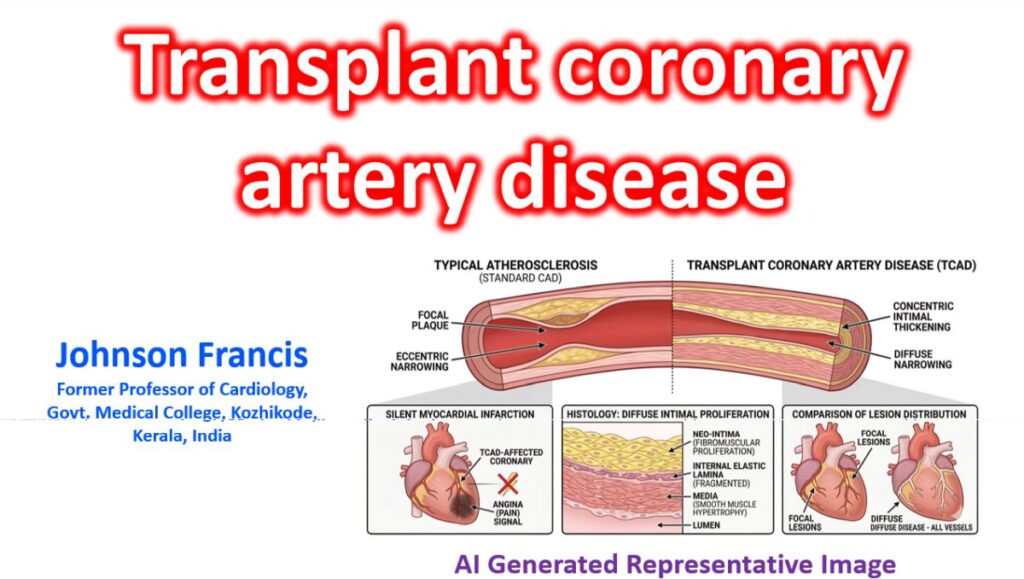

Transplant Coronary Artery Disease (TCAD), also known as Cardiac Allograft Vasculopathy (CAV), is a unique and aggressive form of coronary artery disease that occurs in the transplanted heart. It remains the leading cause of late graft failure and death in heart transplant recipients. Unlike standard coronary artery disease (atherosclerosis), which typically presents as focal, eccentric plaques, TCAD is characterized by concentric, diffuse intimal thickening that often involves the entire length of both epicardial and intramyocardial vessels.
Key Characteristics
- Silent Presentation: Because the transplanted heart is denervated (the nerves were severed during surgery), patients typically do not feel angina (chest pain). Symptoms, if they occur, are often non-specific, such as:
- Unusual fatigue or shortness of breath.
- Nausea or stomach discomfort.
- May present with sudden heart failure, arrhythmias, sudden death or silent myocardial infarction.
- Severe diastolic dysfunction (normal LVEF) can occur due to microvasculopathy or small vessel disease.
- Pathology: It is primarily an immunologic phenomenon. The recipient’s immune system causes chronic injury to the donor heart’s endothelium. This triggers a reparative process where smooth muscle cells and fibroblasts proliferate, gradually narrowing the vessel lumen.
- Risk Factors:
- Immunologic: HLA mismatch, frequency of acute rejection episodes, and Cytomegalovirus (CMV) infection.
- Non-Immunologic: Older donor age, hypertension, diabetes, and hyperlipidemia.
Diagnosis and Grading
Standard coronary angiography often underestimates the severity of TCAD because the narrowing is so uniform.
- Intravascular Ultrasound (IVUS): Considered the most sensitive tool for early detection; it can measure the actual thickness of the arterial wall.
- ISHLT Grading: The International Society for Heart and Lung Transplantation (ISHLT) classifies CAV into four grades based on angiography (description simplified for ease of remembering):
- CAV 0: Not detectable.
- CAV 1 (Mild): Left main <50%, other vessels <70% without allograft dysfunction.
- CAV 2 (Moderate): Left main <50%; single primary vessel or branch ≥70%, without allograft dysfunction.
- CAV 3 (Severe): Left main ≥50%, or two or more primary vessels ≥70% stenosis, or isolated branch stenosis ≥70% in all 3 systems; or previous grades with allograft systolic dysfunction (LVEF ≤45% usually with RWMA) or evidence of significant restrictive physiology.
Management
- Prevention: Aggressive control of lipids (statins are often started early post-transplant regardless of cholesterol levels) and blood pressure.
- Immunosuppression Adjustment: Switching to mammalian target of rapamycin (mTor) inhibitors like Sirolimus or Everolimus have been shown to slow the progression of intimal thickening.
- Revascularization: Stents or bypass surgery are difficult because the disease is so diffuse, but they may be used for focal lesions.
- Retransplantation: This is the only definitive treatment for severe, end-stage TCAD.
Donor-Transmitted Coronary Artery Disease in Heart Transplant Recipients
Heart transplantation donor profile has changed recently due to supply demand mismatch. Older age, more comorbidities, higher frequency of nontraumatic cause of death, hepatitis C positive donors, and donation after circulatory death, have been reported recently. This has led to the possibility of transmission of silent coronary artery disease from the donor. Though consensus documents recommend donor coronary angiography for older donors before procurement, there are practical limitations to this approach. Significant donor-transmitted coronary artery disease has been associated with increased risk of cardiovascular death and Major Adverse Cardiovascular Events (MACE), typically including cardiovascular death, non-fatal myocardial infarction, and non-fatal stroke.