


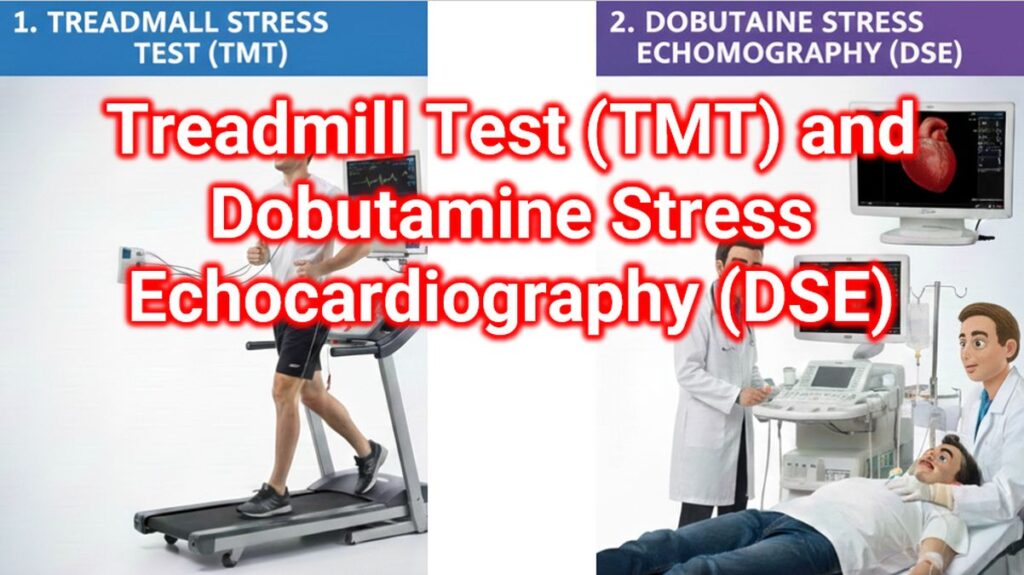

Both the Treadmill Test (TMT) and Dobutamine Stress Echocardiography (DSE) serve to unmask coronary artery disease (CAD) by inducing stress, but they do so through different mechanisms—physical exertion versus pharmacological stimulation.
1. Comparative Overview
| Feature | Treadmill Test (TMT) | Dobutamine Stress Echo (DSE) |
| Primary Mechanism | Physiological exercise (Bruce Protocol) | Pharmacological (Synthetic catecholamine) |
| Best For | Mobile patients with normal baseline ECG | Patients unable to exercise or with abnormal ECG |
| Sensitivity | ~65% – 70% | ~80% – 90% |
| Key Indicator | ST-segment changes on ECG | Regional Wall Motion Abnormalities (RWMA) |
| Cost | Low | Moderate to High |
2. Practical Advice for the Clinician
Treadmill Test (TMT)
- The 85% Rule: A test is technically “non-diagnostic” if the patient fails to reach 85% of their age-predicted maximal heart rate (APMHR: 220 – age: Astrand’s formula [1]), unless ischemic changes appear earlier.
- Post-Exercise Monitoring: Many ischemic events occur during the recovery phase. Monitor the patient for at least 6–9 minutes after they stop walking.
- Blood Pressure (BP) Blunting: A failure of systolic BP to rise (>10 mmHg) or a drop in BP during exercise is a “red flag” for severe multivessel disease or left main stenosis.
Dobutamine Stress Echo (DSE)
- The “Atropine” Push: If the target heart rate isn’t reached with dobutamine alone, adding small doses of Atropine is standard to increase heart rate.
- Side Effects: Warn patients they will feel their heart “thumping.” Minor arrhythmias (PVCs) are common, but sustained VT is a reason to stop immediately.
- Image Quality: Ensure the “endocardial border” is visible in all segments. If not, use a myocardial echo-contrast agent to improve visualization.
3. Common Pitfalls & How to Avoid Them
- Beta-Blocker Interference: Patients on beta-blockers often cannot reach their target heart rate.
- Advice: Ideally, hold beta-blockers for 24–48 hours before the test if the goal is diagnosis (consult the primary physician first).
- False Positive in Woman: TMT has a higher false-positive rate in women due to breast tissue interference or hormonal factors.
- Advice: If a woman has an intermediate pre-test probability, a DSE or Stress MPI (Nuclear) is often more reliable than a standalone TMT.
- LBBB and Paced Rhythms: You cannot interpret ST changes on a TMT if the patient has a Left Bundle Branch Block (LBBB) or a pacemaker.
- Advice: Always check the baseline ECG. If LBBB is present, skip TMT and go straight to DSE or a vasodilator nuclear study.
4. Interpreting Tricky Cases
Mixed Response (The “Biphasic” Response)
This occurs when a heart wall segment initially gets better (increased contractility) at low doses of dobutamine but then worsens (RWMA) at high doses.
- Significance: This is highly specific for viable but hibernating myocardium that is supplied by a stenotic artery. It indicates the muscle is alive and will likely benefit from revascularization (stenting/bypass).
Borderline TMT (The “Equivocal” Result)
If a patient has 0.5 mm to 1.0 mm of ST depression or non-specific T-wave changes:
- Duke Treadmill Score (DTS): Calculate this to clarify risk.
- DTS = Exercise Time (min) – (5 x ST Deviation in mm) – (4 x Angina Index)
- Score ≥ +5: Low risk (annual mortality <1%).
- Score -10 to +4: Intermediate risk; requires further imaging (DSE/Nuclear).
- Score ≤ -11: High risk; consider direct referral for Coronary Angiography.
Angina Index is calculated as follows:
0 Points: No angina (chest pain) occurs during the test.
1 Point: Non-limiting angina occurs (the patient feels discomfort, but it doesn’t stop the test).
2 Points: Limiting angina occurs (the pain is severe enough that the patient must stop exercising)
Isolated Septal Dyssynchrony
In patients with LBBB or post-cardiac surgery, the septum may move “weirdly” even without ischemia.
- Guidance: Look for thickening, not just movement. If the wall thickens during stress, it is likely not ischemic, even if the movement looks paradoxical.
Reference
- Astrand I. Aerobic work capacity in men and women with special reference to age. Acta Physiol Scand Suppl. 1960;49(169):1-92. PMID: 13794892.