


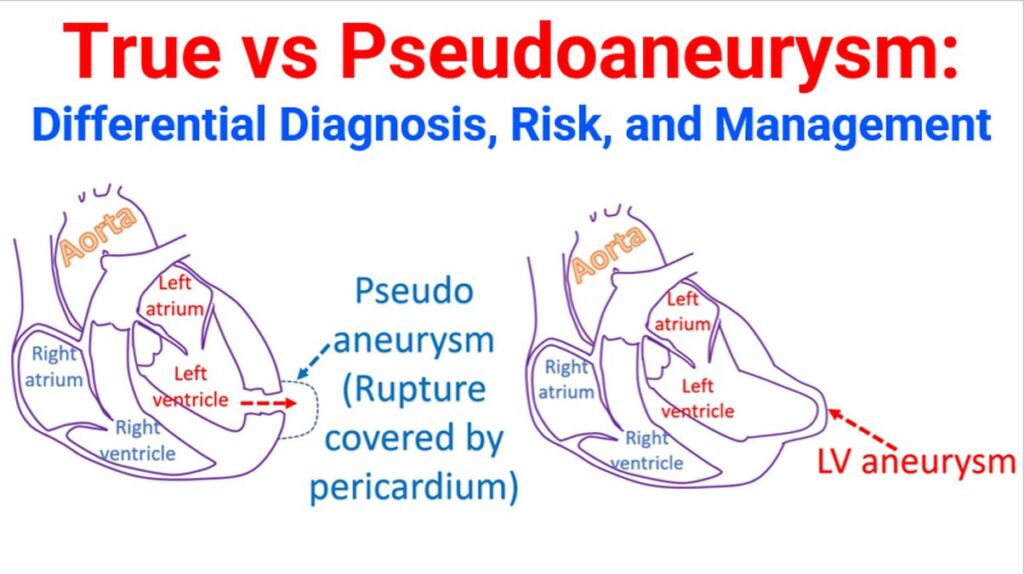

Distinguishing between a true aneurysm and a pseudoaneurysm (false aneurysm) is a critical clinical task because their underlying pathology, risk of rupture, and urgency of treatment differ significantly. True aneurysm of the left ventricle can occur when the scar of myocardial infarction bulges out in chronic stage. Pseudoaneurysm of left ventricle is a rupture contained by pericardium. In case of arteries, true aneurysm occurs by gradual enlargement of a region due to weakening of the vessel wall. Arterial pseudoaneurysm is also a contained rupture. Vascular pseudoaneurysm can also develop after an arterial puncture which has not sealed off well.
1. Difference Between True and Pseudoaneurysm of Arteries
The primary difference lies in the integrity of the arterial wall layers: the tunica intima, media, and adventitia.
| Feature | True Aneurysm | Pseudoaneurysm (False) |
|---|---|---|
| Wall Composition | Involves all three layers of the vessel wall. | Contained hematoma outside the wall; only adventitia or surrounding tissue forms the “sac.” |
| Shape | Usually symmetrical (fusiform) or asymmetrical (saccular). | Typically an eccentric, round bulge with a narrow neck. |
| Imaging (Ultrasound) | Dilated vessel with layered thrombus (optional). | Characteristic “Yin-Yang” sign (turbulent flow) and “to-and-fro” spectral Doppler pattern. |
| Neck Width | Wide neck (neck-to-sac ratio > 0.5–0.9). | Narrow neck (neck-to-sac ratio < 0.5). |
| Common Causes | Atherosclerosis, hypertension, genetic (Marfan). | Trauma, iatrogenic injury (catheterization), infection. |
Similar to this, true aneurysm of the left ventricle has all three layers – endocardium, myocardium and pericardium, while pseudoaneurysm has only a pericardial layer.
2. Risk Profiles
The structural weakness of a pseudoaneurysm makes it inherently more dangerous than a true aneurysm of the same size.
- Rupture Risk: Pseudoaneurysms lack the structural support of the muscular media layer. They have a significantly higher risk of spontaneous rupture. For instance, splenic artery pseudoaneurysms have a rupture risk as high as 37%, with mortality rates approaching 90% if untreated.
- Embolic Risk: Both can harbor thrombus (clots), but the turbulent flow in a pseudoaneurysm often increases the risk of distal embolization, potentially leading to limb ischemia or organ damage.
- Infection: Pseudoaneurysms caused by IV drug use or sepsis (mycotic pseudoaneurysms) can lead to rapid tissue destruction and systemic sepsis.
Profile is similar for the left ventricular pseudoaneurysm as well.
3. Management Strategies
Management depends on the location and the stability of the lesion.
For Pseudoaneurysms (Higher Urgency)
- Conservative: Only for very small (< 2 cm), asymptomatic femoral pseudoaneurysms. They may spontaneously thrombose (clot off).
- Ultrasound-Guided Thrombin Injection: The gold standard for accessible peripheral pseudoaneurysms (like the femoral artery). A clotting agent is injected directly into the sac to seal it.
- Ultrasound-Guided Compression: Manual pressure applied to the “neck” to stop flow until it clots; however, this is painful and less effective than thrombin.
- Endovascular/Surgical Repair: Essential for visceral or aortic pseudoaneurysms. Options include coiling, stent-grafts, or open surgical ligation.
Urgent surgical repair is needed for left ventricular pseudoaneurysm as there is a high risk of secondary rupture.
For True Aneurysms (Often Elective)
- Medical Management: Focuses on blood pressure control (e.g., Beta-blockers) and serial imaging “watchful waiting.”
- Surgical Thresholds: Surgery is typically elective and based on size (e.g., > 5.5 cm for abdominal aortic aneurysms or > 2 cm for visceral aneurysms).
In case of left ventricular true aneurysm, there is additional risk of heart failure and arrhythmias due to reentrant circuit around the scar. Several methods of aneurysm repair have been described, though effectiveness varies due to significant coronary artery disease associated the left ventricular aneurysms.