


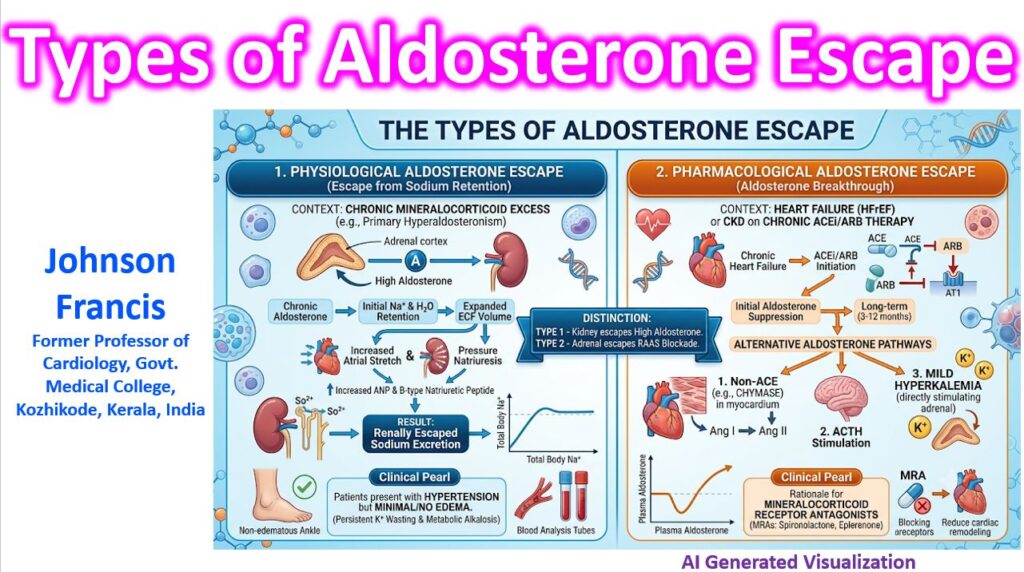

In clinical medicine and physiology, the term “aldosterone escape” is notoriously confusing because it refers to two entirely distinct phenomena depending on the context. To clarify the pathophysiology, it is divided into Physiological Aldosterone Escape (escape from sodium retention) and Pharmacological Aldosterone Escape (also called Aldosterone Breakthrough).
1. Physiological Aldosterone Escape (Escape from Sodium Retention)
This refers to the intrinsic renal mechanism that prevents endless fluid accumulation in states of chronic mineralocorticoid excess, such as Primary Hyperaldosteronism (Conn’s Syndrome).
- The Mechanism: Continuous exposure to high aldosterone initially causes sodium and water retention, expanding the extracellular fluid volume. This hypervolemia stretches the cardiac atria, triggering the release of Atrial Natriuretic Peptide (ANP). Simultaneously, the increased systemic blood pressure induces pressure natriuresis.
- The “Escape”: These compensatory mechanisms override aldosterone’s effect on the distal tubule and collecting duct, leading to increased sodium excretion. The kidneys “escape” the sodium-retaining effects of aldosterone, establishing a new equilibrium at a higher total body volume.
- Clinical Pearl: This is why patients with primary hyperaldosteronism typically present with hypertension but do not develop severe peripheral edema.
- The Catch: While the body escapes sodium retention, there is no escape from potassium or hydrogen ion wasting. The increased distal delivery of sodium (due to proximal and Loop of Henle adjustments) actually accelerates potassium secretion, leading to the hallmark persistent hypokalemia and metabolic alkalosis.
2. Pharmacological Aldosterone Escape (Aldosterone Breakthrough)
In cardiology, this is the much more commonly discussed “escape.” It refers to the failure of ACE inhibitors (ACEi) or Angiotensin Receptor Blockers (ARBs) to maintain long-term suppression of aldosterone production in patients with heart failure (HFrEF) or chronic kidney disease.
- The Mechanism: When a patient is started on an ACEi or ARB, plasma aldosterone levels initially plummet because the primary stimulus, Angiotensin II, is blocked. However, after several months of therapy, aldosterone levels rebound to baseline—or even exceed it—in up to 30% to 40% of patients.
- Why it happens: The zona glomerulosa finds alternative pathways to synthesize aldosterone.
- Alternative Ang II synthesis: Non-ACE pathways, particularly chymase enzymes located in the myocardium and vascular tissue, continue to convert Angiotensin I to Angiotensin II.
- Direct stimulation: Mild increases in serum potassium (often a side effect of the ACEi/ARB itself) directly stimulate the adrenal cortex to produce aldosterone.
- ACTH: Can independently stimulate aldosterone secretion, bypassing the RAAS axis entirely.
- Clinical Pearl: This phenomenon is the foundational pathophysiological rationale for why Mineralocorticoid Receptor Antagonists (MRAs) like spironolactone and eplerenone are mandatory pillars of Guideline-Directed Medical Therapy (GDMT) in HFrEF. Blocking the receptor is the only way to reliably mitigate the fibrotic and arrhythmogenic effects of the rebounding aldosterone.
Summary Distinction:
- Type 1 (Physiological): The kidney escaping the effects of high aldosterone.
- Type 2 (Pharmacological): The adrenal gland escaping the effects of RAAS blockade.