


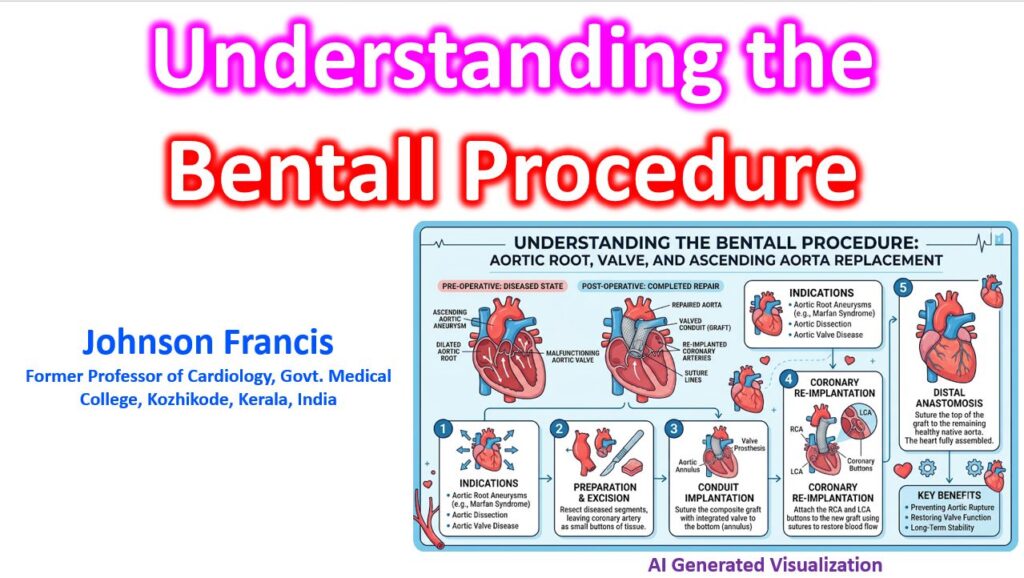

The Bentall procedure is the gold-standard surgical intervention for composite replacement of the aortic valve, aortic root, and ascending aorta, coupled with the re-implantation of the coronary arteries into the graft.
Clinical Indications
This procedure is primarily indicated for pathologies that involve both the aortic valve and the ascending aorta, often where valve-sparing root replacement (VSRR) is not viable. Common indications include:
- Aortic Root Aneurysms: Often associated with connective tissue disorders like Marfan syndrome, Loeys-Dietz syndrome, or Ehlers-Danlos syndrome.
- Aortic Dissection: Specifically acute Type A dissections that compromise the aortic root and valve commissures.
- Annuloaortic Ectasia: Severe dilation of the proximal aorta and aortic annulus, typically presenting with severe aortic regurgitation.
Surgical Nuances: The Modified “Button” Technique
While the original 1968 Bentall procedure involved wrapping the native aorta around the graft, the modern standard is the modified Bentall (Button technique).
- Excision: The diseased aortic valve and aneurysmal aortic tissue are excised.
- Coronary Mobilization: The left and right coronary ostia are dissected out as distinct “buttons” of surrounding aortic wall tissue.
- Graft Placement: A composite valved conduit (a synthetic Dacron tube with a pre-sewn prosthetic valve) is sutured to the aortic annulus.
- Re-implantation: Holes are cauterized into the Dacron graft, and the coronary buttons are anastomosed directly to the conduit.
- Distal Anastomosis: The distal end of the graft is sutured to the healthy native ascending aorta (or aortic arch, if required).
Valve Selection and Lifetime Management
Selecting the valved conduit is arguably the most critical decision in the pre-operative phase. Choosing between a mechanical and a bioprosthetic valve for the composite graft requires a comprehensive, lifetime management strategy rather than a simple binary choice based on age.
- Mechanical Conduits: Offer excellent durability and are typically preferred for younger patients (often the demographic with heritable aortopathies), but require lifelong, stringent anticoagulation (Warfarin) and carry a persistent risk of bleeding and thromboembolism.
- Biological Conduits: Eliminate the need for lifelong anticoagulation, but the risk of structural valve deterioration is inevitable. Re-intervention on a failing bioprosthetic Bentall graft is technically demanding, though Valve-in-Valve (ViV) TAVR within a surgical conduit is increasingly becoming a viable part of the long-term management algorithm for these patients.