


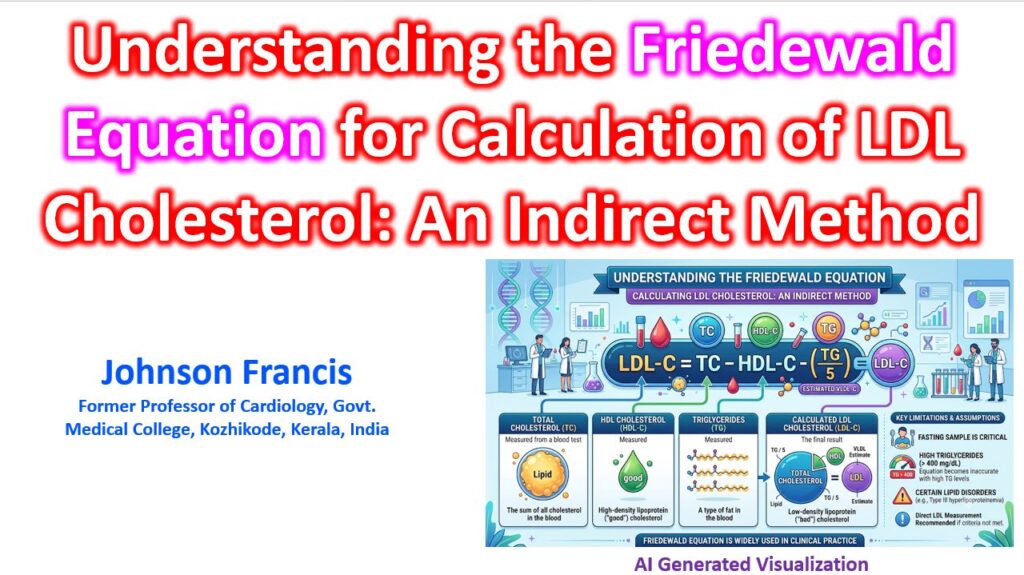

The Friedewald equation is a long-standing clinical formula used to estimate Low-Density Lipoprotein (LDL) cholesterol in the blood, eliminating the need for a direct (and historically more expensive) ultracentrifugation measurement.
The Formula
When lipid panel values are measured in mg/dL:
LDL = TC – HDL – (TG/5)
When lipid panel values are measured in mmol/L:
LDL = TC – HDL – (TG/2.2)
- TC: Total Cholesterol
- HDL: High-Density Lipoprotein
- TG: Triglycerides
- Note: The TG/5 (or TG/2.2) component is an estimate of Very Low-Density Lipoprotein (VLDL) cholesterol.
Clinical Limitations
While highly practical for routine lipid management, the Friedewald equation has well-documented limitations in specific clinical scenarios:
- Hypertriglyceridemia: The formula strictly assumes a fixed ratio of triglycerides to VLDL cholesterol. If a patient’s triglycerides exceed 400 mg/dL (4.5 mmol/L), this assumption fails, and the equation becomes wildly inaccurate (often underestimating LDL).
- Extremely Low LDL: In patients with very low LDL-C levels (e.g., < 70 mg/dL) due to aggressive statin therapy or PCSK9 inhibitors, the Friedewald equation tends to underestimate the true LDL-C concentration.
For patients falling into these categories, alternative methods such as direct LDL measurement, the Martin-Hopkins equation (which uses an adjustable factor based on patient-specific TG and non-HDL levels), or the Sampson equation provide superior clinical accuracy.