


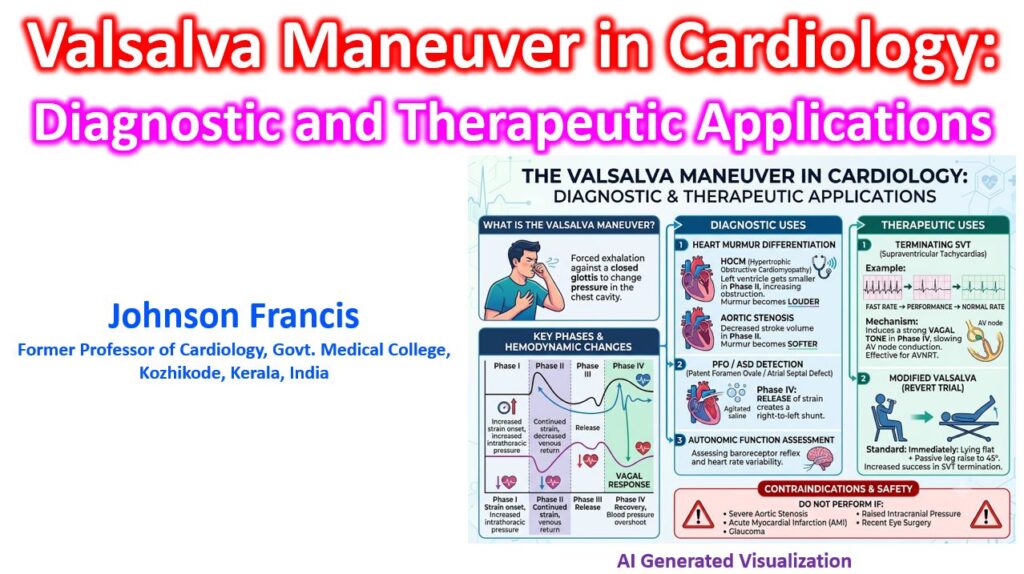

The Valsalva maneuver remains one of the most elegant, non-invasive bedside tools in our clinical arsenal. Because it produces a predictable, four-phase sequence of hemodynamic changes, it allows us to dynamically alter preload and afterload to clarify diagnoses and terminate arrhythmias without pharmacological intervention.
Here is a breakdown of the maneuver’s underlying hemodynamics, diagnostic applications, and therapeutic utility.
The Hemodynamic Foundation: The Four Phases
To leverage the maneuver clinically, we rely on the physiological changes occurring across its four distinct phases (typically a 10–15 second expiration against a closed glottis, ideally generating 40 mmHg of pressure).
- Phase I (Onset of Strain): The sudden increase in intrathoracic pressure mechanically compresses the aorta. This causes a transient increase in blood pressure and a brief, compensatory vagal decrease in heart rate.
- Phase II (Continued Strain): Elevated intrathoracic pressure impedes systemic venous return. Preload drops significantly, leading to a fall in cardiac output and pulse pressure. The baroreceptors sense this drop, triggering a sympathetic surge — causing reflex tachycardia and increased peripheral vascular resistance.
- Phase III (Release): Intrathoracic pressure suddenly normalizes. The pulmonary vascular bed expands, temporarily pooling blood and briefly depriving the left atrium of volume. This causes a transient, sudden drop in blood pressure and a further spike in heart rate.
- Phase IV (Recovery): Normal venous return rushes back into the right, then left heart. Because peripheral vascular resistance is still elevated from Phase II’s sympathetic surge, stroke volume normalizes against high afterload, causing a blood pressure overshoot. This overshoot triggers robust baroreceptor firing, resulting in reflex bradycardia (the phase most responsible for arrhythmia termination).
Diagnostic Uses: The Bedside Stress Test
By dynamically altering ventricular filling (preload) and systemic resistance, Valsalva is highly effective at differentiating structurally complex murmurs and assessing filling pressures.
1. Differentiating Systolic Murmurs
During Phase II, the profound drop in venous return causes the left ventricular end-diastolic volume to shrink. As a general rule, almost all murmurs become softer during the Valsalva strain because there is less blood flowing across the valves. There are two critical exceptions:
| Condition | Response to Valsalva (Phase II) | Mechanism |
| Hypertrophic Obstructive Cardiomyopathy (HOCM) | Murmur becomes LOUDER | Decreased LV cavity size brings the anterior mitral leaflet and septal wall closer together, exacerbating the LVOT obstruction. |
| Mitral Valve Prolapse (MVP) | Click occurs EARLIER; Murmur is LONGER/LOUDER | Reduced LV volume causes the redundant chordae/leaflets to prolapse earlier in systole. |
| Aortic Stenosis (for contrast) | Murmur becomes SOFTER | Decreased stroke volume means less flow across the stenotic valve. (Helps distinguish AS from HOCM). |
2. Assessing Left-Sided Filling Pressures (Heart Failure)
In normal physiology, the blood pressure drops during Phase II. However, in patients with heart failure and significantly elevated left ventricular end-diastolic pressure (LVEDP > 15 mmHg), you will see a “Square Wave” response.
Because these patients are heavily volume-overloaded, the transient drop in venous return during Phase II does not actually deplete their pulmonary venous reservoir. As a result, stroke volume and blood pressure do not fall, and the reflex tachycardia and Phase IV overshoot never occur.
Therapeutic Uses: Rhythm Control
1. Terminating Supraventricular Tachycardias (SVT)
Valsalva is a first-line, Class I recommendation for terminating hemodynamically stable AV nodal reentrant tachycardia (AVNRT) and atrioventricular reentrant tachycardia (AVRT). The sudden spikes in vagal tone—briefly in Phase I, but profoundly during the blood pressure overshoot in Phase IV—increase the refractory period of the AV node, breaking the reentrant circuit.
2. The “Modified” Valsalva Maneuver (REVERT Trial)
Standard Valsalva in a semi-recumbent position historically yielded a relatively low conversion rate for SVT (around 17%). The REVERT trial (2015) revolutionized this approach:
- The patient performs the standard strain (40 mmHg for 15 seconds) in a semi-recumbent position.
- Immediately upon release, the patient is laid flat, and their legs are passively elevated to 45 degrees for 15 seconds.
Why it works: The passive leg raise dramatically increases venous return right at the onset of Phase IV. This magnifies the Phase IV blood pressure overshoot, leading to a much stronger baroreceptor reflex and a massive vagal discharge. This simple postural modification improves SVT termination success rates to over 43%, significantly reducing the need for adenosine.