


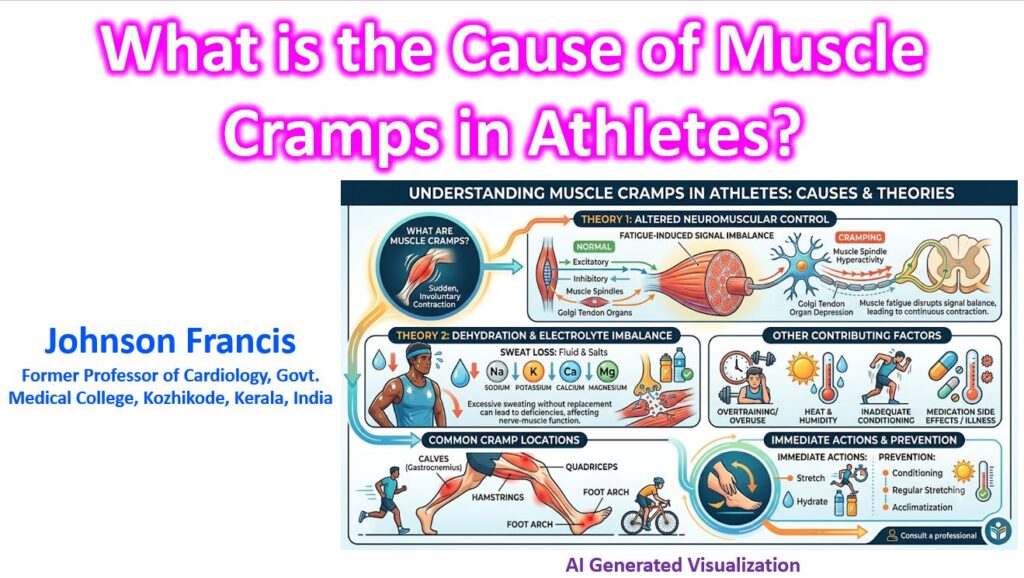
The cause of exercise-associated muscle cramps (EAMC) has been heavily debated in sports medicine. While traditionally blamed on dehydration or a lack of electrolytes, modern scientific consensus points to a localized neurological misfire caused by muscle fatigue. Here is a breakdown of the two prevailing theories.
1. Altered Neuromuscular Control (The Current Consensus)
Today, the strongest evidence supports EAMC as a localized neuromuscular issue rather than a systemic nutritional one. When a muscle becomes severely fatigued from repetitive, high-intensity use, it disrupts the normal communication loop between the muscle and the spinal cord.
- The Receptors: Muscles rely on two key proprioceptors to regulate movement: muscle spindles (which detect stretch and trigger the muscle to contract) and Golgi tendon organs (which detect tension and trigger the muscle to relax).
- The Imbalance: Fatigue causes the muscle spindles to become hyperactive, firing too many excitatory signals. Simultaneously, fatigue depresses the Golgi tendon organs, weakening the muscle’s inhibitory “off” switch.
- The Result: This sudden imbalance overloads the alpha motor neurons in the spinal cord, causing them to fire continuously. This locks the muscle into a painful, sustained, involuntary contraction.
This theory effectively explains why cramps are usually isolated to the specific muscles being overworked, why they frequently occur in cool climates, and why passive stretching provides immediate relief (stretching physically pulls on the Golgi tendon organ, forcibly re-engaging its inhibitory signal).
2. Dehydration and Electrolyte Depletion (The Traditional Theory)
This older theory suggests that EAMC is a systemic issue caused by sweating out too much water and sodium during strenuous exercise.
- The Mechanism: As the body loses sodium and water, the fluid compartment surrounding the muscle cells shrinks. This fluid shift is thought to mechanically deform the nerve endings at the neuromuscular junction, making them hyper-excitable and prone to spontaneous firing.
- The Flaws: While severe fluid and salt loss might contribute to body-wide cramping in extreme environments, it fails to explain the majority of cramps in athletes. For instance, blood tests of cramping endurance runners frequently show that their hydration and electrolyte levels are identical to runners who are not cramping. It also fails to explain why cramps target a single active muscle group rather than occurring systematically across the whole body.
Key insight: Extreme electrolyte loss might lower the overall threshold for cramping in some individuals, but localized muscle fatigue and the resulting neurological imbalance are the primary drivers of EAMC.
Here are the key scientific papers that review the pathophysiology and leading theories behind exercise-associated muscle cramps (EAMC), which support the mechanisms discussed previously (Miller et al., 2021). The literature increasingly favors the “altered neuromuscular control” theory as the primary mechanism, while noting that extreme dehydration and electrolyte depletion might act as contributing factors in some instances (Jahic & Begic, 2018; Maughan & Shirreffs, 2019; Troyer et al., 2020).
References
Jahic, D., & Begic, E. (2018). Exercise-Associated Muscle Cramp-Doubts About the Cause. Materia Socio Medica, 30, 67-69. https://doi.org/10.5455/msm.2018.30.67-69
Maughan, R. J., & Shirreffs, S. M. (2019). Muscle Cramping During Exercise: Causes, Solutions, and Questions Remaining. Sports Medicine, 49, 115-124. https://doi.org/10.1007/s40279-019-01162-1
Miller, K. C., McDermott, B. P., Yeargin, S. W., Fiol, A., & Schwellnus, M. P. (2021). An Evidence-Based Review of the Pathophysiology, Treatment, and Prevention of Exercise-Associated Muscle Cramps. Journal of Athletic Training, 57, 5-15. https://doi.org/10.4085/1062-6050-0696.20
Troyer, W., Render, A., & Jayanthi, N. (2020). Exercise-Associated Muscle Cramps in the Tennis Player. Current Reviews in Musculoskeletal Medicine, 13, 612-621. https://doi.org/10.1007/s12178-020-09662-8