


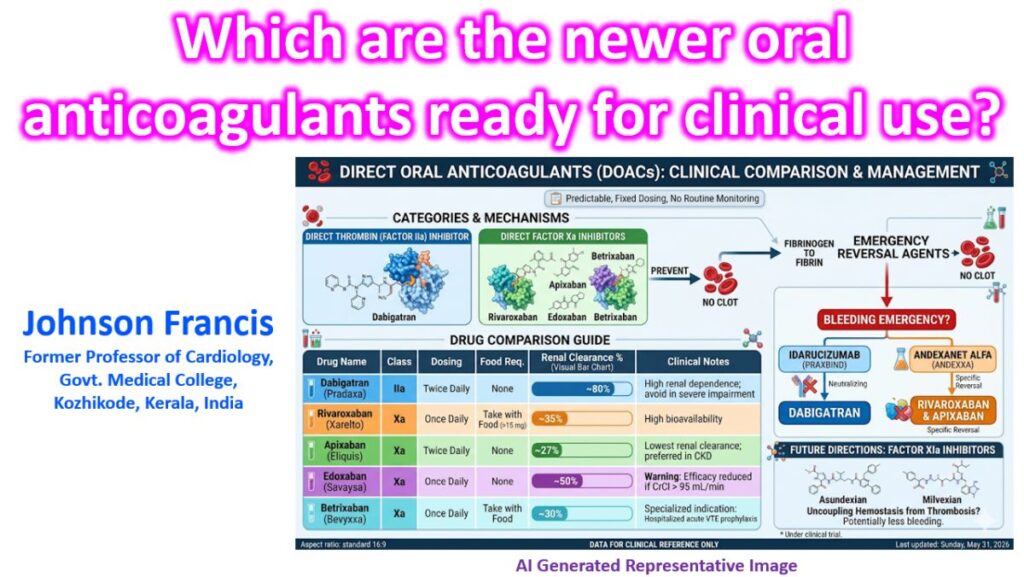

The newer generation of anticoagulants—commonly referred to as Direct Oral Anticoagulants (DOACs) or Non-Vitamin K Antagonist Oral Anticoagulants (NOACs)—have largely replaced Vitamin K antagonists like warfarin for most indications. This is due to their predictable pharmacokinetics, fixed dosing, and the fact that they do not require routine coagulation monitoring.
They are classified into two main categories based on their mechanism of action:
1. Direct Thrombin (Factor IIa) Inhibitors
These agents bind directly to thrombin (Factor IIa), blocking its interaction with substrates and preventing the conversion of fibrinogen to fibrin.
- Dabigatran: The only approved agent in this class. Because it has a high rate of renal clearance (approximately 80%), it requires careful dose adjustment and must be avoided in patients with severe renal impairment.
2. Direct Factor Xa Inhibitors
These selectively inhibit Factor Xa, the catalyst that sits at the convergence of the intrinsic and extrinsic coagulation pathways, preventing the generation of thrombin.
- Rivaroxaban: Typically dosed once daily for most indications. It has high bioavailability, but higher doses (15 mg and 20 mg) must be taken with food to ensure adequate absorption.
- Apixaban: Dosed twice daily. It has the lowest renal clearance (approximately 27%) among the DOACs, making it the preferred choice for patients with chronic kidney disease (CKD) or end-stage renal disease.
- Edoxaban: Dosed once daily. Uniquely, its efficacy is reduced in patients with supranormal renal function (creatinine clearance > 95 mL/min), which carries a black box warning for its use in atrial fibrillation.
- The FDA warning is based on the results of the phase 3 ENGAGE AF-TIMI 48 clinical trial. The study revealed that patients with nonvalvular atrial fibrillation and a CrCl > 95 mL/min had an increased rate of ischemic stroke when treated with 60 mg of edoxaban daily compared to those treated with warfarin. In these specific patients, clinical guidelines and the FDA mandate that an alternative anticoagulant should be used.
Reversal Agents
A major initial limitation of DOACs was the lack of antidotes for severe bleeding or emergency surgery. Specific reversal agents are now clinically available for the most common drugs:
- Idarucizumab: A monoclonal antibody fragment that specifically binds and neutralizes dabigatran within minutes.
- Andexanet alfa: A recombinant modified factor Xa decoy protein that binds and neutralizes the activity of rivaroxaban and apixaban.
On the Horizon: Factor XIa Inhibitors
While not yet globally approved for broad clinical use, Factor XIa inhibitors (such as asundexian and milvexian) represent the next frontier in anticoagulation. Their mechanism aims to “uncouple” hemostasis from thrombosis—potentially preventing pathologic clots (like secondary strokes) without increasing the risk of major bleeding. Asundexian recently received FDA Priority Review in May 2026 for secondary stroke prevention following the phase 3 OCEANIC-STROKE trial. The study demonstrated that adding 50 mg of asundexian daily to standard antiplatelet therapy significantly reduced the risk of recurrent ischemic strokes compared to placebo, notably without increasing the rate of major bleeding, among patients with noncardioembolic ischemic stroke or high-risk TIA.