HADES-L: The Latest OSCAR (Amateur Radio Satellite)
HADES-L—officially designated Spain-OSCAR 132 (SO-132) by AMSAT in November 2026 alongside companion satellite UNNE-1B (SO-131)—is an experimental PocketQube amateur radio satellite developed by AMSAT-EA and Hydra Space in Spain. Unlike conventional V/U FM amateur satellites, SO-132 features an uncommon 10-meter (29 MHz) HF uplink paired with a 70-centimeter (UHF) downlink, enabling both cross-band voice contacts and multi-signal HF digital mode experiments through Low Earth Orbit.
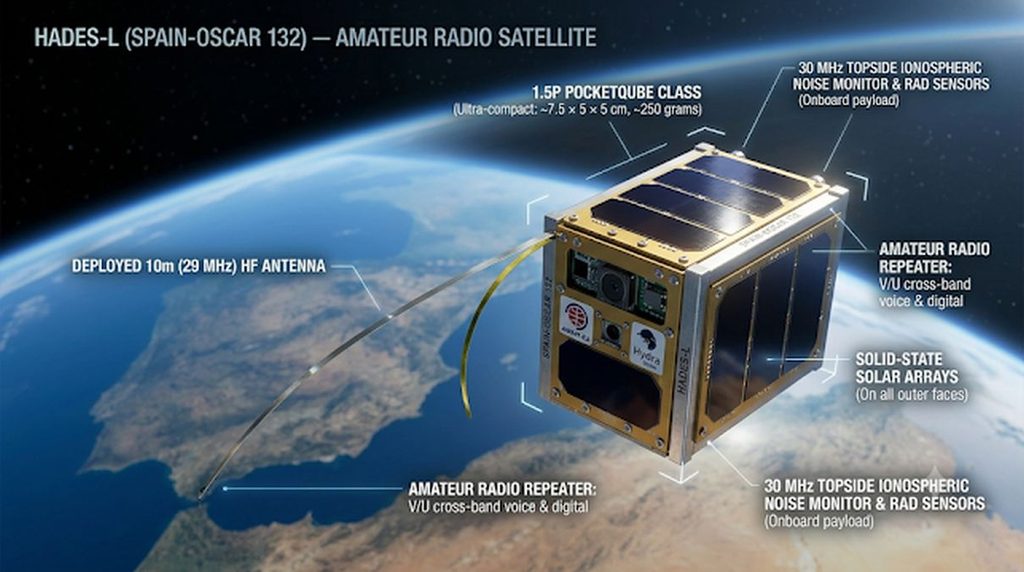
1. Mission & Orbital Parameters
HADES-L launched on
October 1, 2026 (18:32 UTC) aboard a
SpaceX Falcon 9 on the
Transporter-18 rideshare mission from Vandenberg Space Force Base (SLC-4E), California. Carried inside UARX Space’s
OSSIE-D orbital transfer vehicle (OTV) with UNNE-1B, it was deployed into independent orbit on
October 3, 2026 (16:31 UTC).
| Parameter | Specification |
| OSCAR Designation | Spain-OSCAR 132 (SO-132) |
| NORAD Catalog ID | 101102 (initial temporary ID 98206) |
| COSPAR / Int’l ID | 2026-227CQ |
| Form Factor | PocketQube (1.5P–2P class) |
| Orbit Type | Sun-Synchronous Low Earth Orbit (SSO) |
| Altitude / Inclination | ~508–512 km (~510 km avg.) / 97.4° |
| Orbital Period / Speed | ~94.8–95 minutes / 7.61 km/s |
2. Frequencies & Mode A/U Transponder
SO-132 operates an IARU-coordinated
Mode A/U (10m uplink / 70cm downlink) cross-band transponder:
| Link | Frequency | Band | Modulation & Bandwidth |
| Uplink (Ground → Sat) | 29.472 MHz | 10 m (HF) | USB (3 kHz passband; no access tone required) |
| Downlink (Sat → Ground) | 436.665 MHz | 70 cm (UHF) | FM Voice (relayed audio & CODEC2 beacon) + 800 bps FSK telemetry |
(Note: Early IARU coordination paperwork contained a typographical error listing 28.472 MHz, which AMSAT-EA corrected to 29.472 MHz prior to launch.)
Transponder Operating Rules
- Duty Cycle & RF Power: Because of miniature solar-array power limits, the repeater operates on a scheduled duty cycle—active for 4 minutes out of every 12 minutes. Depending on battery state of charge, the UHF downlink automatically switches between +13 dBm (~20 mW) and +20 dBm (~100 mW).
- Uplink Drive: AMSAT-EA recommends 25 W on 29.472 MHz USB. While the spacecraft’s 10m receiver includes Automatic Gain Control (AGC), operators should avoid overdriving the uplink to prevent audio distortion.
- Voice & Digital Scheduling: The 3 kHz USB passband accommodates either one USB voice QSO at a time or multiple simultaneous CW, FT4, or FT8 signals. The first Wednesday of each month is reserved exclusively for digital mode experiments.
3. Onboard Experiments & Payloads
Beyond acting as an amateur repeater, SO-132 carries five engineering and scientific payloads:
- Electrically Short 10m Antenna Evaluation: Characterizes the in-orbit receiving efficiency of a physically compact antenna at 29.472 MHz.
- CODEC2 Digital Voice Beacon: Downlinks low-bitrate digital voice beacons encoded with CODEC2 using convolutional forward error correction (K = 7, code rate R = 1/2).
- 30 MHz Topside Ionospheric Noise Monitor: Measures background RF noise power at 30 MHz in the upper ionosphere to validate HF-to-LEO link budgets, logging battery voltage, internal/external temperatures, signal-to-noise levels, and uptime during the final orbit of each day.
- LEO Radiation Sensor: Measures electron, photon, and X-ray flux in Low Earth Orbit for spacecraft material comparison.
- Autonomous Energy Management: Validates onboard power-scheduling algorithms balancing repeater duty cycles against scientific measurements.
4. Practical Station Notes
- Asymmetric Doppler Shift: Because the uplink is on 10 meters and the downlink is on 70 centimeters, Doppler shift is heavily asymmetric. On 436.665 MHz, the downlink shifts by roughly ± 10 kHz across an overhead pass (requiring receiver tracking from ~436.675 MHz down to ~436.655 MHz), whereas the 29.472 MHz uplink shifts by less than ± 750 Hz, easily accommodated within a standard 2.4–3 kHz SSB filter.
- Telemetry Decoding: The 800 bps FSK telemetry stream on 436.665 MHz can be decoded using UZ7HO SoundModem for HADES-L (via soundcard audio) or N6RFM’s HADESx Generic Decoder (which processes SDR IQ or WAV recordings directly), both hosted on AMSAT-EA’s project portal.