What is a Log-periodic Antenna in Amateur Radio?
What is a Log-periodic Antenna in Amateur Radio?
Log-periodic antennas are typically used for VHF and UHF frequencies. There are radio amateurs who have built it for 20-6m as well! It is also known as a log-periodic array and is a multi-element directional antenna designed to operate over a wide band of frequencies. Log-periodic dipole array is a common type of log-periodic antenna which consists of several half-wave dipole driven elements. They are of gradually increasing length and mounted close together in a line and connected in parallel to the feedline with alternating phase. Thus it simulates a series of Yagi-Uda antennas tuned to different frequencies, connected together. But the Yagi-Uda antenna has only a single driven element while all elements in a log-periodic dipole array are driven elements. Other elements in a Yagi-Uda antenna are parasitic, with one reflector and several directors. While Yag-Uda antenna has a very narrow bandwidth, log-periodic dipole array has a large bandwidth.
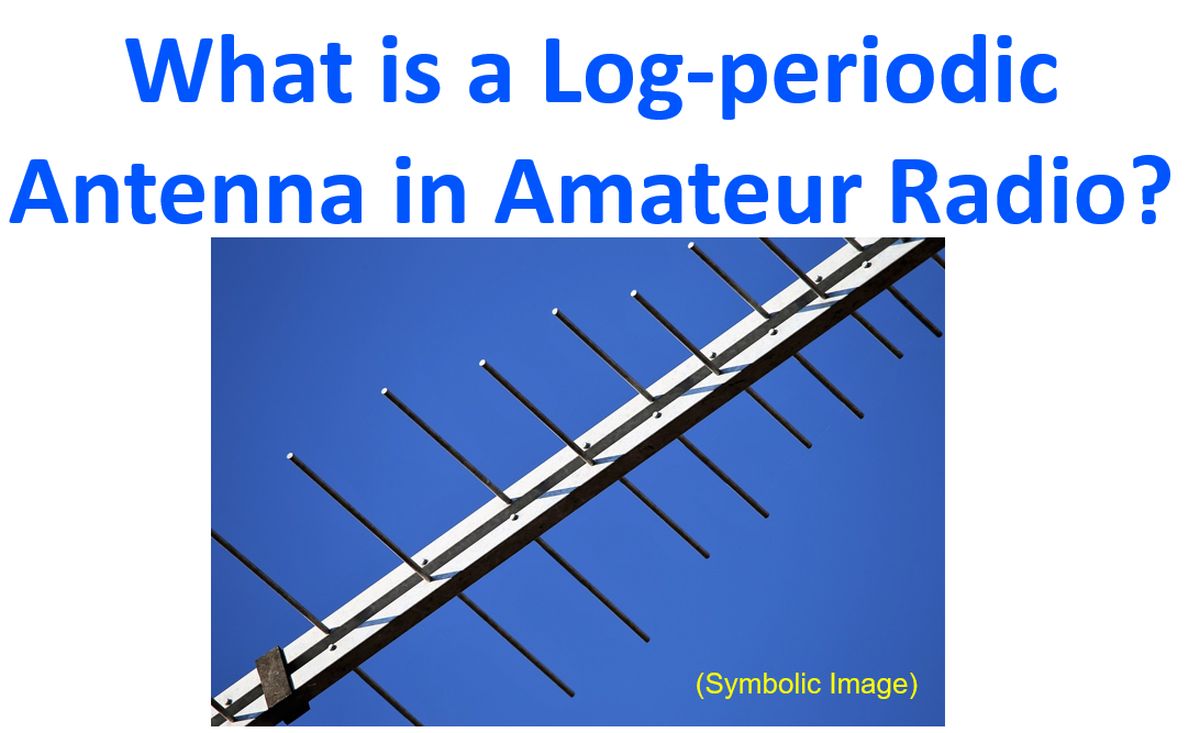
While adding elements to a Yagi-Uda antenna increases its directivity and gain, adding elements to a log-periodic dipole array increases its frequency response or bandwidth. Log-periodic antenna has the same radiation resistance, SWR, gain and front-to-back ratio across the frequency range for which it is meant. Elements of a log-periodic dipole array are pairs of metal rods fixed on a boom. Spacing of the elements follow a logarithmic function of the frequency. Length of successive elements and spacing between them gradually decrease along the boom.
Log periodic dipole arrays were initially designed for TV antennas which require a wide bandwidth for multiple TV channels. Log periodic antennas are somewhat like fan dipole antennas in which antennas for multiple bands are connected to a single feed point. Only the relevant dipole radiates significantly while the rest of the elements are just there and take up very little of the energy from the radio. Gain of log periodic is less than a Yagi antenna for a single band, but covers multiple bands unlike a Yagi antenna. There are no lossy traps unlike multiband Yagis.