Listening to the Magic Band on WebSDR
Listening to the Magic Band on WebSDR
Earlier we had discussed about listening to amateur radio on WebSDR, which mostly caters to the HF bands. Later we found that there are WebSDRs out there for VHF and UHF as well. Six meter, though in the VHF range, has some special features which make it the magic band and sometimes a tragic band with very little activity. Now there is a renewed interest in 6 m activity worldwide which I have noticed as frequent posts on Twitter. Currently I do not have an HF setup and my VHF/UHF radio does not cover 6 m. So my only option is to listen to 6 m on WebSDR. My search led to the Table of SDR Receivers on 50 MHz.
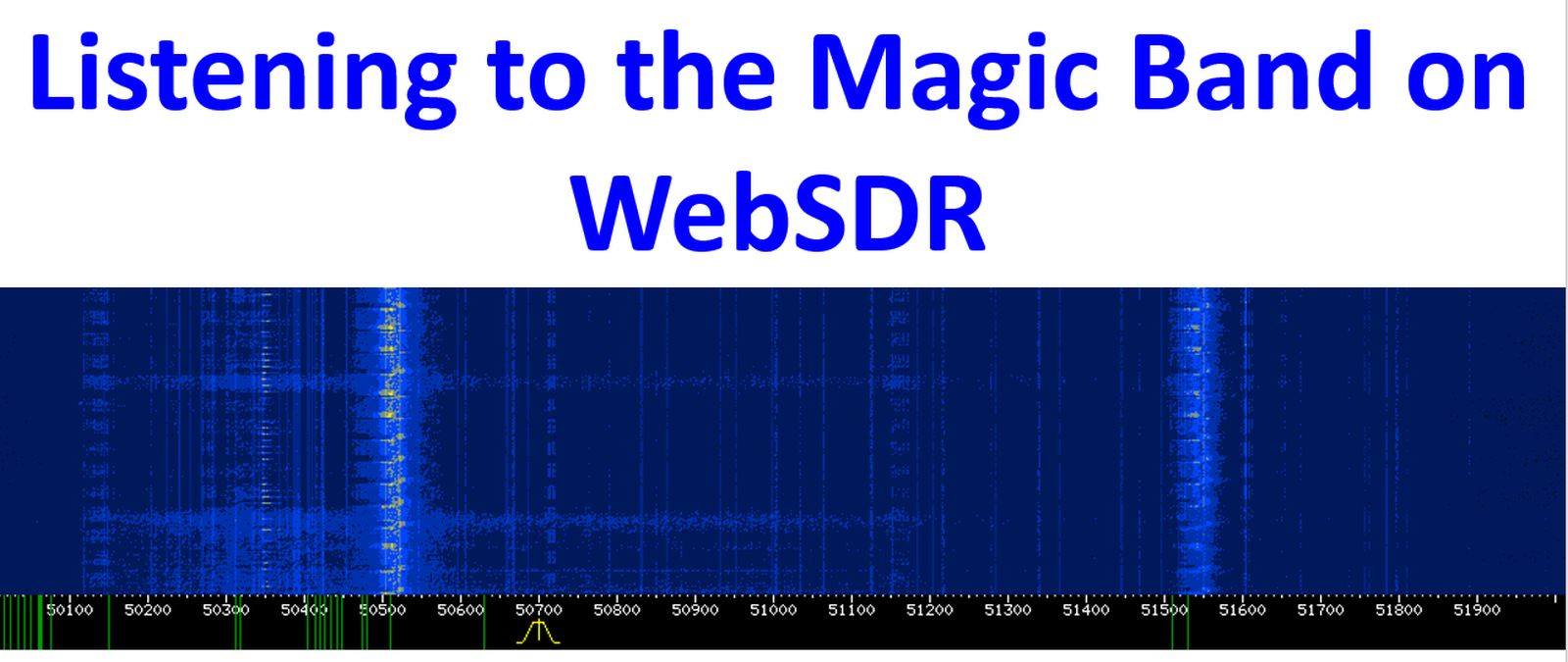
As you are aware, WebSDR is a software defined radio connected to the internet, which can be tuned simultaneously by different users to different frequencies. Table of SDR Receivers lists 18 WebSDRs from from seven countries for listening to 6 m. They are located mostly in Europe and the Americas, with none in a location near me. So I am not sure whether I will be able to hear anything on them considering the difference in time zones between my region and the location of the WebSDRs. I have tried listening to them several times and often found 6 m to be a quiet band like what most of my freinds have told me. It needs some special propagations like Troposcatter, Transequatorial propagation, Auroral propagation and Duct propagation to facilitate long distance communications on 6 m to make it the magic band.
Leave along long distance propagation, local propagation may also be difficult in case of 6 m without a repeater. Though there are numerous 6 m repeaters listed on RepeaterBook in the United States, we have none in our region. Getting a repeater up on 6 m is also quite challenging as the cost of equipment needed is more than that for VHF repeaters, which are there in plenty in our region. Moreover, with even the VHF repeaters being idle at times other than those of local nets, people are less likely to be interested in going for a 6 m repeater. Coming back to the WebSDRs for 6 m, I am planning to monitor them a little more, to check whether I can pick up any activity on them during a regional 6 m net at 2000 IST at 50.700 MHz. At least that is a time when I am sure that there is some 6 m activity. If I am lucky, some of the special propagations mentioned might take the regional signals to the WebSDRs located in other continents and give me an opportunity to do some “Short Wave Listening” on 6 m, though it is strictly not in the short wave spectrum!