LiFePO4 Battery: Preferred Choice of Portable Ham Radio Operators
I have been hearing of lithium iron phospate battery ever since I came back to ham radio last year and became active on Twitter (X). Initially I used to read it as ‘Life’PO4 Battery and it was only later that I understood that it was LiFePO4 battery! It is quite popular among the radio amateurs going for Parks on the Air activation. Many of them use portable solar panels to charge them as well. The battery uses LiFePO4 as the cathode and graphitic carbon with a metallic backing as anode. I am quite familiar with the graphite electrodes of old dry cells. In school days I used to break open used dry cells and use the graphite electrodes for electrolyzing sodium chloride solution in an attempt to produce sodium hydroxide from the sodium released in water getting coverted to sodium hydroxide. Chlorine bubbling from the other electrode used to cause a pungent smell in the room raising concerns from family members! The inverter batteries which I use at home are the so called ‘flooded’ lead acid batteries, which also cause some acid fumes in the region where the batteries are stored.
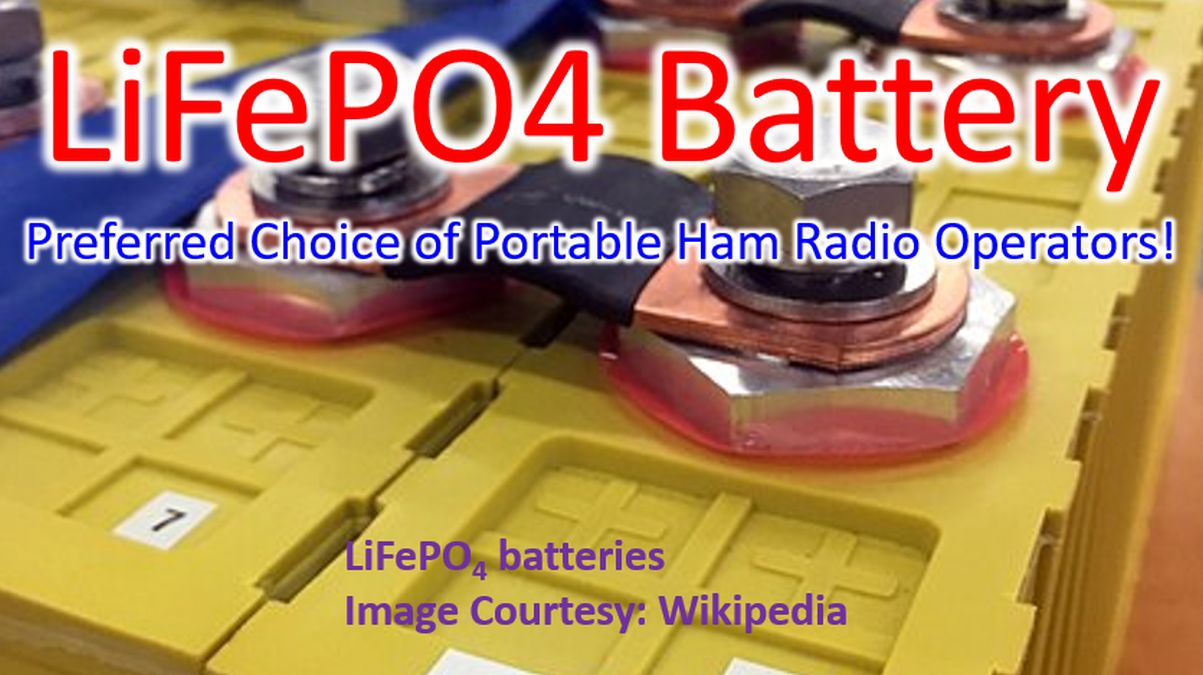
LiFePO4 batteries have relatively lower cost, higher safefty, low toxicity, long life cycle and free of cobalt. Beyond being a source of portable energy for ham radio operations, they find their place in electric vehicles and several other applications. Specific energy of LiFePO4 batteries are lower than other common lithium ion batteries like nickel manganese cobalt and nickel cobalt aluminium. While the specific energy of LiFePO4 batteries may be around 150 Watt-hour/kg, those of nickel manganese cobalt batteries may be more than double that value. While the nominal voltage of a lead acid battery cell is 2V, the working voltage of LiFePO4 is 3.2V. They have long charge cycle life of 3000 or more, even up to 10,000 cycles. Nickel manganese cobalt type of lithium batteries are supposed to support only 1000 to 3000 charge cycles. LiFePO4 batteries also have a slower rate of capacity loss.
There are certain precautions needed for LiFePO4 batteries. Charging voltage should not exceed 3.6V per cell and a battery management system is needed to avoid overcharging. No cell should be discharged below a voltage of 2.5V or severe damage will occur due to irreversible deintercalation of LiFePO4 into FePO4. Thermal and chemical stability is higher for LiFePO4, which improves battery safety. As the bonding of oxygen in the phosphate is stronger, release of oxygen is slower when short circuited or overheated. Hence they are less likely to ignite. LiFePO4 batteries are also available in the AA or conventional pen torch battery size, but be cautious about the higher voltage than conventional dry cells.