A few simple ham radio projects which are not very expensive!
Here are a few classic, inexpensive, and rewarding amateur radio projects that you can easily put together on a weekend:
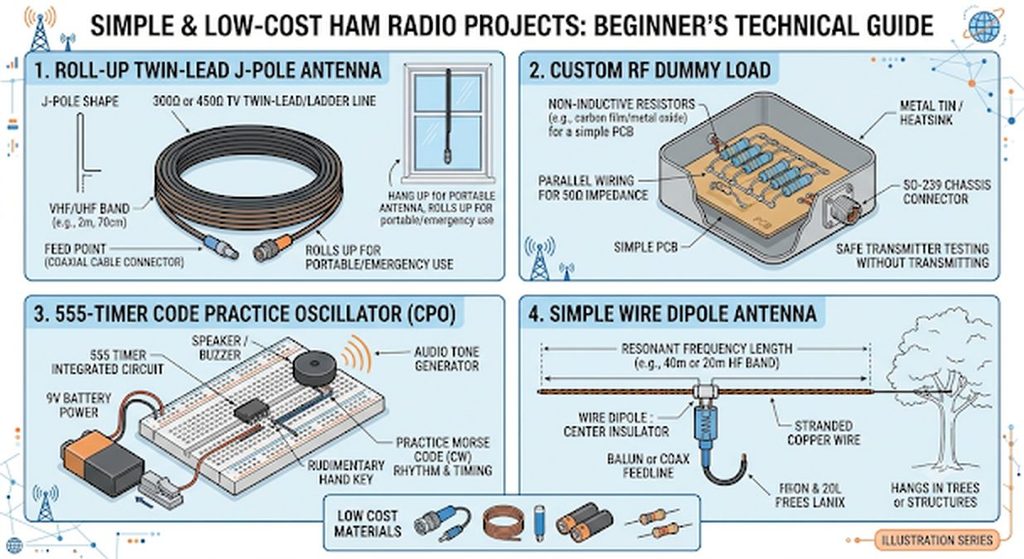
1. Roll-Up Twin-Lead J-Pole Antenna
- What it is: A lightweight, highly efficient vertical antenna designed for the 2-meter (144 MHz) or 70-centimeter (430 MHz) VHF/UHF bands.
- Cost: Under $5.
- Materials: A short length of 300-ohm or 450-ohm ladder line (or TV twin-lead), a length of coaxial cable, and a PL-259 or BNC connector.
- Why it’s great: It rolls up neatly into a backpack, making it ideal for portable operations, emergency preparedness kits, or hanging inside a window or tree branch to dramatically outperform a stock rubber-duck antenna.
2. Custom RF Dummy Load
- What it is: A non-radiating device that safely absorbs RF energy from a transmitter so you can test power output, check audio modulation, or tune equipment without putting signals on the airwaves.
- Cost: $5 – $15 (mostly for connectors and resistors).
- Materials: A bank of non-inductive carbon-film or metal-oxide resistors wired in parallel to hit a target impedance of 50 ohms, mounted inside an old metal tin or heatsink with an SO-239 chassis connector.
- Why it’s great: Every shack needs a dummy load to protect transceiver output stages during testing. Building your own gives you hands-on insight into power dissipation and impedance matching.
3. 555-Timer Code Practice Oscillator (CPO)
- What it is: A compact audio tone generator used to practice Morse code sending rhythm and timing.
- Cost: Under $3.
- Materials: A 555 timer integrated circuit, a few low-cost resistors and capacitors, a small speaker or piezo buzzer, a 9V battery, and a rudimentary hand key.
- Why it’s great: It is one of the most reliable beginner electronics circuits. It helps you build your CW skills while teaching you the basics of oscillator circuits.
4. Simple Wire Dipole or Ground Plane Antenna
- What it is: A resonant antenna cut specifically for your favorite HF frequency band (such as 40m or 20m) or a VHF ground plane using wire radials.
- Cost: Practically free if you raid the junk box for spare wire.
- Materials: Stranded copper wire, eyelet connectors, a small piece of PVC or acrylic for a center insulator, and coaxial feedline.
- Why it’s great: Antennas are often considered the most rewarding part of ham radio experimentation. Building a simple dipole lets you experience firsthand how physical wire length dictates resonant frequency and SWR.