Anticipated current consumption of 1 ton inverter AC during different times of the day
Unlike fixed-speed ACs, a 1 Ton DC Inverter AC does not draw constant current. Because its compressor dynamically modulates its speed to match the cooling load, its current consumption (measured in Amperes, or Amps) changes drastically throughout a 24-hour cycle.
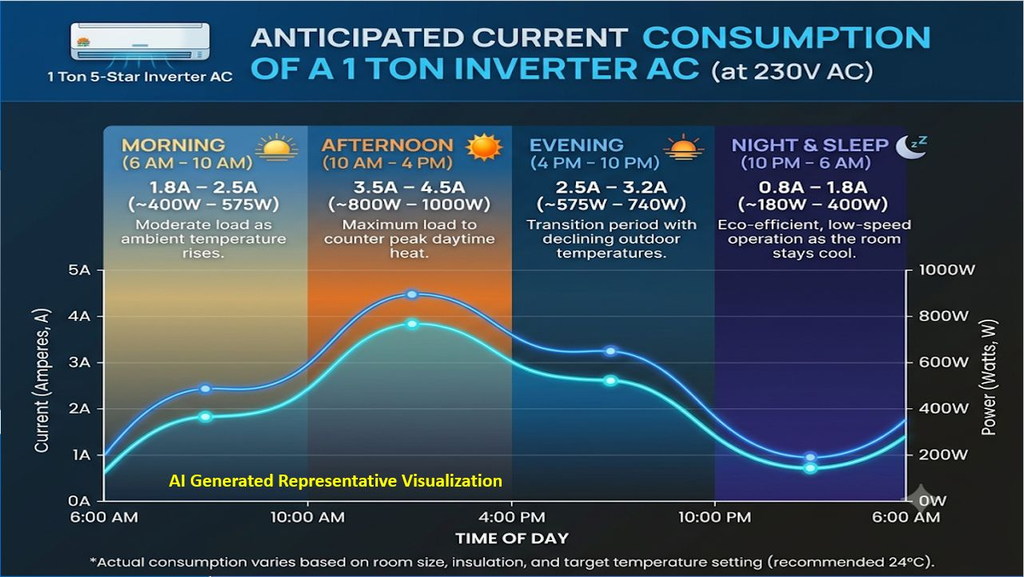
At a standard Indian residential voltage of ~230V, a typical 1 Ton Inverter AC will consume current during different times and stages as follows:
💡 Current & Power Breakdown by Time Stages
| Time Stage / Scenario | Compressor Status | Approx. Current (Amps) | Approx. Power Draw (Watts) |
|---|---|---|---|
| Initial Turn-On (First 20–40 mins) | Max Speed / Turbo Mode | 4.5 A to 5.2 A | 1,000W to 1,200W |
| Afternoon / Peak Heat (12 PM – 4 PM) | High to Medium Speed | 3.5 A to 4.5 A | 800W to 1,000W |
| Evening / Night Run (Stabilised Room) | Low Speed (Eco Mode) | 1.3 A to 2.2 A | 300W to 500W |
| Late Night / Early Morning (Low Ambient Temp) | Minimum Operational Speed | 0.9 A to 1.3 A | 200W to 300W |
| Standby Mode (Turned off via remote) | Off | 0.02 A to 0.06 A | 5W to 15W |
🕒 Detailed Real-World Timeline of a Night Profile
If you turn your AC on at 10:00 PM and set the thermostat to 24°C (the optimal temperature for power savings), the current consumption curve behaves like this:
- 10:00 PM – 10:45 PM (The Cool-Down Stage): The room is warm, so the inverter pushes the compressor to its maximum rated capacity. It continuously draws ~4.8 Amps to pull the temperature down quickly.
- 10:45 PM – Midnight (The Balancing Stage): As the room approaches 24°C, the inverter intelligently drops the compressor speed rather than cutting it off. The current drops steadily to around 2.5 Amps.
- 12:00 AM – 6:00 AM (The Maintenance Stage): The room is now fully sealed and cold. The outside temperature drops as well. The compressor ticks along at its lowest possible frequency, drawing a remarkably low ~1.5 Amps (roughly equal to running just 3–4 ceiling fans).
⚙️ Why Your AC’s Amps Will Vary
- Thermostat Setting: Setting your AC to 18°C forces the compressor to run at its highest speed (~5 Amps) almost indefinitely. Keeping it at 24°C–26°C allows the inverter to drop down to its lowest current level early in the cycle.
- Outdoor Temperature: On a blazing 42°C summer afternoon, the outdoor unit has to work harder to reject heat, which naturally pushes up the operational Amps compared to a rainy or winter night.
- BEE Star Rating: A 5-star inverter AC is equipped with more efficient heat exchangers and electronic expanders, allowing it to drop to lower running currents (~1.3A) faster than a 3-star model.