What is FSK telemetry?
FSK (Frequency-Shift Keying) telemetry is a digital radio transmission method used to send remote sensor readings, health metrics, and status data by shifting the frequency of a carrier wave between discrete values representing binary 1s and 0s. Because it encodes information in frequency rather than signal amplitude, it is widely used in amateur satellites, weather balloons (radiosondes), wildlife tracking, and industrial remote monitoring.
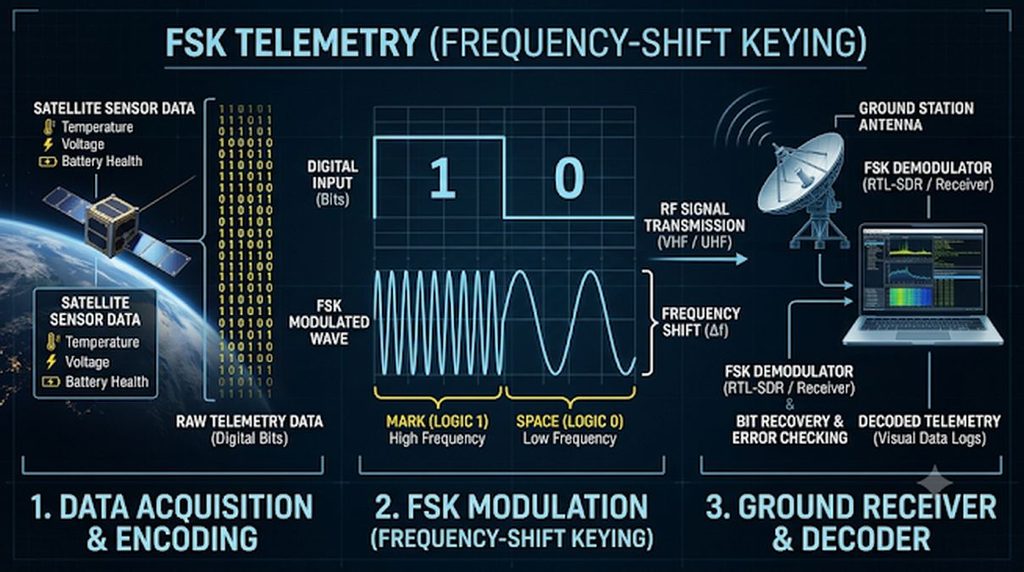
How FSK Encodes Telemetry Data
- Mark and Space Frequencies: In binary FSK (2-FSK), the transmitter switches between two specific frequencies: a higher frequency traditionally called the Mark (representing a logic
1) and a lower frequency called the Space (representing a logic0). The difference between these two frequencies is the frequency shift (Δf). - Direct FSK vs. AFSK:
- Direct FSK: The digital data stream directly shifts the RF carrier frequency of the transmitter’s oscillator or synthesizer. This is standard in dedicated satellite telemetry beacons and low-power UHF/VHF modules.
- AFSK (Audio Frequency-Shift Keying): The data first shifts an audio tone between two pitches (such as 1200 Hz and 2200 Hz in 1200-baud AX.25 packet radio), and that audio signal is then fed into a conventional FM or SSB transmitter.
- GFSK (Gaussian FSK): Before shifting the carrier frequency, the rectangular digital pulses are passed through a Gaussian low-pass filter. This rounds off sharp transitions, significantly narrowing the RF bandwidth and minimizing interference to adjacent channels.
Telemetry Packet Structure & Signal Conditioning
Raw FSK bitstreams are wrapped in structured frames so a ground receiver can reliably extract data under weak-signal conditions:
- Preamble and Sync Word: Packets begin with an alternating bit pattern (
101010...) to let the receiver’s clock-recovery circuit lock onto the symbol timing, followed by a unique binary synchronization word that marks the exact start of the telemetry payload. - Scrambling (Data Whitening): Long strings of identical bits (all
0s or all1s) cause the transmitter to sit on a single frequency, making it easy for the receiver to lose bit synchronization. Telemetry transmitters pass data through a pseudo-random scrambler polynomial so the frequency shifts regularly regardless of the underlying sensor values. - Error Detection and Correction: Frames typically include a Cyclic Redundancy Check (CRC) to discard corrupted packets, and often employ Forward Error Correction (FEC) (such as convolutional or Reed-Solomon coding) so the receiver can reconstruct missing bits caused by fades or interference.
Why FSK Is Ideal for Telemetry
- High Transmitter Amplifier Efficiency: Because an FSK signal maintains a constant amplitude (a constant-envelope waveform), transmitters can use highly efficient nonlinear Class-C, Class-E, or saturated switching power amplifiers without distorting the signal. For battery- or solar-limited platforms like PocketQube satellites (such as UNNE-1B at 200 bps or HADES-L at 800 bps), this maximizes RF output per watt of DC power.
- Immunity to Amplitude Fading: Natural signal fluctuations—such as a tumbling satellite’s antenna nulls, atmospheric scintillation, or multipath fading—alter signal strength rather than frequency. An FM/FSK receiver’s limiter stage strips away amplitude variations, preserving clean data down to low signal-to-noise ratios.
- Simple Ground Demodulation: FSK telemetry can be received on standard FM voice receivers or inexpensive SDR dongles and decoded in software using basic frequency discriminators or PLL detectors, avoiding the strict phase-linearity and frequency-stability demands of phase-modulated schemes like BPSK or QPSK.