What is ionosonde and its relation to amateur radio?
Ionosonde is a radar system directed vertically upwards so that it can observe the density of electrons in the ionosphere as a function of height. The ionosonde system transmits radiowaves upwards, which get reflected by free electrons in the ionosphere. The reflected radiowaves are received by another antenna on the ground. In one such system, an antenna tower was used to transmit the signals while an eggbeater style antenna was used to receive the reflected signals. Ionosonde system varies its frequency in regular sweeps, say from 0.5 MHz to 20 MHz or a different range for another system.
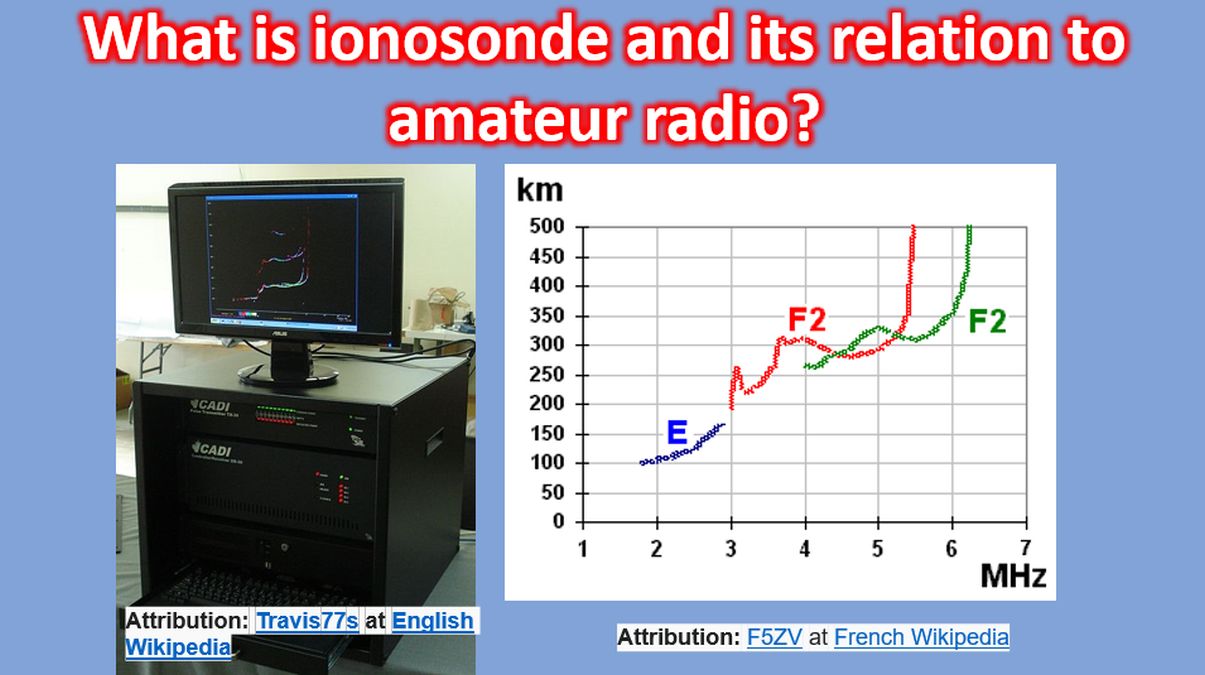
Each frequency gets reflected from a different height at which the plasma frequency matches that of the signal. Height of the reflection layer can be calculated from the time needed for the reflected wave to be received back. As there is a direct relation between the plasma frequency and electron density, electron density at the reflection point can also be calculated. At any given point of time, when the frequency of the ionosonde signal exceeds the highest plasma frequency of the ionosphere, it will not get reflected and travels towards outer space. That frequency will be not received back in the receiver on the ground and is called the critical frequency. A plot of the frequencies and their reflection heights is known as an ionogram. There are two reflections for each upward wave, known as the ordinary and extraordinary waves. Ordinary reflections are colour coded red and extraordinary reflection in green, on the ionogram.
As the ionosphere varies with time, repeated ionosonde measurements are made by repeated frequency sweeps. Similarly, geographic variation of the ionosphere is captured by multiple instruments at different locations. These can be combined to get real-time ionosphere maps of the region. Information received from ionosonde can be used to find out optimum frequencies for communication between regions in amateur radio on HF bands. Quoting from my previous post, Maximum usable frequency (MUF) is dependent on the angle of incidence θ. MUF = critical frequency/cosθ.
Critical frequency is the maximum frequency at which total internal reflection occurs from the ionosphere. Higher frequencies travel further outwards without getting reflected back to the earth. There is also an optimum working frequency or OWF which is 0.85MUF. Maximum usable frequency and optimum working frequency are with reference to communication between two given points at given a time.
The ionogram illustrated here shows MUF 5.5 MHz for 100 km and 17.7 MHz for 3000 km. The date of the ionogram is displayed at the top as 2007 Nov 10 and time as 2230. Station location is also seen near it. There are a lot more information available there on the ionogram, which I have not gone into in detail.
References
- The PITHIA-NRF project article on Ionosonde. Available at: https://pithia-nrf.eu/activities-results/outreach/space-weather-research-instruments/ionosonde. Accessed on 28th April 2024.
- Wikipedia article on Ionosonde. Available at: https://en.wikipedia.org/wiki/Ionosonde. Accessed on 28th April 2024.