What is Narrow Band FM in Amateur Radio?
Some of you would have noted narrow band FM in the settings of your radio. Others would have read that certain amateur radio satellites are better worked with narrow band FM. As you are aware, FM or frequency modulation is encoding of information in a radiofrequency carrier wave by varying the instantaneous freqeuncy of the wave according to the modulating signal, which is your audio in case of amateur radio. This in contrast with AM or amplitude modulation, in which it is the amplitude of the RF carrier wave that is changed according to the audio signal and not the frequency. The amplitude of FM waves are constant while the frequency of AM waves are constant, as you can see in the animation taken from Wikipedia. Narrowband FM is one in which the change in carrier frequency is about the same as the signal frequency. In wideband FM, the change in carrier frequency is much higher than the signal frequency.
Animated diagram illustrating the difference between radio waves modulated by amplitude modulation and by frequency modulation:
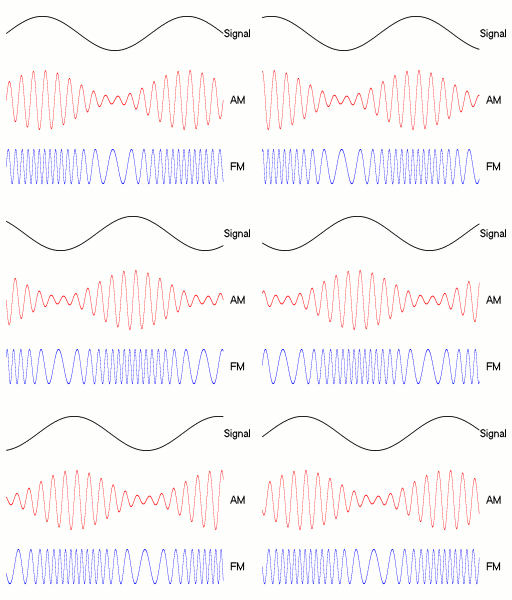 Creative Commons Attribution-Share Alike 2.5 Generic Image by Berserkerus Wikipedia
Narrowband FM is typically used in two way radio communication systems as in amateur radio. In narrowband FM, the carrier is allowed to deviate only 2.5 kHz above and below the center frequency with speech signals. In contrast wideband FM is used in broadcasting where music and speech could cause up to 75 kHz deviation from the centre frequency and carry audio with up to 20 kHz bandwidth. Narrowband FM has a low modulation index, while wideband FM has a higher modulation index. Modulation index is the ratio of the maximum instantaneous frequency deviation of the carrier signal, to the highest frequency component of the modulating signal. Higher bandwidth in wideband FM gives better signal to noise ratio during reception.