What are the routine preparations prior to an EVA (Space Walk)?
Preparing for an Extravehicular Activity (EVA)—standardized around International Space Station (ISS) operations using NASA’s Extravehicular Mobility Unit (EMU) or Russia’s Orlan suit—is a multi-day sequence focused on hardware verification, task rehearsal, and physiological nitrogen purging.
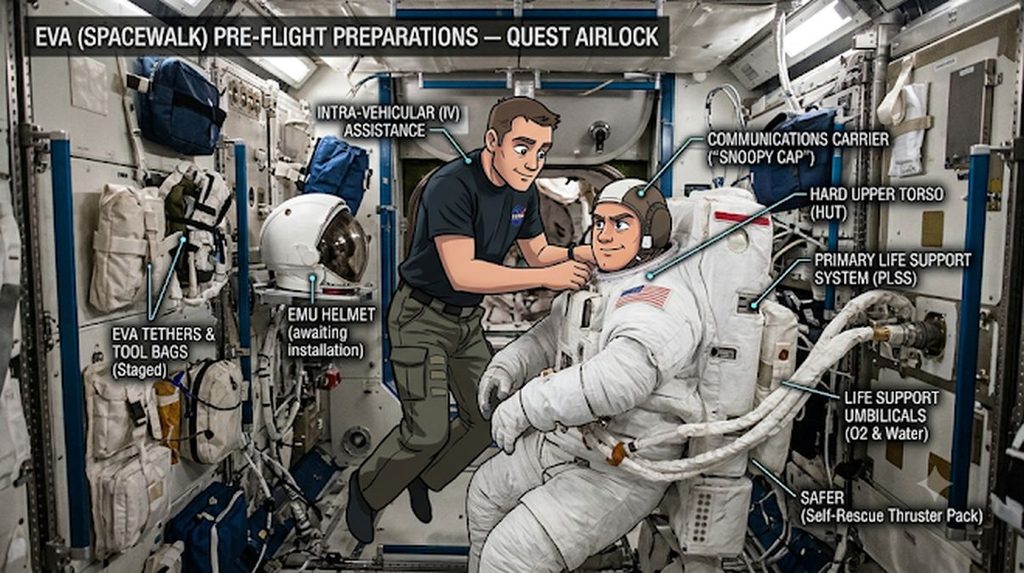
1. Days Prior: Suit Checkout, Tool Staging, and Choreography
- Spacesuit Configuration & Consumables: Crew members size and inspect the modular suit components (arms, legs, gloves, and helmet). Technicians install fresh batteries, Metal Oxide (Metox) or lithium hydroxide carbon dioxide scrubbers, potable water drink bags, and charge the water loop used for thermal regulation.
- Rescue Pack Inspection: On U.S. spacewalks, astronauts attach and test the SAFER (Simplified Aid For EVA Rescue) unit—a small nitrogen-gas thruster backpack worn around the life-support system that allows a tether-detached astronaut to fly back to the station.
- Tool & Tether Preparation: Every wrench, wire tie, foot restraint, and spare component is inventoried, fitted with retractable tethers, and staged inside the airlock. Electronic Pistol Grip Tools (PGTs) are pre-programmed with exact torque, speed, and turn limits for specific bolts.
- Procedure & Translation Review: The spacewalkers and their Intra-Vehicular (IV) crewmate—who coordinates the timeline from inside—conduct a step-by-step walkthrough with Mission Control, reviewing handrail translation paths, tether swap points, solar array glare angles, and emergency “abort-to-airlock” rules.
2. Night Before to EVA Morning: Oxygen Pre-Breathe (Denitrogenation)
- Preventing Decompression Sickness: The ISS cabin is maintained at standard sea-level pressure (14.7 psi / 101.3 kPa, 79% nitrogen), whereas NASA’s EMU operates at 4.3 psi (29.6 kPa) of 100% pure oxygen (Russia’s Orlan operates at ~5.8 psi / 40 kPa) so the inflated fabric joints remain flexible enough to bend. Dropping pressure rapidly without flushing dissolved nitrogen from the bloodstream causes nitrogen bubbles to form in joints and tissues (“the bends”).
- Campout Protocol: Astronauts often sleep the night before an EVA inside the Quest airlock’s crew lock at a reduced pressure of 10.2 psi (70.3 kPa) with an enriched oxygen concentration (~26.5%), followed by a shorter pure-oxygen mask pre-breathe the next morning.
- In-Suit Light Exercise (ISLE) Protocol: Alternatively, spacewalkers breathe 100% oxygen through a mask and then inside the suit while performing controlled, low-impact exercises. Elevating heart rate and blood flow accelerates nitrogen washout from tissues, shortening the required pre-breathe period from four hours down to roughly 2 hours and 20 minutes.
3. Final Hours: Suit Donning and Staged Depressurization
- Inner Garments & Telemetry: After eating a high-energy meal and hydrating, astronauts put on a Maximum Absorbency Garment (MAG), attach biomedical ECG sensors, and don the Liquid Cooling and Ventilation Garment (LCVG)—a form-fitting mesh suit woven with roughly 90 meters of narrow tubing that circulates chilled water to carry away body heat—along with the Communications Carrier Assembly (“Snoopy cap”) for dual-redundant headsets and microphones.
- Suit Entry & Seal Verification: With help from the IV crewmate, each astronaut slides into the Lower Torso Assembly, wriggles up into the Hard Upper Torso (HUT), locks the metal waist-bearing ring, and attaches the helmet and gloves. A positive-pressure leak check confirms all seals are airtight.
- Staged Crew Lock Depressurization: Once the inner airlock hatch is sealed, the suits switch from umbilical station power to internal battery power. Airlock pressure is stepped down in stages—typically pausing at 10.2 psi and 5.0 psi to verify suit pressure integrity, radio clarity, and life-support telemetry—before venting the remaining air to vacuum, opening the thermal cover and outer hatch, and attaching safety tethers to the exterior hull.
Related Posts


About The Author
