What is a Coronal Hole on the Sun?
A coronal hole is a temporary, dark region in the Sun’s outer atmosphere (the corona) where plasma is significantly cooler and less dense than its surroundings. Because they do not emit as much radiation as the rest of the active corona, these holes appear as massive dark patches when viewed through extreme ultraviolet and X-ray telescopes.
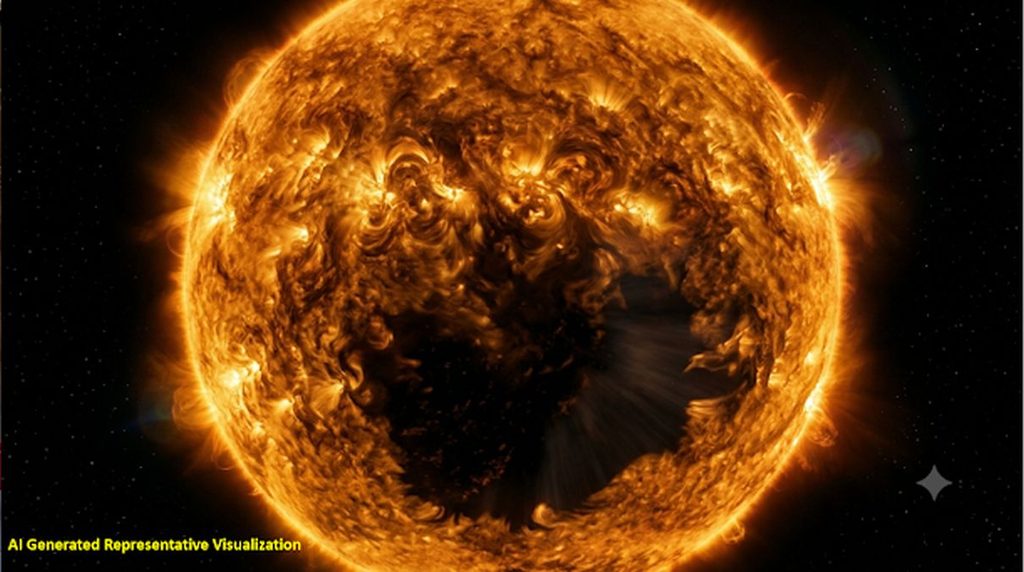
Why They Form
Most of the Sun’s magnetic field lines form closed loops, arching up into the atmosphere and returning directly to the solar surface. However, a coronal hole forms in areas where the magnetic field lines are “open”—meaning they extend outward into interplanetary space without looping back.
Impact on Space Weather
Because these magnetic field lines are open, they act like a massive escape valve for solar plasma.
- High-Speed Solar Wind: Charged particles can flow out of these holes at speeds much faster than the normal, background solar wind.
- Ionospheric Disturbances: When a coronal hole rotates to face Earth, this fast-moving solar stream collides with our planet’s magnetosphere. This triggers geomagnetic storms that can disrupt satellite operations, GPS navigation, and significantly alter high-frequency (HF) radio wave propagation in the ionosphere—a major factor when operating amateur radio equipment on bands like 10m, 20m, or 40m.
- Auroras: The influx of these charged particles funneling into Earth’s upper atmosphere often fuels brilliant, intensified displays of the Northern and Southern Lights (auroras).
Coronal holes can last for weeks or even months. While they can appear anywhere on the Sun, they are most frequently found near the solar poles and become highly prevalent during the declining phase of the 11-year solar cycle.
Related Posts


About The Author
