First Sun-Earth Lagrange Point
The First Sun-Earth Lagrange Point (L1) is a point of gravitational equilibrium located approximately 1.5 million kilometers (about 1 million miles) from Earth, directly toward the Sun. At this specific location, the Earth’s gravitational pull partially counteracts the Sun’s much stronger gravity, allowing a spacecraft to orbit the Sun in exactly the same amount of time (one year) as the Earth.
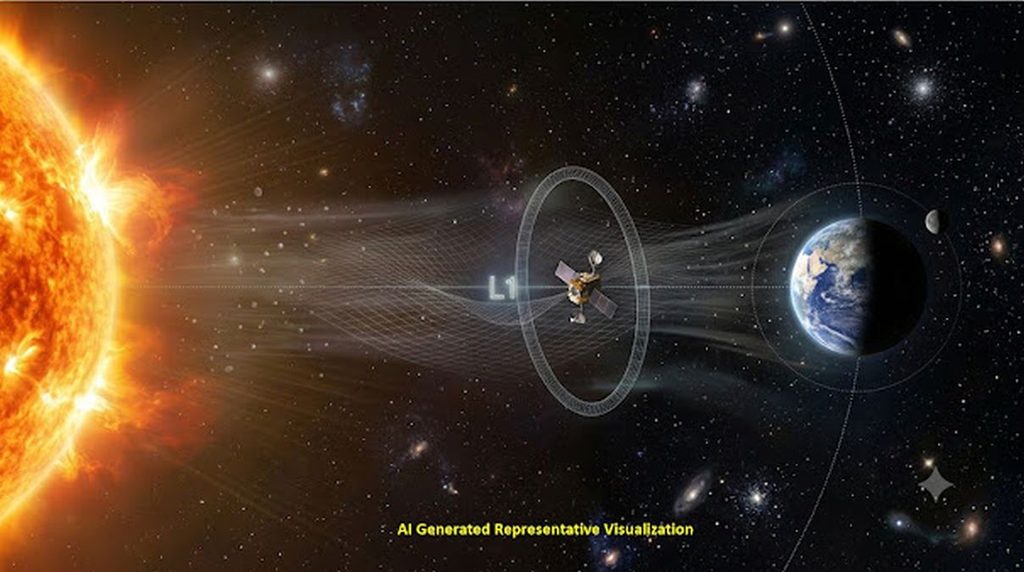
Because an object at L1 remains locked in position between the Earth and the Sun, it offers several unique advantages:
- Uninterrupted Solar View: A spacecraft at L1 enjoys a continuous, 24/7 view of the Sun. It is never eclipsed by the Earth or the Moon, making it the premier location for solar observatories.
- Space Weather Early Warning: Positioned “upstream” in the flow of the solar wind, satellites at L1 can detect Coronal Mass Ejections (CMEs) and high-speed plasma streams about 30 to 60 minutes before they impact Earth’s magnetosphere. This early detection is critical for predicting geomagnetic storms that alter HF radio wave propagation and trigger auroras.
- Notable Satellites: L1 is the primary hub for solar and space weather monitoring. It is home to observatories such as SOHO (Solar and Heliospheric Observatory), ACE (Advanced Composition Explorer), DSCOVR (Deep Space Climate Observatory), and ISRO’s Aditya-L1 mission, which actively studies the solar corona and solar wind.
Similar to the L2 point, L1 is an unstable equilibrium point. Spacecraft do not sit perfectly still at the exact L1 coordinate; rather, they travel in halo or Lissajous orbits around the point and must perform regular thruster burns (station-keeping) to avoid drifting away.
Related Posts
-
 Mangalyaan 1 and 2 Missions (Mars Orbiter and Lander Missions of ISRO)
-
 Historic Untethered EVA with Manned Maneuvering Unit Jetpack & SAFER
-
 How do solid propellant rocket engines compare with those on hypergolic propellants?
-
 How can spacecrafts to Mars be launched beyond the Hohmann transfer Window?
About The Author
