What is Solar Wind?
Solar wind is a continuous stream of charged particles—primarily protons and electrons—flowing outward from the Sun’s outermost atmosphere, the corona. Because the corona is heated to over a million degrees Celsius, the Sun’s gravity cannot contain the rapidly moving plasma, causing it to constantly expand outward into the solar system.
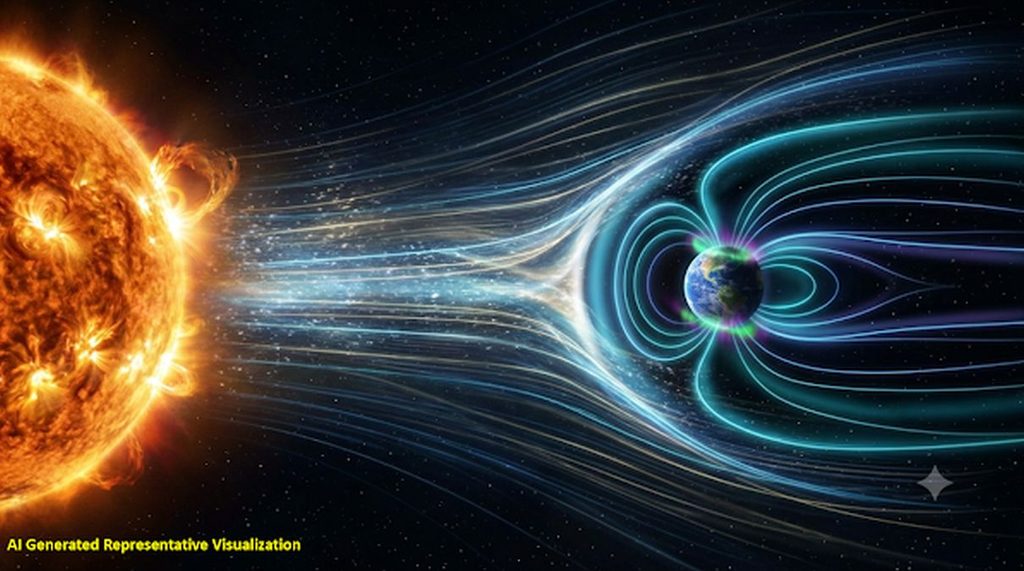
- Speed and Density: The solar wind travels at supersonic speeds, typically ranging from 300 to 800 kilometers per second (about 1 to 2 million miles per hour). The slower wind originates from the Sun’s equatorial regions, while the faster wind escapes through coronal holes at the poles.
- Magnetic Cargo: As the plasma flows outward, it carries a portion of the Sun’s magnetic field with it. This creates the Interplanetary Magnetic Field (IMF), a vast magnetic web that permeates the entire solar system.
- Interaction with Earth: When the solar wind reaches Earth, it is largely deflected by our planet’s magnetic field (the magnetosphere). This interaction compresses the sunward side of Earth’s magnetic field and stretches the night side into a long, trailing magnetic tail.
- Space Weather Impact: Sudden increases in the speed or density of the solar wind—often driven by solar flares or Coronal Mass Ejections (CMEs)—trigger geomagnetic storms. These storms alter the Earth’s ionosphere, which can disrupt satellite operations, degrade GPS accuracy, and cause significant blackouts in high-frequency (HF) radio communications. One such major blackout occurred at around 7 am when we were talking to each other on 40m band on amateur radio in May 2024. Suddenly we lost propagation and and only stations within around 200 km were heard, that too faintly.
- Auroras: Some charged particles from the solar wind become trapped in Earth’s magnetic field and are funneled toward the magnetic poles. When these particles collide with oxygen and nitrogen in the upper atmosphere, they emit light, creating the auroras (the Northern and Southern Lights).

Related Posts


About The Author
