Why is it that hurricanes (or typhoon/tropical cyclone) never cross the Equator?
No hurricane (or typhoon/tropical cyclone) has ever been recorded crossing the Equator. While a storm’s outer rainbands or wind field can occasionally spill over into the opposite hemisphere, the actual low-pressure center of a tropical cyclone never crosses the 0° latitude line. This happens because of three interconnected meteorological forces driven by the Earth’s rotation:
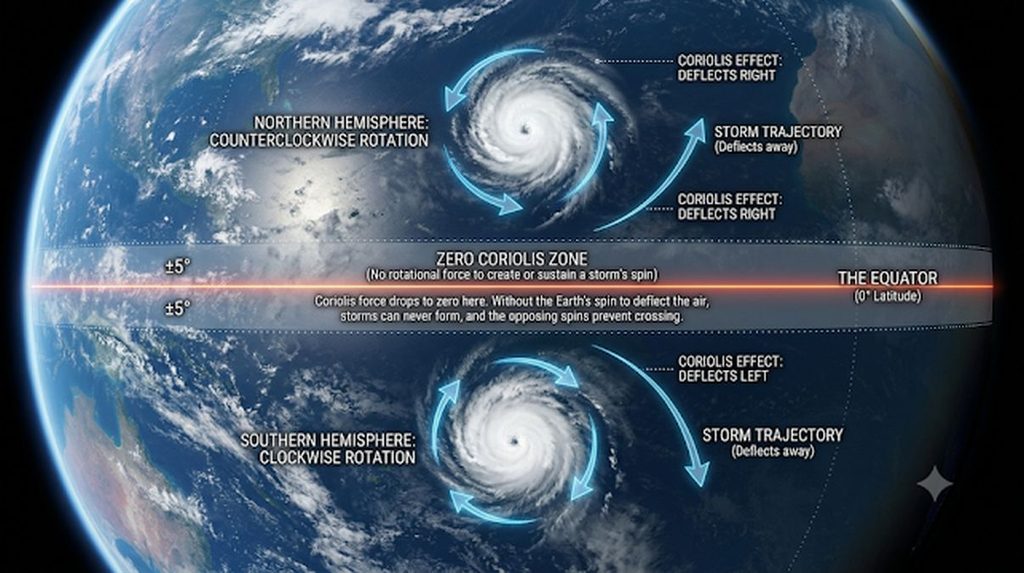
1. The Coriolis Effect Drops to Zero at the Equator
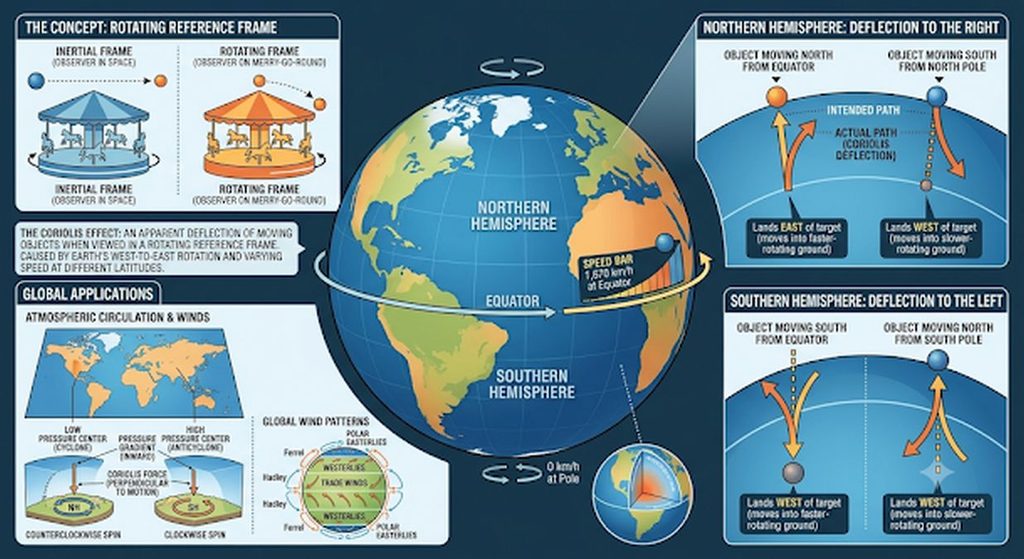
Hurricanes are essentially giant heat engines that rely on air rushing toward a central area of low pressure. Because the Earth rotates, moving air is deflected sideways—a phenomenon known as the
Coriolis effect:
- In the Northern Hemisphere, air is deflected to the right, causing storms to spin counterclockwise.
- In the Southern Hemisphere, air is deflected to the left, causing storms to spin clockwise.
However, the Coriolis force depends on latitude (f = 2Ωsin ϕ, where ϕ is latitude). Right at the Equator (ϕ= 0°), the Coriolis force is
zero. Without this rotational deflection, air rushing toward a low-pressure zone simply flows straight into the center and fills it in, preventing a vortex from forming or sustaining itself. Because of this, tropical cyclones almost never form within
5° latitude (about 550 km) of the Equator.
2. Prevailing Winds Steer Storms Away from the Equator
A hurricane cannot move on its own; it is carried along by large-scale atmospheric steering currents (such as the trade winds and subtropical highs):
- Trade winds near the tropics generally blow from east to west, while the Coriolis effect creates a subtle poleward drift (known as beta drift).
- As a result, once a storm forms, its natural trajectory curves poleward—away from the Equator—rather than toward it. There are virtually no large-scale wind patterns capable of pushing a mature storm directly across the equatorial boundary.
3. Dynamical Disruption
Even if an atmospheric anomaly were somehow able to push a mature hurricane toward the Equator, it would weaken and unravel before making it across:
- As the storm approached 0°, the vanishing Coriolis force would break the delicate balance between inward pressure forces and outward centrifugal/Coriolis forces that holds the eyewall together.
- Crossing into the opposite hemisphere would pit the storm’s existing angular momentum against an opposing Coriolis deflection, destabilizing the organized circulation and causing the storm to dissipate into a disorganized cluster of thunderstorms.
Notable Near-Equatorial Exceptions
While no mature tropical cyclone has ever crossed the Equator, a few rare systems have formed remarkably close to it:
- Typhoon Vamei (December 2001): Formed in the South China Sea at just 1.4°N–1.5°N (about 160 km north of the Equator near Singapore), aided by a rare combination of a localized Borneo vortex and a strong winter monsoon surge. While its center stayed in the Northern Hemisphere, its outer cloud bands straddled the Equator.
- Cyclone Agni (November 2004): Formed in the Arabian Sea at roughly 1.5°N. While still a weak, unorganized tropical disturbance prior to becoming a named cyclone, its formative circulation center briefly crossed from the Southern Hemisphere into the Northern Hemisphere before intensifying.
About The Author
