What are hypergolic propellants?
Hypergolic propellants are rocket fuel and oxidizer combinations that ignite spontaneously on physical contact with each other, eliminating the need for a spark plug, torch, or pyrotechnic ignition system. Because combustion begins the instant the two liquids mix inside a thrust chamber, hypergolic engines are mechanically simple and exceptionally reliable.
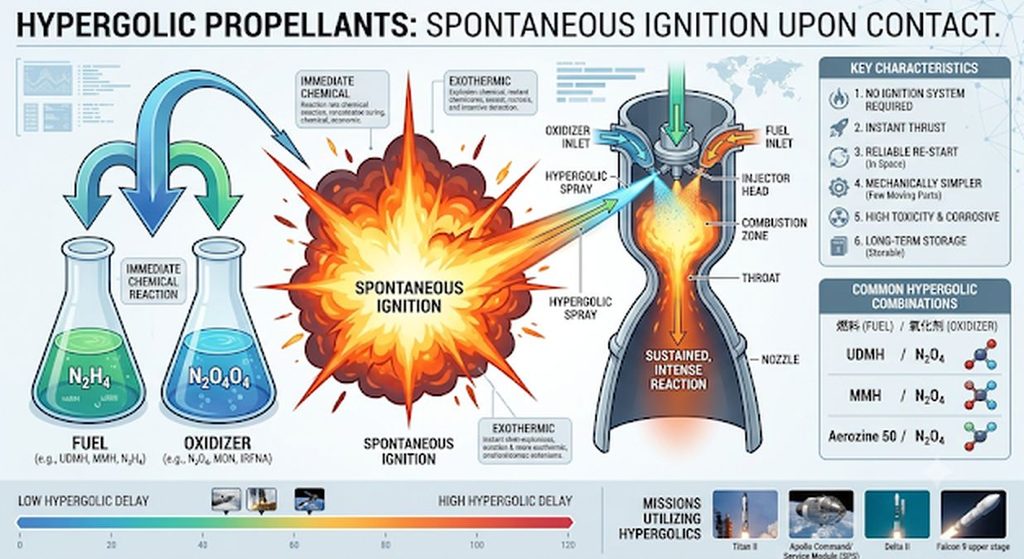
Why Spacecraft Use Them
- Instant, Repeatable Restarts: Without an igniter that can fail or wear out, hypergolic thrusters can be pulsed on and off thousands of times in vacuum. This makes them standard for reaction control system (RCS) attitude thrusters, orbital maneuvering engines, deep-space probes, and crew launch escape systems.
- Ambient-Temperature Storability: Unlike cryogenic propellants (such as liquid oxygen, liquid hydrogen, or liquid methane) that require sub-zero insulation and continually boil off, hypergolic fuels and oxidizers remain liquid at room temperature. Spacecraft can keep them sealed in tanks for years during interplanetary missions.
- High Propellant Density: Hypergolic liquids are relatively dense, allowing engineers to use smaller, lighter propellant tanks that fit cleanly inside compact satellite and probe fairings.
Common Hypergolic Combinations
| Fuel | Oxidizer | Notable Applications |
| Monomethylhydrazine (MMH) | Dinitrogen tetroxide (N2O4 / NTO) | Space Shuttle Orbital Maneuvering System (OMS) & RCS thrusters, satellite apogee engines |
| Unsymmetrical dimethylhydrazine (UDMH) | Dinitrogen tetroxide (NTO) | ISRO’s Vikas liquid engine (PSLV, GSLV, LVM3) and Roscosmos Proton rockets |
| Aerozine 50 (50% hydrazine, 50% UDMH) | Dinitrogen tetroxide (NTO) | Apollo Lunar Module ascent/descent engines and Titan II launch vehicles |
| Triethylaluminum-triethylborane (TEA-TEB) | (Pyrophoric igniter fluid) | Used in small bursts to ignite non-hypergolic kerosene/LOX engines like SpaceX’s Merlin and Saturn V’s F-1 |
Drawbacks and Modern Alternatives
Despite their reliability, traditional hydrazine- and nitric-acid-based hypergols are
extremely toxic, carcinogenic, and corrosive. Ground crews must wear full self-contained hazmat suits during propellant loading, which slows down launch pad operations and raises handling costs. In addition, hypergolic combinations produce lower specific impulse (fuel efficiency) than cryogenic propellants like liquid hydrogen/oxygen or liquid methane/oxygen.To avoid toxic ground operations while preserving rapid reusability, newer spacecraft like Starship use non-toxic cryogenic methane and oxygen—relying on pressurized boil-off gas rather than hypergols for attitude control—while chemical researchers continue developing non-toxic
“green” hypergolic propellants pairing high-concentration hydrogen peroxide with specialized amine-borane or metal-hydride fuels.
Related Posts


About The Author
