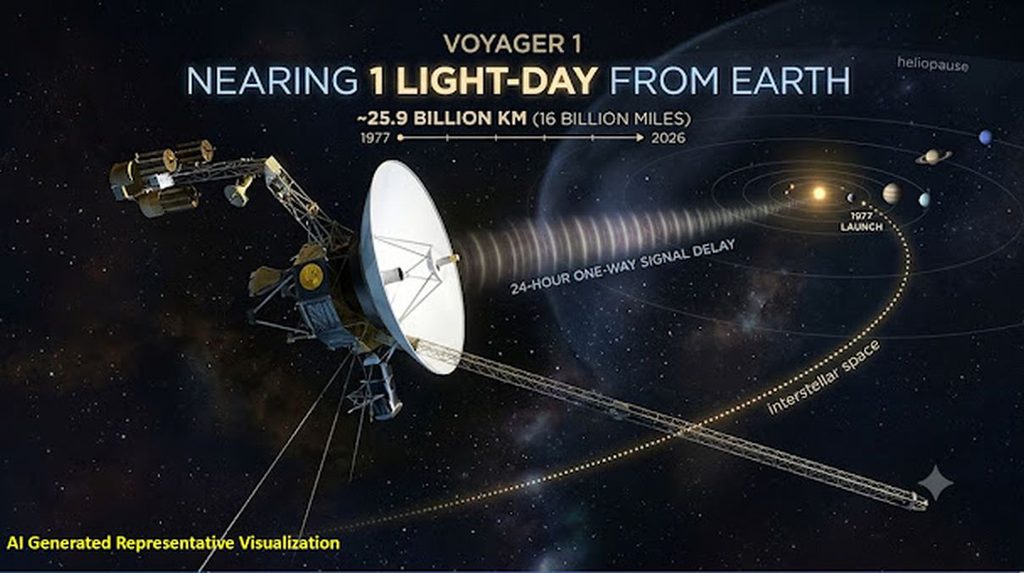
Voyager Mission Nearing One Light Day!
The NASA Voyager program consists of twin robotic probes—Voyager 1 and Voyager 2—launched in 1977 to explore the outer solar system and the interstellar space beyond. They are the longest-operating and farthest-traveling human-made objects in history.
The Planetary “Grand Tour” The mission exploited a rare geometric alignment of the outer planets that occurs only once every 175 years. This alignment allowed the spacecraft to use
gravity assists (slingshot maneuvers around massive planets) to boost their speed and trajectory from one giant planet to the next, drastically reducing the fuel and flight time required to reach the outer solar system.
Key Mission Highlights
- Voyager 1: Launched on September 5, 1977, on a faster trajectory than its twin. It performed close flybys of Jupiter (1979) and Saturn (1980). A targeted flyby of Saturn’s moon Titan diverted it out of the ecliptic plane, sending it heading out of the solar system. In 1990, it captured the famous “Pale Blue Dot” photograph. In August 2012, Voyager 1 became the first spacecraft to cross the heliopause—the boundary where the solar wind ends—and enter interstellar space.
- Voyager 2: Launched first on August 20, 1977, on a longer, broader trajectory. It completed the full “Grand Tour,” remaining the only spacecraft ever to visit all four outer planets: Jupiter (1979), Saturn (1981), Uranus (1986), and Neptune (1989). It discovered 16 new moons and active planetary features like Neptune’s Great Dark Spot and Triton’s cryovolcanoes. Voyager 2 crossed the heliopause into interstellar space in November 2018.
Core Technical Systems
- Power Supply: Because sunlight in the outer solar system is too weak for solar panels, both spacecraft are powered by Radioisotope Thermoelectric Generators (RTGs). These units convert heat generated by the natural radioactive decay of Plutonium-238 into electricity.
- Communications: Each probe features a large 3.7-meter (12-foot) high-gain dish antenna operating on X-band and S-band frequencies, transmitting weak signals across billions of kilometers to NASA’s Deep Space Network (DSN).
- The Golden Record: Both probes carry a 12-inch gold-plated copper phonograph record containing 115 images, natural sounds, world music, spoken greetings in 55 languages, and audio encoded with information about human civilization and Earth’s location.
Current Interstellar Status Both probes continue to transmit telemetry and scientific data on cosmic rays, interstellar plasma density, and magnetic fields from beyond the sun’s heliosphere. Voyager 1 is located over 160 Astronomical Units (AU)—around 24 billion kilometers—from Earth, with Voyager 2 trailing at over 135 AU.
Related Posts
-
 Which are the spacecrafts which have been launched to Mars successful beyond the Hohmann window?
-
 Exoplanets: How many have been discovered and where is the nearest one?
-
 What are the chances of seeing Starship moving across the sky from Kerala, without a telescope, as per the current launch schedule?
-
 What is the planned sequence of Super Heavy Booster once it is decided that tower catch is not feasible?
About The Author
