Exoplanets: How many have been discovered and where is the nearest one?
As of November 2026, there are 6,464 confirmed exoplanets.The nearest known exoplanet to Earth is
Proxima Centauri b. It is located approximately 4.2 light-years away (about 1.3 parsecs) and orbits the star Proxima Centauri.
What are Exoplanets?Exoplanets, or extrasolar planets, are planets that orbit stars outside of our solar system. Because they are located light-years away and are vastly outshined by the intense glare of their host stars, they are exceedingly difficult to see directly and are primarily studied using specialized space telescopes and indirect detection methods.
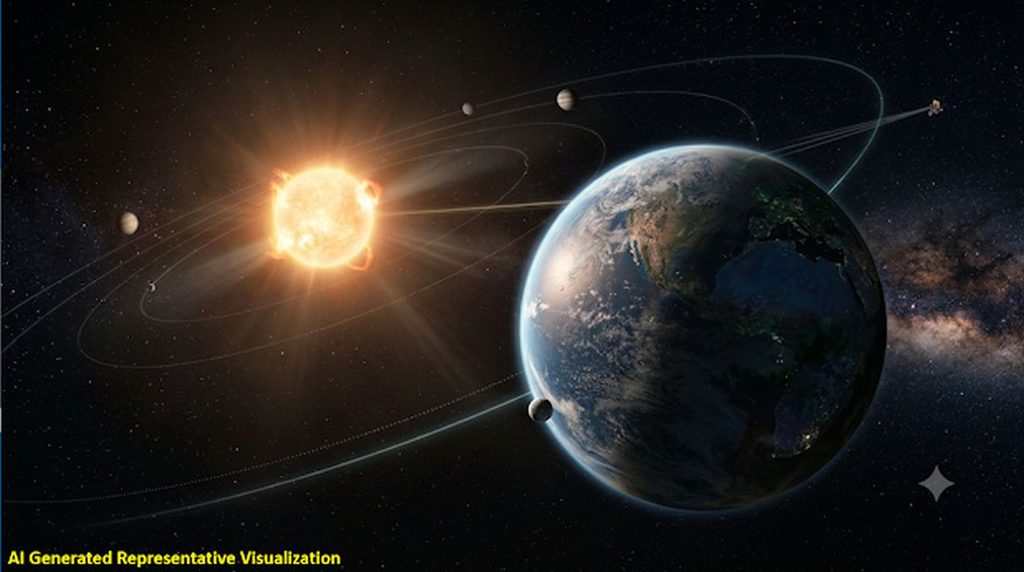
- Types of Exoplanets: They come in a wide variety of sizes and compositions. These include gas giants similar to or larger than Jupiter, “Neptunian” planets dominated by atmospheres of hydrogen and helium, “Super-Earths” (massive rocky or water-rich planets with no direct analog in our solar system), and smaller, Earth-sized terrestrial planets.
- How They Are Found:
- Transit Method: Observatories like the Kepler Space Telescope and TESS monitor a star’s brightness over time. If a planet passes directly between the star and the telescope, it blocks a tiny fraction of the starlight, creating a measurable dip in brightness.
- Radial Velocity (Wobble Method): As a planet orbits a star, its gravity exerts a slight tug on the star, causing it to “wobble.” Astronomers detect this by measuring minute shifts in the star’s light spectrum (Doppler shift).
- Direct Imaging: Using instruments like coronagraphs (such as the one on the Nancy Grace Roman Space Telescope) to block the star’s glare, astronomers can occasionally capture actual pictures of large, young exoplanets that are still glowing with the heat of their formation.
- The Habitable Zone: A primary focus of exoplanet astronomy is identifying terrestrial planets orbiting within their star’s “Goldilocks zone”—the specific distance where the temperature is neither too hot nor too cold, allowing liquid water to potentially exist on the planet’s surface.
How many are potenitally habitable?The exact number fluctuates based on the strictness of the criteria used by astronomers, but current estimates range between 45 and 70 potentially habitable exoplanets.
- The Habitable Worlds Catalog: Maintained by the Planetary Habitability Laboratory, this catalog lists 70 potentially habitable worlds out of the thousands of known exoplanets. This is divided into a “conservative sample” of 29 likely rocky planets capable of supporting surface liquid water, and an “optimistic sample” of 41 planets with a lower likelihood of habitability, such as water worlds or mini-Neptunes.
- Recent 2026 Research: A March 2026 study published by the Royal Astronomical Society narrowed the cosmic search down to a specific list of 45 rocky exoplanets in their stars’ habitable zones that may have the right conditions to harbor life.
Many of the most promising candidates orbit small red dwarf stars, with nearby systems like TRAPPIST-1 and Proxima Centauri serving as major focal points for ongoing observations by the James Webb Space Telescope.
Related Posts


About The Author
