How is Falcon 9 First Stage Landing on Droneship and Recovery?
SpaceX’s Falcon 9 is the world’s first orbital class reusable rocket, utilizing Autonomous Spaceport Drone Ships (ASDS) to recover its first-stage boosters at sea. Sea landings are heavily utilized for missions where the rocket does not have enough reserve fuel to return all the way to the launch site, offering a critical balance between maximum payload performance and booster recovery.
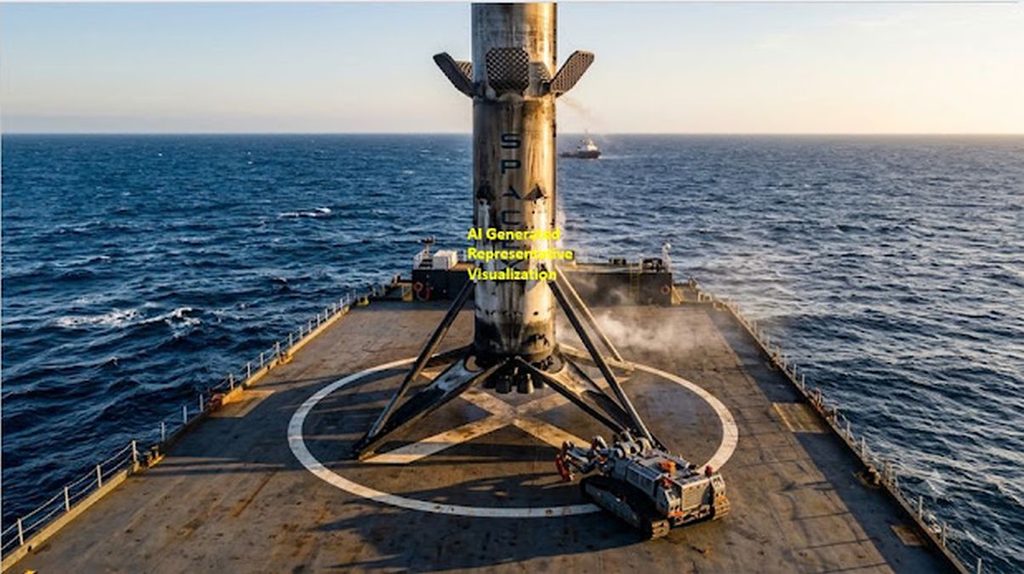
The recovery process relies on a sequence of automated navigation and stabilization technologies:
- Descent and Navigation: After separating from the second stage, the Falcon 9 first stage flips and begins its descent, utilizing deployable grid fins and nitrogen gas thrusters to steer and control its attitude. The booster executes a series of retro-propulsion engine burns to slow down, utilizing a single Merlin engine or, on high-energy missions with low propellant margins, a rapid three-engine landing burn.
- The Drone Ship Positioning: The landing targets are uncrewed, GPS-guided barges. They are equipped with four 300-horsepower azimuth thrusters that allow the vessel to autonomously maintain a highly precise position in the ocean as the rocket approaches. The center of the landing pad is marked with a stylized SpaceX “X”.
- Touchdown and Securing: Once the 25-tonne booster touches down vertically on its four carbon fiber and aluminum landing legs, it must be secured to survive ocean swells. SpaceX deploys a specialized robot officially known as the “Octagrabber,” which drives underneath the rocket and locks onto the hold-down clamps located on the outside of the booster’s structure. This holds the tall booster firmly to the deck, preventing it from toppling over during the maritime transit back to port. Then the droneship is towed by a tug back to its home port in Long Beach—not Starbase. After touchdown the Octagrabber robot clamps the booster; crews board later from support boats to prepare the tow. The deck uses steel blast shielding and water deluge systems. Successful landings produce little to no lasting damage.
Related Posts


About The Author
