The Hubble Space Telescope (HST)
The Hubble Space Telescope (HST) is a large, space-based observatory launched on April 24, 1990, aboard the Space Shuttle Discovery. Named after astronomer Edwin Hubble, it remains one of the most famous and scientifically productive instruments in the history of astronomy.
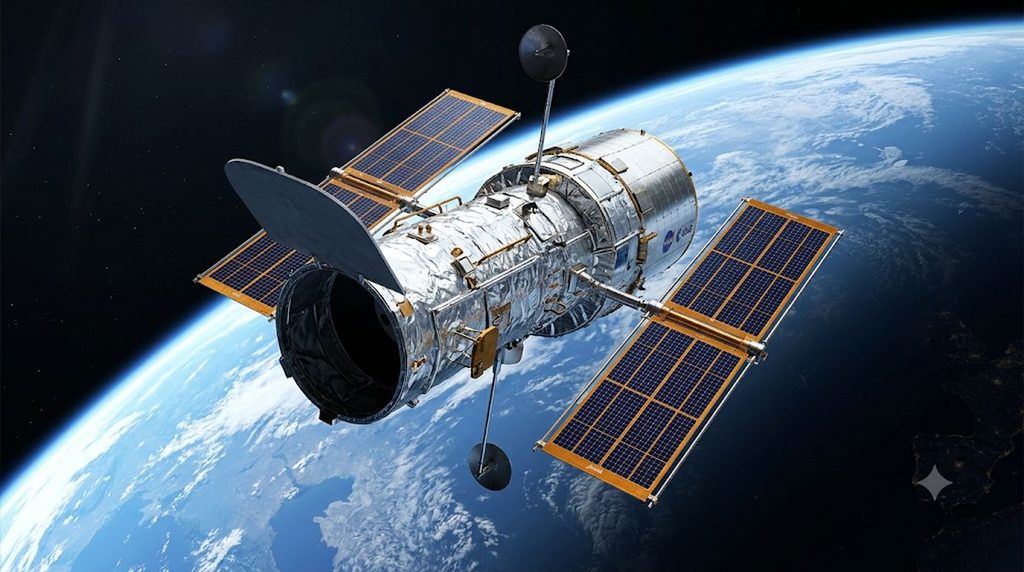
Orbit and Location Unlike newer observatories such as JWST or Aditya-L1 that operate at distant Lagrange points, Hubble orbits Earth in Low Earth Orbit (LEO) at an altitude of approximately 540 kilometers (340 miles). This relative proximity was a deliberate design choice, making Hubble the first and only space telescope designed to be physically serviced by astronauts in space.
Key Specifications
- Primary Mirror: Hubble features a 2.4-meter (7.9-foot) primary mirror.
- Wavelengths: While JWST is optimized for the infrared, Hubble is uniquely designed to capture high-resolution images primarily in the visible light spectrum, as well as near-ultraviolet and near-infrared wavelengths. Because Earth’s atmosphere blocks most ultraviolet light, Hubble’s position in space gives it an unobstructed view.
- Servicing Missions: Shortly after launch, scientists discovered a microscopic flaw in the primary mirror (spherical aberration) that severely blurred its vision. In 1993, the first of five Space Shuttle servicing missions installed corrective optics, flawlessly restoring its focus. Subsequent missions added increasingly powerful cameras (like the Advanced Camera for Surveys and Wide Field Camera 3), replaced aging gyroscopes, and installed new batteries, greatly extending the telescope’s operational life.
Scientific Legacy Over more than three decades, Hubble has fundamentally transformed astrophysics across several domains:
- The Age and Expansion of the Universe: By observing pulsating stars called Cepheid variables, Hubble helped pin down the age of the universe to roughly 13.8 billion years. It also provided crucial data leading to the Nobel Prize-winning discovery that the expansion of the universe is accelerating due to dark energy.
- The Deep Fields: By pointing its cameras at seemingly empty, dark patches of sky for days at a time, Hubble captured the “Deep Field” images. These long exposures revealed thousands of distant, ancient galaxies, proving that the universe is far more crowded and vast than previously understood.
- Black Holes: Hubble provided the first definitive observational evidence that supermassive black holes reside at the centers of almost all large galaxies.
- Exoplanets and Solar System: It has captured direct images of exoplanets, detected elements like sodium and water in their atmospheres, and continually monitored the weather and auroras on giant planets like Jupiter and Saturn within our own solar system.
Related Posts


About The Author
