James Webb Space Telescope (JWST)
The James Webb Space Telescope (JWST) is the largest and most powerful space telescope ever built, designed primarily to conduct infrared astronomy. Launched on December 25, 2021, by an international collaboration between NASA, the European Space Agency (ESA), and the Canadian Space Agency (CSA), it serves as the scientific successor to the Hubble Space Telescope.
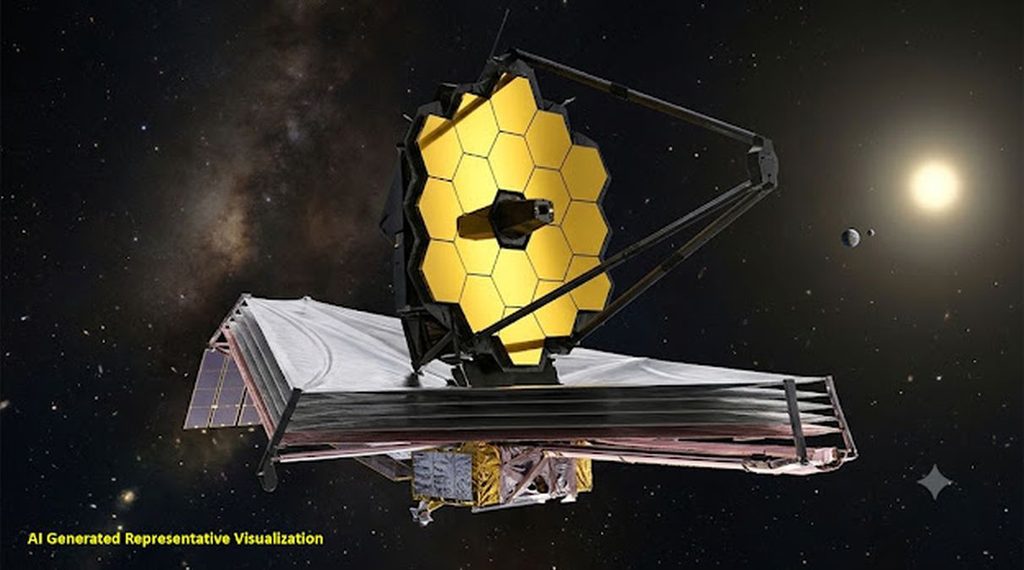
Orbit and Location Unlike Hubble, which orbits Earth in Low Earth Orbit, JWST orbits the Sun at the second Sun-Earth Lagrange point (L2), located approximately 1.5 million kilometers (nearly 1 million miles) away. This specific gravitational equilibrium point allows the telescope to maintain a halo orbit where its massive sunshield can continuously block the heat and light from the Sun, Earth, and Moon.
Key Specifications
- Primary Mirror: The telescope features a massive 6.5-meter (21.3-foot) primary mirror made of 18 individual, gold-coated beryllium hexagonal segments.
- Sunshield: A five-layer, tennis court-sized shield (22 meters by 12 meters) protects the observatory, passively cooling it to extremely low temperatures (down to -233.2 °C).
- Deployment Sequence: Because of its immense size, JWST was folded origami-style to fit inside the 5-meter fairing of its Ariane 5 launch vehicle. It executed a highly complex, multi-week unfolding and tensioning sequence as it traveled to L2.
Scientific Instruments Housed inside the Integrated Science Instrument Module (ISIM), JWST’s four primary instruments are highly sensitive to wavelengths ranging from visible red (0.6 µm) to the mid-infrared (28.5 µm):
- NIRCam (Near-Infrared Camera): The observatory’s primary near-infrared imager, which also acts as the wavefront sensor used to perfectly align the 18 mirror segments.
- NIRSpec (Near-Infrared Spectrograph): Features a unique microshutter mechanism that allows the instrument to simultaneously capture the spectra of hundreds of individual objects across its field of view.
- MIRI (Mid-Infrared Instrument): The only instrument that observes longer mid-infrared wavelengths. Because it detects longer wavelengths, MIRI requires an active mechanical helium cryocooler to keep its operating temperature below 6 Kelvin (−267 °C).
- FGS/NIRISS: A dual-purpose Canadian contribution containing the Fine Guidance Sensor (used to precisely point and stabilize the telescope) and the Near-Infrared Imager and Slitless Spectrograph.
Primary Science Mandate JWST was built to answer fundamental questions about the universe across four primary themes:
- First Light: Seeking out the very first stars and galaxies that formed immediately after the Big Bang.
- Galaxy Assembly: Studying how galaxies form, merge, and evolve over cosmic time.
- Star and Planet Formation: Peering through dense clouds of space dust to witness the birth of stars and protoplanetary systems.
- Exoplanetary Systems: Analyzing the atmospheres of exoplanets to determine their chemical composition and potential habitability.
Related Posts


About The Author
