AI Laser Robots to Battle Salmon Lice!
Autonomous laser robots represent one of the most innovative advancements in modern precision aquaculture. Primarily developed by the Norwegian tech company Stingray Marine Solutions, these underwater AI units are deployed inside sea pens to combat Lepeophtheirus salmonis (salmon lice)—a microscopic parasite that costs the global salmon farming industry over $1 billion annually.
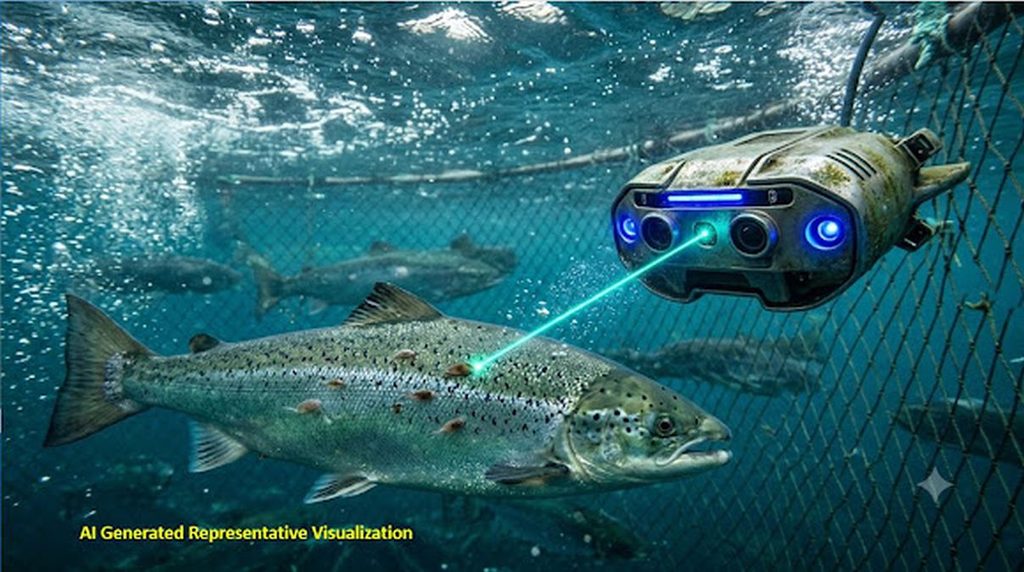
How the AI Laser System Works
The submerged robotic nodes operate 24/7 inside net pens, processing passing fish in real time.
┌────────────────────────────────────────────────────────┐
│             1. Stereo Optical Scanning                 │
│   High-speed cameras & royal blue LEDs (450 nm) photo  │
│      passing salmon at up to 120 frames/sec.           │
└──────────────────────────┬─────────────────────────────┘
                           │
                           ▼
┌────────────────────────────────────────────────────────┐
│         2. Real-Time AI Detection & Velocity           │
│  Machine learning algorithms pinpoint lice & calculate │
│   fish speed while flagging sensitive areas (eyes).    │
└──────────────────────────┬─────────────────────────────┘
                           │
                           ▼
┌────────────────────────────────────────────────────────┐
│            3. Precision Laser Strike                   │
│   Galvo-mirrors direct a pulse of light to incinerate  │
│  the parasite's translucent shell in milliseconds.      │
└────────────────────────────────────────────────────────┘
- Stereo Camera Detection: The underwater node uses high-resolution stereo cameras paired with targeted royal blue LED illumination (450 nm). The wavelength maximizes image contrast between the reflective salmon skin and the translucent sea lice.
- AI Computer Vision & Velocity Prediction: Custom neural network models identify parasites as small as a few millimeters across the salmon’s body. The computer vision system simultaneously calculates the vector velocity of the moving fish to project the exact coordinates of the louse milliseconds into the future.
- Targeted Laser Ablation: A guided galvanometer mirror system directs a high-precision green/blue laser pulse directly at the parasite. The energy pulse Coagulates and destroys the louse’s tissue instantly without burning into the salmon’s protective mucous layer or scales.
- Safety Protocols (“No-Fire Zones”): The AI automatically maps the anatomical structure of the salmon. If a parasite is located too close to the fish’s eyes, the system flags a “no-fire zone” to prevent blinding the salmon.
Key Operational Advantages
| Feature | Traditional Chemical/Thermal De-Lousing | AI Laser Robotic System |
| Fish Stress & Welfare | High (requires crowding, pumping, or chemical baths) | Zero handling; fish swim naturally without intervention |
| Environmental Impact | Potential toxic chemical runoff into marine ecosystems | Chemical-free; zero environmental emissions |
| Operation Frequency | Intermittent treatment cycles (every few weeks) | Continuous 24/7 monitoring and ablation (up to 5 pulses/sec) |
| Parasite Resistance | Lice build chemical immunity over time | Physics-based ablation (lice cannot adapt to light intensity) |
Real-Time Monitoring & Population Tracking
Beyond targeted removal, the AI nodes continuously collect fish health data. The system logs biomass metrics, swimming patterns, skin condition, and overall louse density across pens, streaming live analytics to farm operators via cloud dashboards.
Related Posts


About The Author
