Aditya-L1
Aditya-L1 is the Indian Space Research Organisation’s (ISRO) first dedicated space-based observatory designed to study the Sun. Launched in September 2023, it is stationed in a complex halo orbit around the first Sun-Earth Lagrange Point (L1), approximately 1.5 million kilometers from Earth.
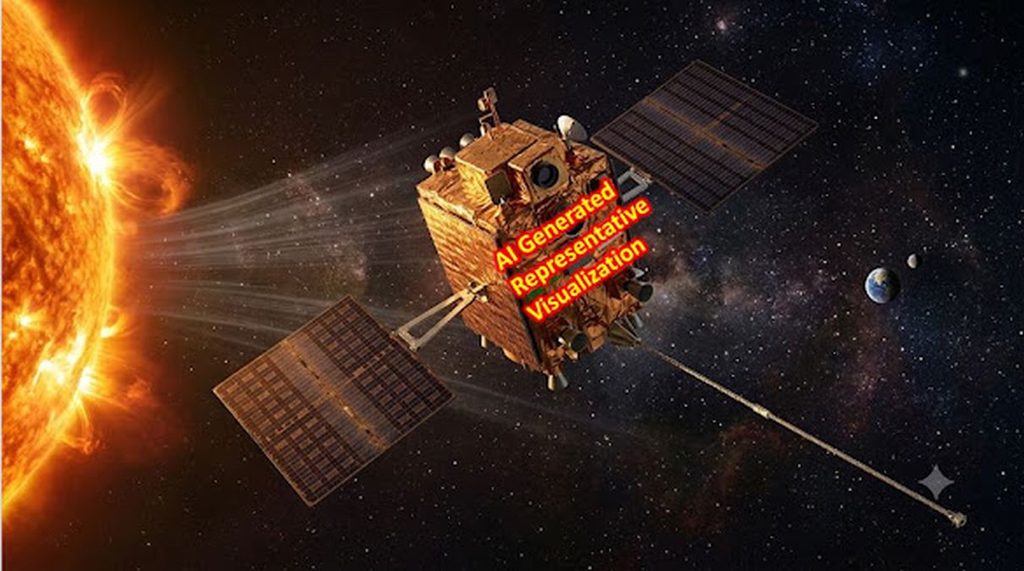
Mission Objectives
- Solar Atmosphere Dynamics: Investigating the behavior of the Sun’s upper atmosphere, specifically the chromosphere and the corona, to help solve the “coronal heating problem” (why the corona is millions of degrees hotter than the solar surface).
- Space Weather Drivers: Tracking the initiation and development of Coronal Mass Ejections (CMEs), solar flares, and the continuous outflow of the solar wind.
- In-Situ Monitoring: Observing the particle flux and magnetic field variations precisely at the L1 point as plasma travels outward toward Earth.
Scientific Payloads The spacecraft carries seven specialized instruments. Four point directly at the Sun for remote sensing, while three conduct local, in-situ measurements:
- VELC (Visible Emission Line Coronagraph): The primary instrument, designed to artificially eclipse the Sun’s bright disk to image the faint corona and study CMEs.
- SUIT (Solar Ultraviolet Imaging Telescope): Captures high-resolution images of the photosphere and chromosphere in near-ultraviolet wavelengths.
- In-situ Instruments (ASPEX, PAPA, SoLEXS, HEL1OS, and a Magnetometer): A suite of sensors that measure solar wind plasma, energetic ions and electrons, solar X-ray flares, and the interplanetary magnetic field passing through the L1 environment.
Importance for Communications Because it sits upstream of Earth, Aditya-L1 acts as an early warning system for incoming solar storms. By detecting changes in the solar wind and magnetic field before they hit our magnetosphere, the mission provides critical data for predicting ionospheric disturbances. This space weather forecasting is particularly vital for anticipating blackouts or enhancements in high-frequency (HF) radio wave propagation on bands like 10m and 40m.
Related Posts


About The Author
