Halo or Lissajous orbits
Halo and Lissajous orbits are complex, three-dimensional trajectories that spacecraft use to “orbit” the empty space of unstable Lagrange points (like L1 and L2). Because a spacecraft cannot sit perfectly still at these gravitationally unstable equilibrium points without constantly burning fuel, it is placed in a dynamic, hovering path that loops around the point.
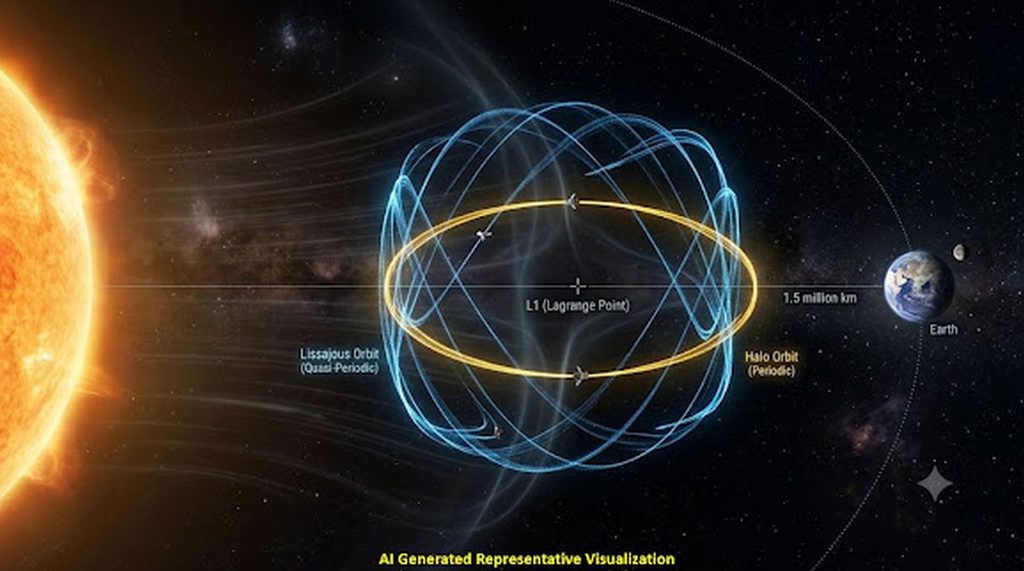
- Lissajous Orbits: These are quasi-periodic orbits, meaning the spacecraft’s path does not perfectly close on itself. Because the motion in the horizontal plane has a slightly different frequency than the vertical motion, the spacecraft traces a complex, continuously shifting 3D pattern over time (similar to the Lissajous curves plotted on an oscilloscope).
- Halo Orbits: A Halo orbit is a highly specific, perfectly periodic subset of a Lissajous orbit. By carefully designing the initial trajectory, mission engineers can mathematically match the horizontal and vertical frequencies. This causes the spacecraft to trace a closed, repeating, circular or elliptical loop around the Lagrange point.
Why these orbits are critical for space missions:
- Unobstructed Radio Communications: If a spacecraft sat precisely at the exact mathematical center of L1, it would be perfectly in line with the Sun. The Sun’s overwhelming radio frequency (RF) noise would easily drown out the telemetry downlink to Earth. By flying in a wide halo orbit, the spacecraft stays out of the direct solar exclusion zone, maintaining a clear, quiet line-of-sight for data transmission and command uplinks.
- Continuous Solar Power and Observation: For solar observatories like ISRO’s Aditya-L1, a halo orbit ensures the spacecraft is never eclipsed by the Earth or the Moon, allowing for uninterrupted monitoring of solar wind and coronal activity. For L2 missions like the James Webb Space Telescope (JWST), looping around the Earth’s shadow allows the spacecraft’s solar panels to remain bathed in sunlight while its massive sunshield continuously blocks heat from reaching its sensitive infrared instruments.
- Station-Keeping Efficiency: While these orbits are fundamentally unstable and require the spacecraft to perform small, periodic thruster burns (station-keeping) to prevent drifting off into deep space, they harness the natural gravitational dynamics of the Sun-Earth system to keep fuel consumption remarkably low over a multi-year mission.
Related Posts


About The Author
