What is Heliopause?
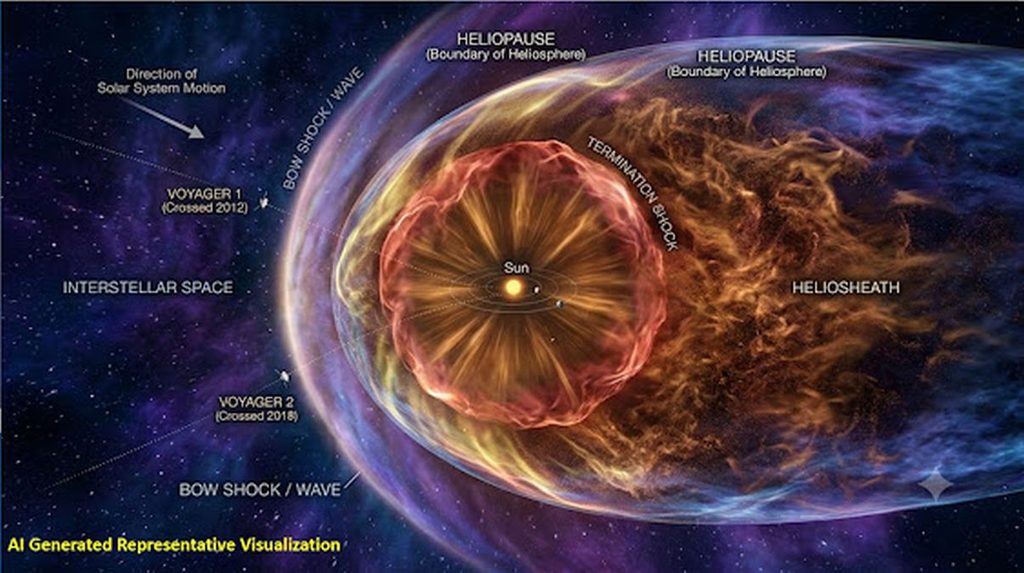
The heliopause is the theoretical border where the Sun’s solar wind is stopped by the interstellar medium. It defines the outer boundary of the heliosphere, the vast magnetic bubble surrounding our solar system.
At this boundary, the outward dynamic pressure of the ionized gas (plasma) ejected by the Sun balances the inward pressure of the interstellar gas and magnetic fields from the Milky Way galaxy:
Psolar wind = Pinterstellar medium
Structure of the Heliospheric BoundaryThe transition from solar dominance to interstellar space occurs across three primary layers:
- Termination Shock: The inner boundary where the supersonic solar wind abruptly slows down to subsonic speeds as it collides with the interstellar medium, causing intense turbulence and heating.
- Heliosheath: The thick, highly turbulent region beyond the termination shock where the slowed solar wind interacts directly with incoming interstellar gas.
- Heliopause: The sharp outer surface of the heliosheath where solar plasma ends entirely and the interstellar medium begins.
Physical Signatures of Crossing the HeliopausePassing through the heliopause triggers distinct physical changes measured by space probes:
- Solar Wind Plasma Drop: Low-energy charged particles originating from the Sun drop to near-zero levels.
- Galactic Cosmic Ray Spike: High-energy particles originating from outside the solar system rapidly increase in density because the protective shielding of the heliosphere is left behind.
- Magnetic Field Shift: The orientation and strength of the magnetic field abruptly shift from the solar magnetic field lines to the prevailing interstellar magnetic field direction.
Spacecraft MeasurementsOnly two human-made objects have crossed the heliopause into interstellar space:
- Voyager 1: Crossed the heliopause on August 25, 2012, at a distance of approximately 121 Astronomical Units (AU) from the Sun.
- Voyager 2: Crossed the heliopause on November 5, 2018, at approximately 119 AU.
Because the heliosphere expands and contracts slightly in response to the Sun’s 11-year solar activity cycle, the exact location of the heliopause varies dynamically over time.
Related Posts


About The Author
