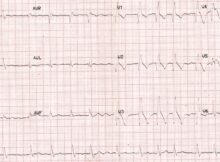
Pseudo atrial fibrillation is seen in:
a) Mitral stenosis
b) Chronic obstructive pulmonary disease
c) Post cardiac transplant state
d) None of the above
Rhythm strip for diagnosis: a) Atrial fibrillation b) Sinus arrhythmia c) Multifocal atrial tachycardia d) None of the above Correct answer: c) Multifocal atrial tachycardia Multifocal atrial tachycardia is
Splintered QRS is a term used in the description of ECG in: a) Ebstein’s anomaly b) Acute myocardial infarction c) Ventricular septal defect d) Pericardial effusion Correct answer: a) Ebstein’s
Factor/s enhancing the risk of digoxin toxicity: a) Co-administration of verapamil b) Hypokalemia c) Hypomagnesemia d) All of the above Correct answer: d) All of the above Hypokalemia which
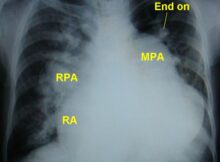
This chest X-ray is suggestive of: a) Primary pulmonary hypertension b) Atrial septal defect with pulmonary hypertension c) Ventricular septal defect with pulmonary hypertension d) Idiopathic dilatation of
Giant wide T inversion may be seen in all except: a) After a cardiac arrest b) Subarachnoid hemorrhage c) Hyperkalemia d) Takotsubo cardiomyopathy Correct answer: c) Hyperkalemia Giant T wave
This ECG shows: (Click on the image for an enlarged view) a) Anterior wall infarction b) Anterior wall infarction with right bundle branch block c) Anterior wall infarction
Type II truncus arteriosus is: a) Common pulmonary trunk arises from the truncus arteriosus and divides into left and right pulmonary arteries b) Two pulmonary arteries arise separately
Which of the following is not true of Mahaim fibre tachycardia? a) Left bundle branch block pattern b) Normal baseline ECG c) Mahaim fibres do not conduct retrogradely d)
Wide QRS tachycardia at 300 per minute can occur with: a) Atrial fibrillation with Wolff–Parkinson–White syndrome (WPW) syndrome b) Supraventricular tachycardia with aberrancy in the very young c) Atrial flutter